UPSC Current Affairs May 11, 2026 | Mission Divyastra: Detailed Analysis of Agni-5 MIRV Missile Test | Daily GK Update Atharva Examwise
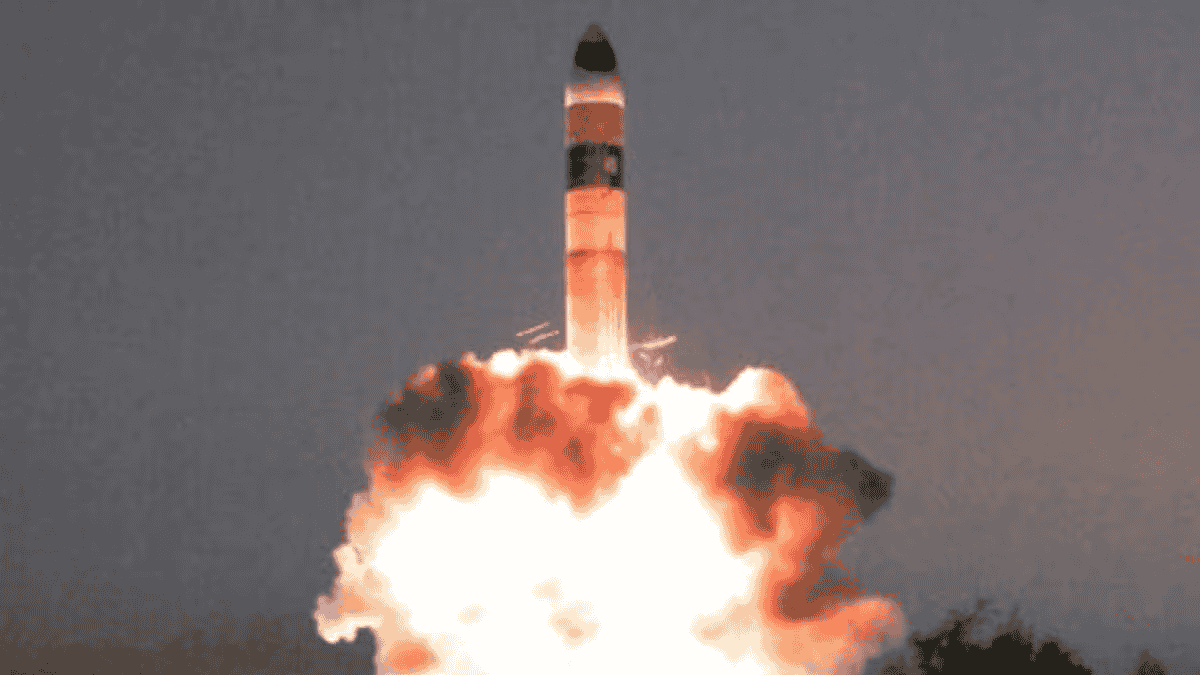
On May 8, 2026, India took a historic leap in its strategic capabilities by successfully conducting a flight test of an advanced Agni missile under 'Mission Divyastra'. The test was carried out from Dr. APJ Abdul Kalam Island off the coast of Odisha, the primary hub of India’s Integrated Missile Test Range (ITR). According to official information released by the Ministry of Defence, the missile utilized Multiple Independently Targeted Re-entry Vehicle (MIRV) technology to simultaneously and successfully strike multiple targets located at different geographical locations in the Indian Ocean region. This achievement not only demonstrates the maturity of India’s indigenous defense technology but also has the potential to redefine the Balance of Power in South Asia.
Mission Divyastra: Modern India's Strategic Shield
The name 'Mission Divyastra' is derived from the Sanskrit words 'Divya' (Divine) and 'Astra' (Weapon), symbolically expressing the devastating power and precision of this weapon. India first successfully tested MIRV technology with the Agni-5 in March 2024, and this latest test in May 2026 confirms the operational stability and refined lethality of the system. Defense Minister Rajnath Singh and Prime Minister Narendra Modi praised the scientists of the Defence Research and Development Organisation (DRDO) and industry partners for this success, calling it an "unparalleled capability" that strengthens India’s readiness against growing security challenges.
The missile test was monitored by several ground and ship-based tracking systems, which tracked the entire trajectory from lift-off to the impact of all payloads. Analysis of flight data confirmed that all mission objectives were achieved with precision. This test is particularly significant as it places India among a select group of nations possessing proven MIRV technology, including the United States, Russia, China, France, and the United Kingdom.
Technical Specifications of Agni-5 MIRV
The Agni-5 is a three-stage, solid-fueled engine-based missile with a strike range exceeding 5,000 kilometers. With the integration of MIRV technology, the scope of its lethality has become even more formidable.
| Feature | Description |
|---|---|
| Missile Type | Intercontinental Ballistic Missile (ICBM) Category / IRBM |
| Technology | Multiple Independently Targeted Re-entry Vehicle (MIRV) |
| Strike Range | 5,000 - 7,000+ Kilometers |
| Engine | Three-stage Solid Propellant |
| Speed | Mach 24 in terminal phase (approx. 29,400 km/h) |
| Payload Capacity | 4 to 5 Nuclear Warheads (Estimated) |
| Launch Platform | Road-mobile Canister System |
In-depth Analysis of MIRV Technology: Science and Strategy
MIRV (Multiple Independently Targetable Re-entry Vehicle) technology is a revolutionary shift compared to traditional ballistic missiles. While a standard missile carries only one nuclear warhead, an MIRV-equipped missile is capable of carrying several independent warheads. These warheads can target different locations hundreds of kilometers apart through a single missile launch.
How does this technology work?
The operation of an MIRV missile can be divided into four main stages:
Boost Phase: Rocket engines ignite, pushing the missile outside the atmosphere. A three-stage solid fuel system provides extreme velocity.
Mid-course Phase: Upon reaching the vacuum of space, the main payload "bus" or post-boost vehicle becomes active. This bus maneuvers in space and releases each warhead toward its specific trajectory.
Deployment: The payload bus changes its orientation and releases warheads one by one. Along with these, 'decoys' or false targets can also be released to confuse enemy radar.
Re-entry and Impact: Each warhead enters the Earth's atmosphere in its own re-entry vehicle. Advanced carbon-carbon composite materials are used to withstand the intense heat generated by atmospheric friction.
With the Agni-5 reaching a terminal speed of Mach 24, it presents an almost impossible challenge for any existing Missile Defence System. This speed, combined with the presence of multiple warheads, "saturates" enemy defense systems, increasing the probability of successfully hitting the targets.
Strategic Importance
The integration of MIRV technology provides India with several strategic advantages:
Enhanced Deterrence: It sends a message to adversaries that India can destroy multiple critical centers with a single missile.
Second Strike Capability: Under India's 'No First Use' (NFU) policy, this capability is vital. If India faces a nuclear attack, its surviving missiles can ensure a massive retaliatory strike.
Penetrating Missile Defenses: MIRV is an effective answer to advanced anti-missile systems (such as the HQ-19) being developed by China and other nations.
Evolution of the Agni Series: From Agni-1 to Mission Divyastra
The Agni missile program has been the backbone of India’s strategic autonomy. It began in 1983 under the leadership of Dr. A.P.J. Abdul Kalam as part of the Integrated Guided Missile Development Programme (IGMDP).
| Missile | Category | Range | Key Features |
|---|---|---|---|
| Agni-I | SRBM | 700 - 1,200 km | Single-stage, solid fuel; significant in Pakistan context |
| Agni-II | MRBM | 2,000 - 3,500 km | Two-stage, rail and road mobile |
| Agni-III | IRBM | 3,000 - 5,000 km | High precision (CEP), two-stage solid |
| Agni-IV | IRBM | 3,500 - 4,000 km | Advanced navigation and high accuracy |
| Agni-V | ICBM | 5,000 - 7,000+ km | Canister launch, MIRV technology, global reach |
| Agni-P | MRBM | 1,000 - 2,000 km | New generation, lightweight canister missile |
| Agni-VI | ICBM | 8,000 - 12,000 km | Under development; capable of carrying more warheads |
The canister-based launch system of the Agni-5 provides it with immense flexibility. It can be transported anywhere via rail or road and launched within minutes, helping to evade enemy surveillance via satellites.
Geopolitical Implications: New Balance of Power in the Indo-Pacific
The May 2026 test is not just a technical success but also a powerful diplomatic message. Amidst China's increasing military activity in the Indo-Pacific and its strategic ties with Pakistan, India has made its position clear.
Impact on China
The range of the Agni-5 covers the entire Asian continent, including the far northern regions of China. The advent of MIRV technology has reduced the effectiveness of China's Ballistic Missile Defence (BMD) systems. Analysts believe this test is specifically a response to China's growing nuclear arsenal and its aggressive expansionist policies. India can now target Beijing, Shanghai, and other critical Chinese industrial centers simultaneously, which is essential for establishing "Credible Minimum Deterrence."
Pakistan and Regional Stability
Although Pakistan claimed to have tested MIRV technology with the 'Ababeel' missile in 2017, the accuracy and range of India's Agni-5 technology place it in a different league. India’s technical edge may force Pakistan to invest more in its missile program, despite facing economic challenges. However, this also raises concerns about a regional arms race.
India's Position in the Global Club
India now stands firmly among the elite group of nations possessing sophisticated long-range nuclear strike capabilities. Interestingly, while North Korea also possesses ICBM technology, India's program is considered more reliable in terms of MIRV maturity and precision.
An Exemplar of Atmanirbhar Bharat and Nari Shakti
The success of Mission Divyastra is a victory for Indigenization. Most of the components used in Agni-5, including avionics, high-accuracy sensor packages, and control systems, have been developed indigenously.
Leadership of Women Scientists
One of the most inspiring aspects of this mission is the prominent role played by women scientists. Senior DRDO scientist Sheena Rani led the Agni-5 project.
| Important Personality | Role |
|---|---|
| Sheena Rani | Programme Director, Agni-5 MIRV |
| Shankari Chandrasekaran | Project Director |
Sheena Rani, who has also been addressed as 'Divya Putri', has been working on Agni missile systems since 1999. She received her education from the College of Engineering, Thiruvananthapuram, and joined DRDO after the 1998 Pokhran-II tests. Her team included several other women scientists, symbolizing India's changing work culture in the defense sector.
Technical Innovation
The Ring Laser Gyroscope-based Inertial Navigation System (RLG-INS) and Micro Navigation System (MINGS) used in Agni-5 provide dual-layer security, ensuring the missile remains precise on its target despite external interference. Additionally, lightweight composite materials have been used instead of steel to reduce the missile's weight, increasing its range and payload capacity by up to 20%.
India's Nuclear Doctrine: A Blend of Peace and Power
In the context of Mission Divyastra, understanding India's Nuclear Doctrine is vital. India's approach is based on "Peace through Strength."
No First Use (NFU): India will not be the first to use nuclear weapons.
Credible Minimum Deterrence: India will maintain only enough arsenal to deter any potential attack.
Nuclear Triad: India has achieved nuclear strike capabilities from land (Agni missiles), air (fighter jets), and sea (Arihant-class submarines).
Civilian Control: The decision to use nuclear weapons can only be taken by the civilian political leadership (the Nuclear Command Authority headed by the Prime Minister).
As of May 2025 data, India possesses approximately 180 nuclear warheads, while China has 600 and Pakistan has 170. MIRV technology allows India to ensure the maximum impact of its limited warheads, maintaining qualitative deterrence despite quantitative inferiority.
The Path Ahead: Agni-VI and the Hypersonic Era
Following the success of Mission Divyastra, India's next challenges are the development of Agni-VI and hypersonic weapons.
Agni-VI: This will be a full-scale Intercontinental Ballistic Missile (ICBM) with a range likely between 8,000 and 12,000 kilometers. It may be capable of carrying 10 to 12 warheads simultaneously.
Hypersonic Glide Vehicles (HGV): According to some reports, elements of hypersonic glide technology were also tested in the May 8, 2026, test. In the future, India will develop missiles that can fly 5-10 times faster than the speed of sound and change direction during flight, making them invincible.
K-Series Missiles: MIRV technology will soon be integrated into Submarine-Launched Ballistic Missiles (SLBM) like K-4 and K-5, making India's sea-based strike capability even more impenetrable.
Why this matters for your exam preparation
From the perspective of competitive exams, especially UPSC, Mission Divyastra is a 'hot topic'. Its various aspects touch upon different parts of your syllabus:
1. UPSC Preliminary Exam (Prelims)
Factual Questions: Range of Agni missiles, their stages, and the working principle of MIRV technology.
National/International Importance: List of countries possessing MIRV technology.
Defense Organizations: The role of DRDO and IGMDP.
Personalities in News: Names of women scientists who led the mission.
2. UPSC Main Exam (Mains)
General Studies III (Science and Tech): "Indigenization of technology and developing new technology." You can use Agni-5 as a primary example here.
General Studies III (Internal Security): "Border security and strategic deterrence." Analyze the impact on India's nuclear policy and security challenges.
General Studies II (International Relations): "Relations with neighboring countries" and "India's growing global stature." How this test affects India-China and India-Pak relations.
3. Interview
Ethical and Strategic Perspectives: Benefits and challenges of the 'No First Use' policy.
Gender Equality: Thoughts on the increasing participation of women in defense research.
Atharva Examwise Expert Tip: While writing about Agni-5, always use terms like "Credible Minimum Deterrence" and "Balance of Power." This makes your answer more mature and exam-oriented. Stay tuned to our website Atharva Examwise for regular Daily GK Updates.