
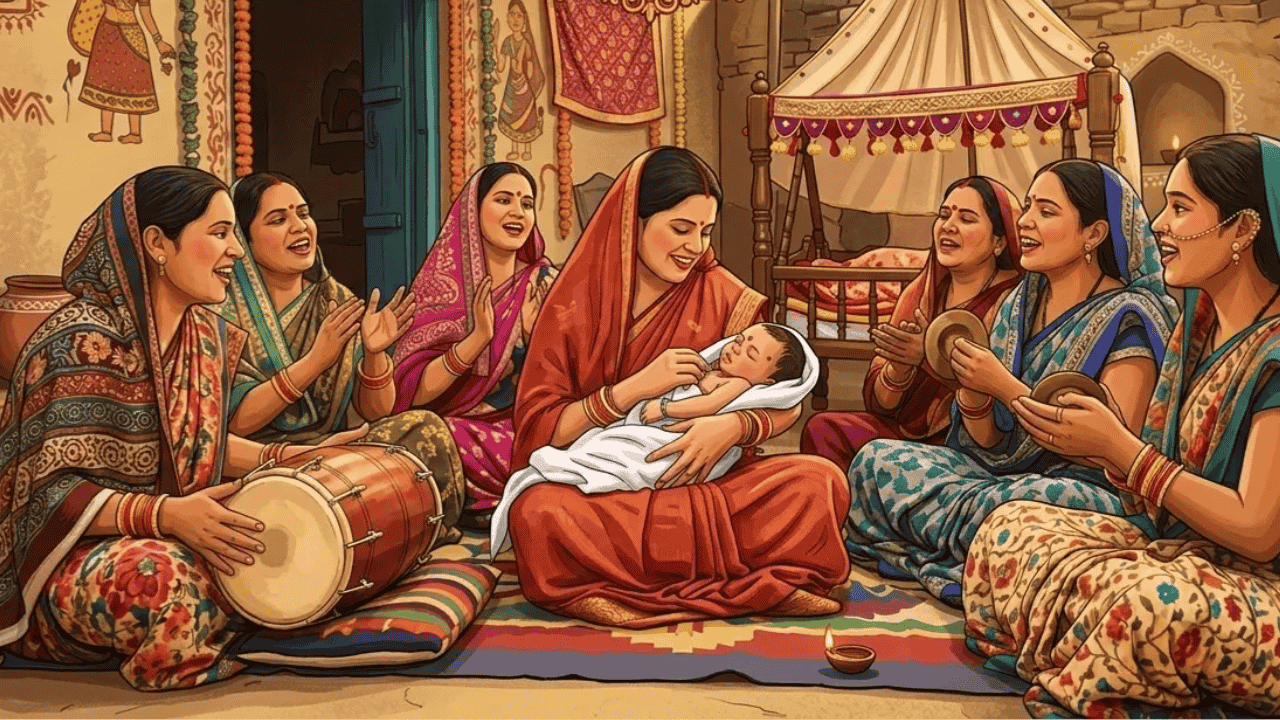
UPSC Current Affairs May 1, 2026: In-depth Analysis of 'Sohar' Folk Singing – Cultural Heritage of North India and Mithila
In the Indian cultural landscape, folk music is not merely a medium of entertainment; it is a living document of society's collective psychology, historical continuity, and regional identity. 'Sohar' folk singing, prevalent primarily in Bihar (especially the Mithila region) and the eastern parts of Uttar Pradesh, stands as a major pillar of this unbroken tradition. Sung on the occasion of a child's birth, these auspicious songs express the importance of 'Sanskaras' (sacraments) in Indian society and echo the female voice within the family structure. From the perspective of UPSC Current Affairs (May 1, 2026), studying Sohar is essential for understanding Art and Culture as well as the evolutionary principles of Indian Society.
Historical and Philosophical Roots: From the Vedic Era to the Present
The roots of Sohar are deeply embedded in India's oldest civilizations and Vedic traditions. Historians and sociologists believe that in the Vedic period, the birth of a child was viewed as a divine blessing, and there was a custom of performing 'Mangal Gaan' (auspicious songs) on this joyous occasion. This Oral Tradition has been transferred from generation to generation over centuries and is preserved today in the form of Sohar.
Vedic Continuity and Spiritual Hue
Sohar is not just a song of worldly joy; its inclusion of spiritual and mythological references provides it with a distinct elevation. Many Sohar songs describe the birth episodes of Lord Rama and Lord Krishna, where an ordinary family perceives their newborn as a manifestation of these divine avatars. This process is known as 'Universalization', where the folk mind connects daily life experiences with the grand traditions of epics.
| Historical Aspect | Description |
|---|---|
| Origin | 'Mangal Gaan' tradition of the Vedic period. |
| Spread | Transmitted across generations through oral tradition. |
| Region | Mithila (Bihar), Eastern Uttar Pradesh, and the Terai region of Nepal. |
| Language | Maithili, Bhojpuri, Magahi, and Awadhi. |
Structure and Style of Sohar: A Musicological Analysis
The singing style of Sohar is extremely simple yet emotionally dense. It is usually performed by groups of women without any formal classical training, based instead on Memory and Experience.
Musical Instruments and Rhythm
During Sohar singing, women use traditional instruments like the Dholak and Manjira. Its tune is melodious and rhythmic, making the festive atmosphere more vibrant. Although rulers like Nanyadev (1097–1133 AD) provided a classical foundation to Mithila music in ancient times, Sohar has kept its 'folk' identity intact, with only a partial introduction of modern instruments over time.
Elements of Satire and Humor
A key feature of Sohar songs is the inherent 'Satire' and 'light-hearted banter.' These songs are not only blessings for the infant but often include witty exchanges between various family members (such as sister-in-law and brother's wife, or mother-in-law and daughter-in-law) and critiques of social discrepancies. This feature elevates it from a religious ritual to a medium of social dialogue.
Social and Ritualistic Importance: From Birth to 'Chhathi'
Sohar is primarily sung immediately after the child's birth and during the 'Chhathi' ceremony held on the sixth day. During the Chhathi ritual, Mother Goddess Shastika is worshipped, who is considered the protector of children.
Women's Empowerment and Collective Expression
According to folk culture experts, Sohar is a tradition specifically preserved and developed by women. Within the closed social structures of rural India, Sohar singing provides women a platform to voice their collective joy, their pain (the mother's struggle during childbirth), and their aspirations.
Symbol of Collective Joy: Sohar is a medium for connecting the family and society.
Sharing Experiences: The songs describe maternal love and labor pains.
Cultural Identity: It underlines the distinct identity of Mithila and North Indian society.
Regional Diversity: Maithili vs. Bhojpuri Sohar
Although the core soul of Sohar remains the same, subtle differences in presentation arise due to the influence of regional languages and dialects.
Maithili Sohar of Mithila
In the Mithila region, the tradition of Sohar singing is exceptionally rich, and it is also known as 'Sahara' songs. The softness of the Maithili language and the influence of Vidyapati's poetic tradition are clearly reflected in these songs. Maithili Sohars often emphasize the episodes of the marriage and birth of Lord Rama and Mother Sita (the daughter of Mithila).
Sohar of Bhojpuri and Other Regions
In Bhojpuri-speaking areas (such as Arrah, Buxar, Ballia, Ghazipur), Sohar is more energetic and based on the sharp beats of the dholak. In Bhojpuri Sohar, the word 'Lalna' is frequently used, referring to the newborn son.
| Comparative Point | Maithili Sohar | Bhojpuri Sohar |
|---|---|---|
| Major Regions | Darbhanga, Madhubani, Sitamarhi. | Bhojpur, Ghazipur, Ballia. |
| Linguistic Feature | Verb forms ending in '-ch' (e.g., Dekhait-chi). | Verb forms ending in '-la' or '-bate' (e.g., Dekhai-la). |
| Cultural Context | Focus on Ram-Sita marriage/birth episodes. | Focus on Krishna’s birth and joy of 'Lalna'. |
| Influence | Vidyapati and ancient Maithil Classicalism. | Bhikhari Thakur and folk theatre traditions. |
Cultural Synthesis: A Bridge of Hindu-Muslim Unity
The most beautiful and relevant feature of Sohar is its Cultural Syncretism. In many parts of Uttar Pradesh and Bihar, Muslim communities have also adopted the tradition of Sohar. These 'Muslim Sohars' follow the same musical tune and structure, but the characters and religious references in the lyrics change. This is an excellent example of 'Ganga-Jamuni Tehzeeb', where art transcends religious boundaries to connect with human emotions.
Dr. Sharda Sinha: Global Ambassador of Folk Music
The contribution of Padma Vibhushan Dr. Sharda Sinha in bringing national and international recognition to Sohar and other North Indian folk songs is incomparable. Following her passing on November 5, 2024, the Government of India honored her with the Padma Vibhushan in 2025 (posthumously), the country's second-highest civilian honor.
Sharda Sinha's Contribution and Legacy
Known as the 'Bihar Kokila' (Cuckoo of Bihar), Sharda Sinha gave a new dimension to Sohar, wedding songs, and Chhath songs. Her voice brought Bhojpuri and Maithili folk songs to the urban middle class through Bollywood (e.g., the song "Kahe Tose Sajna" from the film Maine Pyar Kiya). The Sohars sung by her still resonate in every household of North India upon a child's birth.
| Award | Year | Category |
|---|---|---|
| Padma Shri | 1991 | Art/Music |
| Sangeet Natak Akademi Award | 2000 | Folk Music |
| Padma Bhushan | 2018 | Art |
| Padma Vibhushan (Posthumous) | 2025 | Art (Folk Music) |
Government Efforts and Cultural Preservation
The Ministry of Culture, Government of India, is operating several schemes for the conservation of endangered folk arts like Sohar.
Kala Sanskriti Vikas Yojana (KSVY)
This is a Central Sector Scheme under which financial assistance is provided to artists and organizations engaged in folk and traditional arts. Its main components include:
Scholarships for Young Artists: Assistance of ₹5000 per month for advanced training in traditional arts for artists aged 18-25.
Preservation of Guru-Shishya Tradition: Gurus are provided ₹15,000 and disciples ₹2,000–₹10,000 per month to ensure the transfer of oral knowledge continues.
MoU with YouTube (2024-25): The Ministry of Culture has signed a Memorandum of Understanding (MoU) with YouTube to take Indian folk and tribal music to a global level. The aim is to provide artists with digital skills and make them economically independent.
Sohar and Other Maithili Folk Songs: A Comparative Study
According to research by Atharva Examwise, there are two other major song categories in Maithili folk music besides Sohar that are essential for UPSC candidates to understand:
Samdaun: This is a farewell song, sung at the time of a daughter's departure after her wedding. The dominant emotion is 'Karun Ras' (pathos).
Batgamni: These are songs sung during a journey. They are often sung by a wife in the memory of her husband who has gone abroad.
| Song Type | Occasion | Primary Emotion |
|---|---|---|
| Sohar | Birth and Chhathi | Joy, Blessing, Humor |
| Samdaun | Wedding and Farewell | Separation, Sorrow, Sensitivity |
| Batgamni | Travel and Work | Waiting, Longing, Courage |
Intangible Cultural Heritage (UNESCO ICH) and Sohar
Although Sohar is not yet included in the UNESCO 'Representative List,' it fulfills all its criteria. Currently, 16 elements from India are granted Intangible Cultural Heritage status, including the 'Tradition of Vedic Chanting' (2008), 'Ramlila' (2008), and 'Sankirtana' (2013). Preserving traditions like Sohar is important not only for regional pride but also for the conservation of global cultural diversity.
Key Facts for Competitive Exams
Language of Sohar: Primarily Maithili, Bhojpuri, and Magahi.
Main Instruments: Dholak and Manjira.
Time of Singing: Immediately after birth and on the Chhathi Sanskar (6th Day).
Cultural Impact: Prevalent in Muslim families of UP and Bihar as well.
Padma Vibhushan 2025: Sharda Sinha (Posthumous).
Ministry Scheme: Kala Sanskriti Vikas Yojana (KSVY).
Related Festivals: Jur Sital (Mithila New Year - April 14), Sama Chakeva (Festival of brother and sister).
Analysis for UPSC and Competitive Exams
Folk arts are frequently questioned in the UPSC Mains GS Paper-1 and Essay. By giving the example of Sohar, you can clarify the following points:
Cultural Continuity: How Vedic traditions are still alive in modern society.
Social Harmony: Shared folk heritage between Hindu and Muslim communities.
Regional Identity: Maithili folk songs as an identity of Mithila.
Preservation of Art: The role of the government and digital platforms (YouTube).
Why this matters for your exam preparation
According to experts at Atharva Examwise, studying 'Sohar' folk singing is vital for UPSC and State PCS exams (especially BPSC and UPPSC) for the following reasons:
Art & Culture (GS Paper 1): The UPSC syllabus includes "salient aspects of Art Forms, Literature and Architecture from ancient to modern times." Sohar is a living 'art form' providing an excellent example of cultural continuity.
Indian Society: Analyzing Sohar songs helps in understanding the changing mindset of a patriarchal society and the collective expression of women. It is an important case study from a sociological perspective.
Current Affairs (Prelims): The honor of Sharda Sinha in the 2025 Padma Awards and the Ministry of Culture's new digital initiative (YouTube MoU) are directly relevant for the preliminary examination.
Interview/Personality Test: If you belong to Bihar or Uttar Pradesh, having a deep grasp of topics like Sohar is necessary to demonstrate an understanding of your regional culture.
Historical Linkages: From the Vedic era to the reign of Nanyadev and the modern-day Bhikhari Thakur, the history of Sohar reflects the gradual cultural development of India.
To read more Art and Culture notes from Atharva Examwise, click here: Atharva Examwise Art and Culture Notes and follow us for daily GK updates.