
Today’s Current Affairs for UPSC and Competitive Exams (April 13, 2026): Discovery of Rare ‘False Tiger Moth’ in Singhbhum and Detailed Analysis of Jharkhand’s Biodiversity
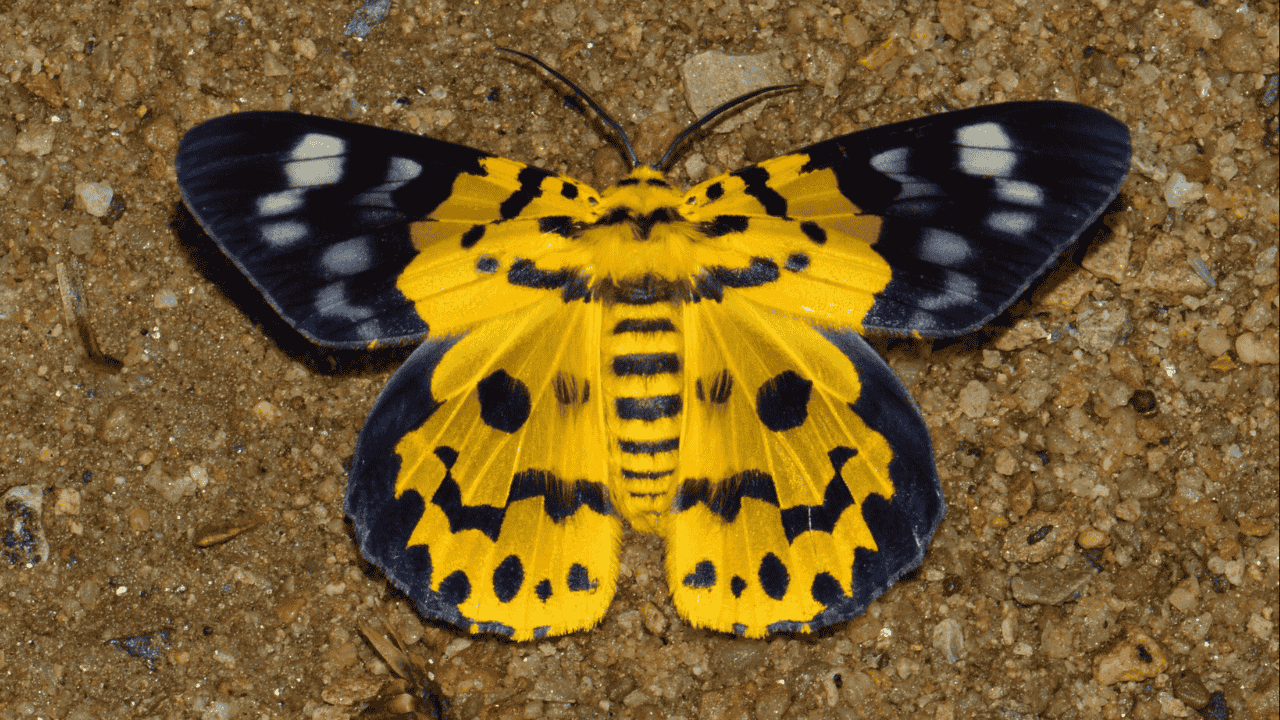
The discovery of a rare moth species in the Matkamhatu area under the Khuntpani block of West Singhbhum district, Jharkhand, is not only a landmark event for the state’s biodiversity but also adds a new chapter to the entomological mapping of India. The moth has been identified as the 'False Tiger Moth', scientifically known as $Dysphania \ militaris$. This discovery was made by Raja Ghosh, a Forest Guard and researcher working on the 'Elephant Project' of the Forest Department, who spotted the moth active near a stream in a patch of dense deciduous forest. This species has been officially recorded in the forests of Jharkhand for the first time, serving as a testament to the ecological resilience and rich biodiversity of the region. For aspirants preparing for UPSC and other state-level administrative services, this topic is extremely relevant from the perspective of Environment, Ecology, and Biodiversity Conservation (GS Paper III).
False Tiger Moth ($Dysphania \ militaris$): Taxonomy and Physical Characteristics
The False Tiger Moth belongs to the 'Geometridae' family, which is one of the largest families of moths. Moths of this family are often called 'inchworms' due to the distinctive looping gait of their larvae. The scientific description of $Dysphania \ militaris$ was first recorded by Carl Linnaeus in 1758 in the 10th edition of Systema Naturae.
| Scientific Classification | Description |
|---|---|
| Kingdom | Animalia |
| Phylum | Arthropoda |
| Class | Insecta |
| Order | Lepidoptera |
| Family | Geometridae |
| Subfamily | Geometrinae |
| Genus | Dysphania |
| Species | D. \ militaris |
The physical structure of this moth makes it distinct and attractive. It has a wingspan of approximately 80 to 96 mm. The wing pattern consists of golden yellow and deep purplish-black, providing it with a tiger-like appearance, which is why it is called the 'False Tiger'. The inner half of the forewings is golden-yellow, while the outer half is deep purple. The spots and stripes on its wings serve as a warning to predators that the creature might be toxic or unpalatable—a defense mechanism known in biology as 'aposematism'.
Diurnal Activity and Behavioral Specifics
While most moth species are nocturnal, the most unique feature of the False Tiger Moth is its diurnal (daytime) activity. it flies in bright daylight, especially during the morning and late afternoon, which often leads to it being mistaken for a butterfly. Its discovery in Singhbhum near a stream indicates that this species may engage in 'mud-puddling'. Mud-puddling is a process in which moths and butterflies soak up essential minerals, salts, and amino acids from damp soil or the edges of streams. This behavior is considered crucial for supplying the sodium required for reproduction.
Jharkhand’s Biodiversity and Ecological Significance of Singhbhum
The Matkamhatu area of West Singhbhum district, where this moth was found, is covered with dense vegetation and mixed deciduous forests. This terrain of Jharkhand provides a favorable habitat for insects as it offers sufficient humidity and food sources. The larvae of $Dysphania \ militaris$ primarily depend on plants such as Carallia species, Kandelia candel, and Rhodomyrtus tomentosa.
Jharkhand is often referred to as the heart of the 'Chhota Nagpur Plateau', which has served as a bridge between the Satpura range and the Eastern Himalayas. This geographical position has fostered species exchange and a high level of endemic diversity. The Singhbhum discovery confirms that the state's forests still harbor many species that are yet to be documented.
New Prospects in Research and Zoological Survey of India (ZSI) Data
The most significant aspect of this discovery is that recent documents published by the Zoological Survey of India (ZSI), such as "Moths of Bihar and Jharkhand," do not mention this species. ZSI released a checklist of moths from Bihar and Jharkhand in 2019, detailing 373 species, but $Dysphania \ militaris$ was not included.
| Research Document | Reference and Significance |
|---|---|
| Moths of Bihar and Jharkhand (ZSI) | A checklist of 373 species; the Singhbhum discovery will now be added to this. |
| State Biodiversity Board (Jharkhand) | Responsible for documentation and implementation of conservation policies. |
| Bonai Forest Division Report (Odisha) | Confirmation of the first photographic evidence of this moth in Odisha in 2025. |
According to Dr. Abhishek Kumar, DFO of Dalma Wildlife Sanctuary, and Hari Shankar Lal, Technical Officer of the Jharkhand Biodiversity Board, this discovery will act as a catalyst for future research into new species. The role of dedicated Forest Guards and researchers like Raja Ghosh becomes vital in this context, as they monitor ecological changes and new discoveries at the ground level.
India’s Biodiversity Strategy and Global Goals 2030
India recently submitted its 7th National Biodiversity Report, detailing progress toward achieving targets for 2030. India aims to achieve the "30x30" target under the Kunming-Montreal Global Biodiversity Framework, which means conserving 30% of the world's land and oceans by 2030.
The discovery of rare species in regions like Singhbhum strengthens the concept of 'Conservation Beyond Protected Areas'. Currently, 25.17% of India's geographical area is under forest and tree cover, with a target to increase this to 33% under the National Forest Policy.
Moths as Bioindicators
Moths are excellent bioindicators of ecosystem health. Since they are sensitive to subtle changes in temperature, humidity, and vegetation, their presence or absence can be used to assess the impacts of climate change. The presence of a rare moth like $Dysphania \ militaris$ in Singhbhum indicates that the local environment is still relatively safe from the effects of pollution and habitat destruction.
| Indicator Property | Significance |
|---|---|
| Sensitive Habitat | Moths thrive only in specific plants and micro-climates. |
| Food Web Link | They are a primary food source for birds, bats, and other insectivores. |
| Pollination | Many moths assist in plant reproduction during the night and day. |
Intersection of Jharkhand’s Cultural Heritage and Nature Conservation
The tribal art and culture of Jharkhand have always been close to nature. For example, 'Kohbar' and 'Sohrai' paintings, which received the Geographical Indication (GI Tag) in 2020, are primarily based on the depiction of flora and fauna. These artworks use motifs of peacocks, elephants, turtles, and various flowers, reflecting the respect of local communities for biodiversity.
Additionally, Jharkhand recently achieved a historic milestone in wetland conservation by getting 'Udhwa Lake' declared its first Ramsar Site under the Ramsar Convention. India now has a total of 89 Ramsar sites, the highest in Asia. Such conservation efforts indirectly help in securing the habitats of rare insects living in regions like Singhbhum.
Global and National Perspective of 2026: Environmental Challenges
In 2026, several significant events are occurring in the field of environment and biodiversity that directly relate to ecological stability:
Global Water Bankruptcy: According to a UN report, many of the world's major water systems have lost their recharge capacity, threatening wetlands and riverside habitats (where moths are found).
Green Energy Transition: India has surpassed its target of obtaining more than 50% of its total power capacity from non-fossil sources and has now set a new target of 60% by 2035.
International Big Cat Alliance (IBCA): Headquartered in New Delhi and formed under India's leadership, this alliance aims to conserve seven big cats, including tigers. The habitats of these big cats (such as the forests of Dalma or Saranda) are also the homes of these rare moths.
Quick GK Update for Competitive Exams
Aspirants should specifically note the following points for their preparation:
Discovery Site: Singhbhum, Jharkhand (Matkamhatu area).
Discoverer: Raja Ghosh (Forest Guard, Elephant Project).
Scientific Name: $Dysphania \ militaris$ (False Tiger Moth).
Family Classification: Geometridae.
Behavior: Diurnal, Mud-puddling.
Conservation Status: Currently not listed as 'Threatened' on the IUCN Red List, but habitat loss is a major threat.
Jharkhand’s First Ramsar Site: Udhwa Lake.
GI Tag (Jharkhand): Kohbar and Sohrai Art (2020).
| Important Terminology | Definition / Meaning |
|---|---|
| Lepidoptera | The group comprising butterflies and moths. |
| Aposematism | The use of bright colors to deter predators. |
| 30x30 Target | Global goal to conserve 30% of the area by 2030. |
| M-STrIPES | Digital app used for monitoring tigers. |
| GI Tag | Recognition given to products originating from a specific geographical area. |
Why is this Important for Your Exam Preparation?
This news holds immense importance for UPSC and State PSC exams (GS Paper III: Environment & Biodiversity). It covers the following dimensions:
Prelims: Questions are often asked regarding the discovery of new species, their scientific names, families, and unique behaviors. Particular attention is paid to species that may be scheduled under the Wildlife Protection Act (1972) or mentioned for the first time in ZSI publications.
Mains: Questions can be framed on the lack of regional data in biodiversity documentation and the role of local researchers in addressing this. When discussing the balance of "Development vs. Environment" in mineral-rich states like Jharkhand, the habitat of such rare species can be cited as an example.
Interview: If you belong to Jharkhand, it is mandatory to have information about the state’s biodiversity, new Ramsar sites, and recent ecological discoveries (like the Singhbhum moth).
Atharva Examwise (www.atharvaexamwise.com) advises aspirants to study the static part of Environment and Ecology by linking it with current affairs. For instance, when you read about the 'Geometridae' family, link it to this new discovery in Singhbhum. This type of integrated study will keep you ahead of others in the exam.
Biodiversity is not just about large animals (like tigers or elephants) but also about small insects and plants that form the foundation of our ecosystem. This 'False Tiger Moth' found in Singhbhum is a symbol that much remains to be done to save the beauty and diversity of nature. Stay connected with Atharva Examwise to make your preparation more effective.