
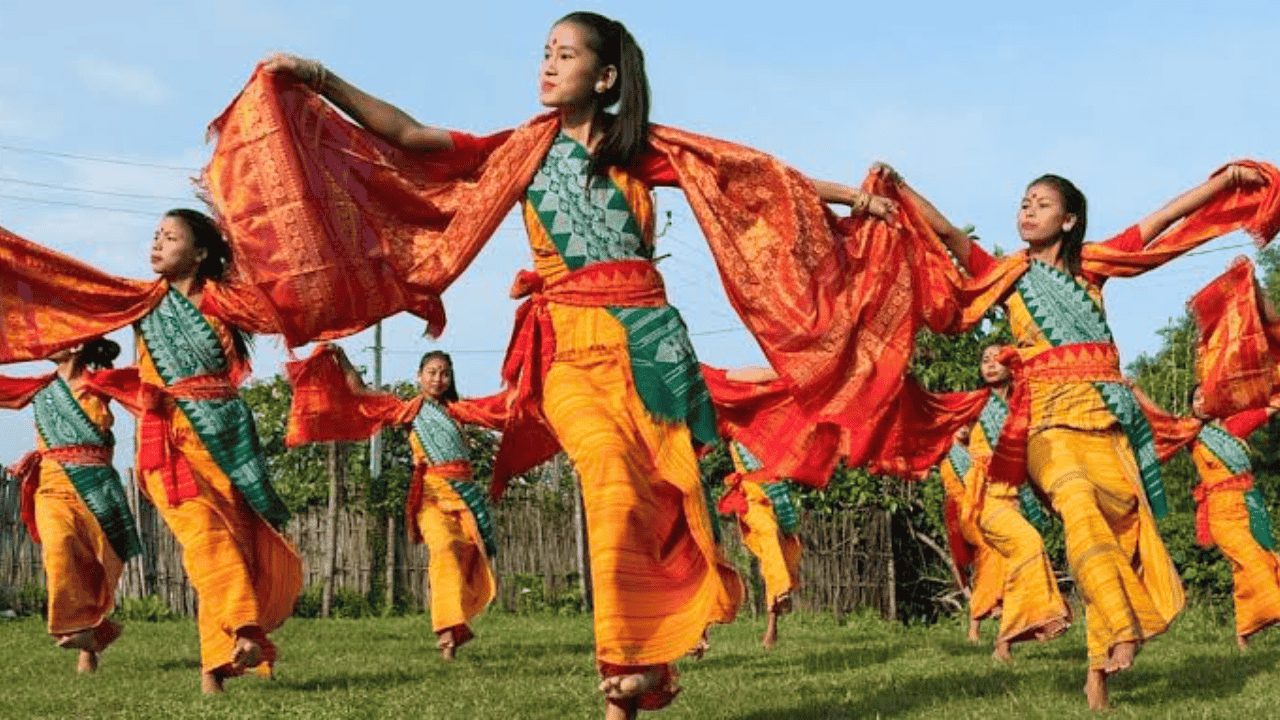
UPSC Current Affairs April 10, 2026: Bagurumba Dance of Assam and the Cultural Heritage of the Bodo Tribe – Atharva Examwise Daily GK Update
The geographical and cultural diversity of Assam serves as a vital pillar of India's Northeast region. This state is famous not only for its natural beauty and biodiversity but also for its tribal art and culture, which have gained global recognition. Among these rich traditions of Assam is the 'Bagurumba Dance', which is an integral part of the Bodo tribe's identity. In recent years, specifically between 2024 and 2026, this dance and its associated cultural products have garnered significant national and international attention. This report provides a detailed analysis of the technical, social, religious, and contemporary aspects of the Bagurumba dance, which is highly significant for UPSC and other competitive exam aspirants.
The Bodo Tribe: Historical and Demographic Background
To understand the Bagurumba dance, it is essential to study the history and social structure of its creators—the Bodo tribe. The Bodos are the largest indigenous ethnolinguistic group in Assam and a prominent Scheduled Tribe (ST). Historically, they are part of the broader 'Bodo-Kachari' family, considered among the oldest inhabitants of Northeast India.
| Feature | Description |
|---|---|
| Ethnic Group | Indo-Mongoloid |
| Language Family | Tibeto-Burman |
| Geographical Spread | Primarily Assam (Bodoland Territorial Region), but also present in Nagaland, Meghalaya, West Bengal, and Tripura. |
| Constitutional Status | The Bodo language is one of the 22 scheduled languages included in the 8th Schedule of the Indian Constitution. |
The influence of the Bodo community is not limited to art; their political and social consciousness has also shaped the governance of the region. The legacy of leaders like 'Bodofa' Upendranath Brahma continues to inspire the community's efforts toward cultural resurgence and empowerment.
Bagurumba Dance: The Artistry and Symbolism of the 'Butterfly Dance'
Bagurumba is popularly known as the 'Butterfly Dance' due to its gentle, rhythmic, and undulating movements. Every posture of the dance reflects the community's deep connection with nature. Traditionally, this dance is performed by Bodo women, while men provide the musical foundation as instrumentalists.
Technical Structure and Choreography
The choreography of Bagurumba is based on mimicking various elements of nature. Dancers use their colorful traditional attire (especially the 'Jwmgra') like the wings of butterflies. During the performance, artists often form circular or linear patterns, symbolizing social unity and collective harmony.
The tempo of the dance is slow and serene, reflecting the simplicity and joy of life. It expresses natural processes such as the blooming of flowers, the flight of birds, and the flow of rivers through physical gestures. At a spiritual level, this dance is a medium to express gratitude to the supreme Bodo deity, 'Bathou', embodying respect for creation and nature.
Traditional Attire and the Art of Weaving
In Bodo culture, weaving is not just an economic activity but an artistic expression. The costumes used in the Bagurumba dance are a testament to the expertise of Bodo women.
Dokhona: A traditional hand-woven garment wrapped around the body. It often features intricate floral and geometric patterns inspired by nature.
Jwmgra (Jwmgra/Fasra): A colorful scarf or shawl worn over the shoulders. During the dance, it is spread out to create the visual effect of butterfly wings.
Aronai: A small hand-woven scarf that serves as a symbol of respect and cultural identity. It is frequently used to welcome guests.
The importance of these textiles is further evidenced by the fact that in 2024, the 'Bodo Dokhona' and 'Bodo Eri Silk' were granted Geographical Indication (GI) Tags by the Government of India, providing legal protection to their uniqueness and quality.
Music and Instruments: The Sound of Bodo Culture
The music of the Bagurumba dance is incomplete without traditional Bodo instruments. These are crafted from locally available materials like bamboo and wood, each possessing distinct acoustic characteristics.
| Instrument | Description | GI Tag Year |
|---|---|---|
| Kham | A long wooden drum that provides a deep rhythmic base. | 2024 |
| Sifung | A long bamboo flute; its music is believed to destroy snake eggs and bring well-being. | 2024 |
| Serja | A violin-like stringed instrument that adds emotional depth to the melodies. | 2024 |
| Thorkha | A split bamboo clapper used to maintain tempo. | 2024 |
| Jotha | Metal cymbals that help maintain the rhythm. | 2024 |
| Gongwna | A small bamboo mouth organ (jew's harp). | 2024 |
Among these, the 'Thorkha' is particularly significant as it is made from the Bambusa tulda species of bamboo, chosen for its durability and sound quality. The GI tags received by these instruments not only bring global recognition to the artists but also secure the livelihoods of thousands of artisans involved in their creation.
Bwisagu Festival: The Ritualistic Foundation of Bagurumba
Bagurumba is primarily performed during the 'Bwisagu' festival. This is the Bodo New Year celebration observed in mid-April, coinciding with Assam’s 'Bohag Bihu' and North India’s 'Baisakhi'.
The Seven-Day Ritual Cycle
The celebration of Bwisagu follows a structured cycle, where each day is dedicated to a different element of nature:
First Day (Mashau): Dedicated to cattle. Cows are bathed in rivers, smeared with mustard oil, and adorned with garlands made of eggplant and gourd.
Second Day (Mansi): Dedicated to humans. On this day, the supreme deity 'Bathou' (symbolized by the Sijou tree) is worshipped. Collective Bagurumba dances and festivities begin in full swing from this day.
Subsequent Days: Specific days are set aside to express gratitude toward dogs (Saima), pigs (Oma), and birds (Dao), reflecting the eco-centric approach of Bodo culture.
Final Day: Reserved for visiting relatives, seeking blessings from elders, and resolving old grievances.
The tradition of 'Gwkha-Gwkhwi Janai' is also vital during Bwisagu, involving the consumption of bitter and sour medicinal herbs collected from the forest, symbolizing the purification of the body.
Bagurumba Dwhou 2026: A Historic Milestone
In January 2026, the 'Bagurumba Dwhou' held at the Sarusajai Stadium in Guwahati established this folk dance on the global stage. The word 'Dwhou' means 'Wave' in the Bodo language, indicating the magnitude of cultural consciousness.
Key Facts of the Mega Performance
This event was not just a dance performance but a display of the Bodo community’s cultural strength:
Number of Artists: Over 10,000 Bodo artists performed Bagurumba simultaneously to a single rhythm.
Geographical Participation: Artists from 81 assembly constituencies across 23 districts of Assam participated.
World Record: The objective was to set a new world record for Bagurumba, similar to previous records set by Bihu and Jhumur.
National Significance: The presence of Prime Minister Narendra Modi underscored the government's commitment to preserving tribal heritage.
Modern Context: Digital Preservation and Infrastructure
Alongside cultural pride, there is a focus on economic and ecological development in Bodo areas. During the Prime Minister's 2026 visit, the foundation stone for the 'Kaziranga Elevated Corridor Project' was laid.
Kaziranga Elevated Corridor and Ecology
This project is a significant case study for UPSC GS Paper III (Environment and Infrastructure):
Structure: A 35 km elevated section on National Highway 715 (formerly NH-37).
Objective: To ensure the free movement of wildlife in Kaziranga National Park, especially during monsoons when animals seek safe higher ground.
Cultural Connection: Just as the Bagurumba dance sends a message of harmony with nature, this project exemplifies the balance between modern engineering and environmental conservation.
Additionally, under the 'Digital Bodoland' initiative, platforms like Bagurumba.org are being used for the digitization and global promotion of the dance.
Why This is Important for Your Exam Preparation
For UPSC and other state-level competitive exams (such as APSC), information regarding the Bagurumba dance and the Bodo tribe holds multi-dimensional importance:
1. General Studies Paper I (Art & Culture and Indian Society)
Folk Art: Identifying Bagurumba as the 'Butterfly Dance' and understanding its nature-centric symbolism.
Tribal Culture: The contribution of the Bodo tribe to India's diversity and their distinct cultural identity (language, attire, festivals).
GI Tags: Questions may be asked regarding the legal protection of cultural products and their economic impact.
2. General Studies Paper II (Governance and Social Justice)
Scheduled Tribes: Constitutional provisions for tribal communities (e.g., the Bodo language in the 8th Schedule) and the protection of their rights.
Cultural Diplomacy: The importance of large-scale cultural events (like Bagurumba Dwhou 2026) in national integration and soft power.
3. General Studies Paper III (Environment and Biodiversity)
Sustainable Development: Examples like the Kaziranga Elevated Corridor Project that show the balance between development and conservation.
Ecological Rituals: Studying animal welfare and nature worship through the Bwisagu festival.
4. Prelims (Current Affairs & Daily GK)
Names of Bodo instruments that recently received GI tags (Kham, Sifung, Thorkha, etc.).
The venue of Bagurumba Dwhou 2026 (Sarusajai Stadium) and the number of participating artists (10,000+).
The role of the famous Bodo leader 'Bodofa' Upendranath Brahma.
At Atharva Examwise (www.atharvaexamwise.com), we provide you with such deep insights that go beyond mere facts to strengthen your conceptual foundation. Bagurumba is not just an art form; it is a symbol of the eternal balance between nature, society, and culture—a concept essential for future administrators to understand.