UPSC Current Affairs April 3, 2026: Garuda Garvabhangam Dance and Indian Culture Atharva Examwise Current News, Daily GK Update, Competitive Exam News Today
The tradition of presenting various mythological anecdotes and religious episodes through dance and drama has been extremely robust in Indian culture and traditions since ancient times. Various classical and folk arts have not only spread spiritual messages but also taught morality and social harmony to society. A unique expression of this tradition is found in the dance-drama titled 'Garuda Garvabhangam.' This episode is not only a significant part of South Indian dance-drama traditions but also links the evolution of ancient sculpture and modern cinematic history. This article presents a detailed and exam-oriented analysis of this specific art form, its historical origin, its transformation across various classical styles, and its evidence in temple architecture, which is highly relevant for the Union Public Service Commission (UPSC) General Studies Paper-1 (Art and Culture).
Mythological Background and Philosophical Significance of Garuda Garvabhangam
The term 'Garuda Garvabhangam' is essentially derived from the combination of three Sanskrit words: 'Garuda' refers to the divine vehicle of Lord Vishnu, 'Garva' means ego or pride, and 'Bhangam' signifies destruction or termination. Thus, its literal and metaphorical meaning denotes "the story of the end of the ego of Garuda, the vehicle of Lord Vishnu."
According to mythological narratives, Garuda begins to feel immense pride due to his unique speed, strength, and status as the exclusive vehicle of Lord Vishnu. This pride gradually transforms into a deep-seated ego, leading him to consider himself superior to other gods and devotees. In Sanatan philosophy, ego is considered the root cause of the downfall of both humans and deities. For this reason, Lord Vishnu orchestrates a 'Leela' (divine play) to teach his beloved vehicle a lesson in humility.
Expanding on this story in South Indian folk genres and theatrical traditions, it is shown that Lord Vishnu sends Garuda to invite Hanuman, the son of the Wind God. Hanuman, known as the supreme devotee of Lord Rama in the Treta Yuga and for his limitless power, was residing in the Kadali forest at that time. When Garuda arrives there, his inherent ego is clearly reflected in his behavior. Hanuman, recognizing Garuda's arrogance and understanding the purpose of Lord Vishnu's divine play, refuses to accompany him. This results in a duel or battle between the two divine entities. Ultimately, Garuda is defeated by Hanuman’s profound devotion and valor, and his pride is shattered. Finally, Garuda renounces his ego and adopts the path of humility and true devotion. This story demonstrates that the right to power and service is meaningful only when it is free from ego and transformed into complete surrender.
Kerala’s Ottan Thullal Art Tradition and Garuda Garvabhangam
One of the most powerful and popular art forms to bring this story of Garuda's humbled pride to life on stage is Kerala's 'Ottan Thullal.' Ottan Thullal is an approximately 300-year-old traditional performing art form of Kerala, considered an excellent blend of classical and folk elements.
According to historical evidence, this art form was invented in the 18th century by the renowned poet and Mizhavu (a percussion instrument) player, Kunchan Nambiar. It is believed that after being insulted by a Chakiyar artist for dozing off during a performance of Chakiyar Koothu in a temple, Nambiar developed this new and more accessible art form. While Chakiyar Koothu was based on Sanskrit verses and classical language, Kunchan Nambiar used simple and colloquial Malayalam for Ottan Thullal. This linguistic simplification brought the art very close to the general public and granted it immense popularity.
The greatest feature of Ottan Thullal is its solo performance. In this dance-drama, a single artist plays all the roles of the story—such as Lord Vishnu, Garuda, and Hanuman—themselves. The artist sings, acts, and dances with rapid footwork. Among the collection of 64 established plays of Ottan Thullal, 'Garuda Garvabhangam' is considered artistically superior. The dialogue between Garuda and Hanuman in this play is worth seeing and hearing. For instance, when Garuda addresses Hanuman disrespectfully and Hanuman mocks his pride, that dialogue remains the biggest attraction of Ottan Thullal performances even today.
Costumes and Unique Stage Makeup
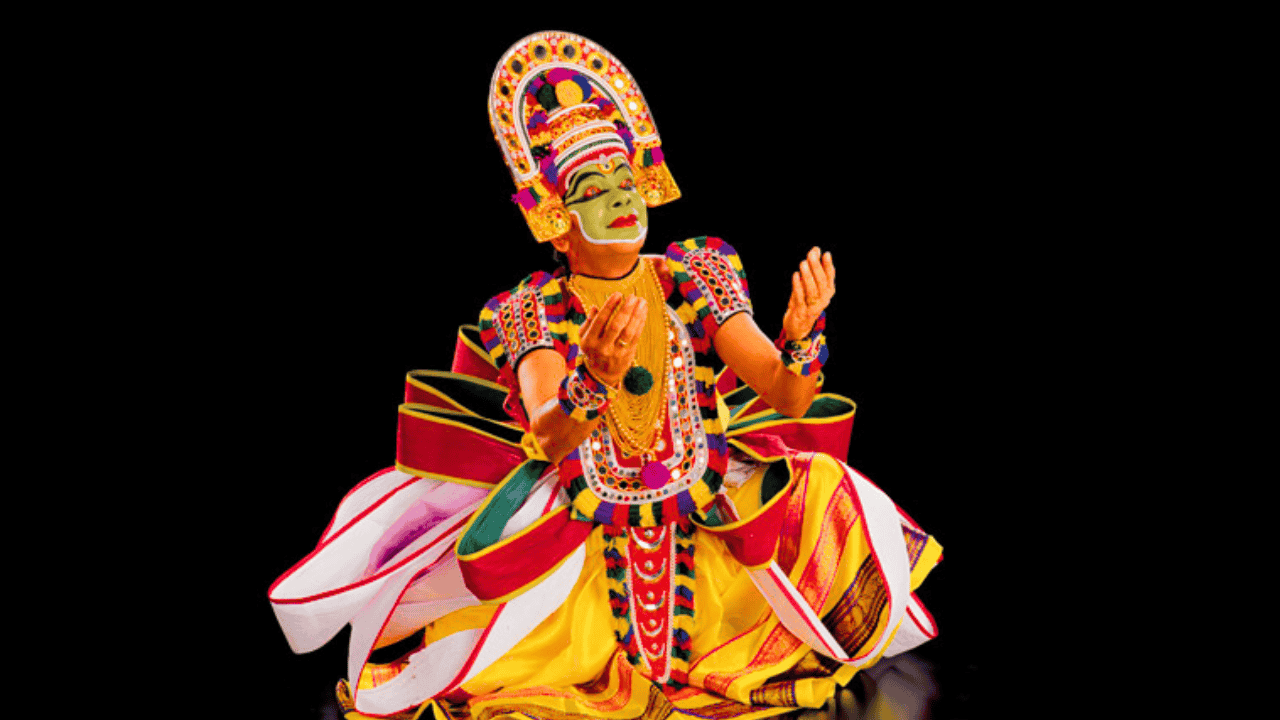
During the presentation of Garuda Garvabhangam in Ottan Thullal, the makeup and costumes of the artists are highly distinctive and attractive.
Special Face Makeup: The performers apply a special green makeup on their faces. This green color is quite similar to the Pachha makeup of Kathakali, representing qualities of righteousness (Sattvik) and heroism.
Attire and Jewelry: Artists are adorned in extremely colorful and flared costumes. They wear specific types of headgear and beautiful traditional jewelry, making their gestures and postures captivating for the audience.
Instruments and Music: In an Ottan Thullal performance, a group of singers sits behind the main artist and repeats the lines sung by the performer. For musical accompaniment, traditional percussion instruments like the 'Mridangam' and 'Edakka' are used, which control the rhythm and pace of the performance.
Classical Transformation in Kathakali and Bhagavata Mela
Although the staging of Garuda Garvabhangam in Ottan Thullal is known for its satirical style and simplicity, this story has also been adapted into the more rigid classical traditions of South India.
Use of Garuda Garvabhangam in Kathakali
Kathakali, the highly prestigious and serious dance-drama form of Kerala, has also incorporated this story through periodic innovations. For example, in 2016, 'Garuda Garvabhangam' was successfully staged in the Kathakali style as a new play written by Vinod Kumar Mukundan in Thrissur. Through the complex hand gestures (Mudras) and subtle facial expressions (Abhinaya) of Kathakali, the depiction of Garuda's anger and ego versus Hanuman's calm and invincible valor provides a profound and divine experience. During its staging in Kathakali, more emphasis is placed on the expression of emotions and the precise combination of classical Ragas and Talas rather than dialogues.
The Bhagavata Mela Tradition of Tamil Nadu
Additionally, the ancient dance-drama tradition called 'Bhagavata Mela', prevalent in the Tanjore region of Tamil Nadu, has a long history of presenting Vaishnava narratives. Bhagavata Mela essentially developed from the historical migration of Kuchipudi artists from Andhra Pradesh to Tamil Nadu in the 16th century, following the fall of the Vijayanagara Empire and Islamic invasions in the Deccan region, when they sought the patronage of the Tanjore Nayak rulers and Maratha kings. While Prahlada Charitam is most popular in Bhagavata Mela, short episodes based on the Vaishnava conflicts between Garuda and Hanuman are also occasionally seen in its extensive performances.
Comparative Table of South Indian Performing Art Forms:
| Art Form | Origin & Region | Main Features | Instruments Used | Language & Style |
|---|---|---|---|---|
| Ottan Thullal | 18th Century, Kerala | Solo performance, abundance of satire and humor | Mridangam and Edakka | Simple and colloquial Malayalam |
| Kathakali | 17th Century, Kerala | Group dance-drama, complex hand gestures | Chenda and Maddalam | Sanskritized and symbolic acting |
| Bhagavata Mela | 16th Century, Tamil Nadu | Annual temple festival, classical acting | Mridangam, Flute, and Cymbals | Telugu/Tamil based on Carnatic music |
Evidence of the Garuda-Hanuman Duel in Deccan Temple Architecture
Beyond dance and drama, history researchers have found evidence of medieval sculptures depicting the struggle between Garuda and Hanuman in various Vaishnava temples of South India, particularly in the Deccan region. These artworks are believed to have been created during the Bhakti period of Vaishnava Acharyas like Ramanujacharya and Madhvacharya, and the Alwar saints.
According to historians, on the wall panels of several prominent temples in Karnataka and Andhra Pradesh, Garuda and Hanuman are shown clashing over an oval object, a fruit, or a structure resembling a Lingam. Although there is no direct and clear written evidence of these specific sculptures in the primary Puranas, they are linked to the 'Garuda Garvabhangam' prevalent in folk traditions or other incidental stories of conflict between Garuda and Hanuman. In most cases, these sculptures are found in temples whose construction was sponsored or patronized by the contemporary royal dynasties of that region.
Brief details of these sculptures found at various historical sites:
| Temple Name | Location | Dynasty/Period | Sculpture Feature |
|---|---|---|---|
| Chennakeshava Temple | Belur, Karnataka | Hoysala Dynasty | Hanuman and Garuda fighting over an oval object |
| Lakshmi-Narayana Temple | Harnahalli, Karnataka | Hoysala King Vira Someshwara (1235 AD) | Two monkey-like figures shown holding a fruit |
| Ugra-Narasimha Temple | Ahobilam, Andhra Pradesh | Later Chalukyas of Kalyani | Figures from both sides holding a Lingam-like structure |
This archaeological evidence confirms that episodes related to Garuda's ego and Hanuman's superiority were not limited to oral or theatrical traditions but were also significant sources of artistic inspiration in medieval society.
The Place of Garuda Garvabhangam in Modern Indian Cinema
In the first half of the 20th century, when the era of talkies (speaking films) began in India, a new medium developed to present mythological stories through motion pictures. The popularity of 'Garuda Garvabhangam' can be gauged from the fact that several important films were made on this subject in the early period of Indian cinema.
According to historical documents, the first silent film based on this episode was made in 1929 by A. Narayanan. Subsequently, in 1936, a talkie film of the same name was released in the Tamil language, directed by R. Padmanabhan. This film is considered one of the early talkies based on mythological themes in Tamil cinematic history. Following this, in 1943, the famous filmmaker Ghantasala Balaramayya produced a remake in the Telugu language under the same title, starring the famous actress P. Bhanumathi and the renowned Kuchipudi dancer Vedantam Raghavayya.
The involvement of classical dance gurus like Vedantam Raghavayya in cinema was a significant historical turning point. Raghavayya himself was a great exponent of Kuchipudi, and by moving from stage to films, he played a vital role in bringing classical elements to the masses through dance direction. Thus, starting from an ancient temple tradition, this episode successfully reached the most powerful audio-visual technique of the modern era—the cinema screen.
Key Points and Exam-Oriented Facts
For the quick review of serious candidates preparing for competitive exams, important facts are summarized below:
Core Meaning of Garuda Garvabhangam: A dance-drama based on the mythological story of destroying the ego of Garuda, Lord Vishnu's divine vehicle.
Artist Costumes: Performers wear special green makeup, feather-adorned costumes, jewelry, and crowns.
Origin of Ottan Thullal: Developed in the 18th century by poet and Mizhavu player Kunchan Nambiar as an alternative to Chakiyar Koothu.
Feature of Thullal: It is a solo dance style with a high content of humor and social satire.
Comparison with Kathakali: Kathakali is a classical form with complex mudras, while Ottan Thullal is more vibrant, colloquial, and entertaining.
Evidence in Architecture: Sculptures of the struggle between Garuda and Hanuman are carved in the Hoysala-era Chennakeshava Temple in Belur, Karnataka, and the Ugra-Narasimha Temple in Ahobilam, Andhra Pradesh.
Cinematic History: The first Tamil talkie on Garuda Garvabhangam was made in 1936 and a Telugu film in 1943, reflecting the development of early Indian cinema.
Why this matters for your exam preparation
For candidates preparing for the UPSC and other state-level administrative exams, this topic holds multi-dimensional importance.
General Studies Paper-1 (Art & Culture): The UPSC Mains syllabus includes the main aspects of art forms, literature, and architecture from ancient to modern times. By studying a specific episode like 'Garuda Garvabhangam,' candidates can deeply understand the subtle differences and interconnections between folk art (like Ottan Thullal) and classical art (like Kathakali and Bhagavata Mela). Questions on the social significance of folk arts are frequently asked, where the use of this art by Kunchan Nambiar to strike at societal discrepancies can be cited as an excellent example.
Preliminary Examination (Prelims - Art & Culture): The Prelims often feature objective questions related to performing arts from specific geographical regions, their origins, instruments, and creators—such as the link between Kunchan Nambiar and Ottan Thullal, or specific sculptural motifs in Hoysala temples. This report provides precise data to help solve such complex code-based questions.
Essay and Interview: The philosophical value of Indian heritage, such as the fall of ego and the rise of service spirit, can be presented as a strong example in philosophical essay topics. Additionally, during interviews, discussing such regional art forms while talking about India's Intangible Cultural Heritage demonstrates the candidate's cultural awareness and extensive study.
Therefore, candidates are advised to pay special attention to the historical progression, regional variations, and the interrelationship of archaeological evidence while studying contemporary topics related to art and culture.