UPSC Current Affairs March 20, 2026: NASA's Artemis-II Moon Mission – Daily GK Update and Detailed Analysis
March 20, 2026, marks a significant milestone in the history of human space exploration as the National Aeronautics and Space Administration (NASA) enters the final stages of preparation for the launch of its ambitious Artemis-II mission. After a long hiatus of nearly 54 years, humans are once again ready to break the boundaries of Low Earth Orbit (LEO) and head toward the Moon. This mission is not merely a technical test; it is the first and most crucial step toward future Mars missions and establishing a permanent human settlement on the Moon. For UPSC and other State Service Exam aspirants, the Artemis-II mission is highly relevant from the perspectives of Science and Technology, International Relations, and Geopolitics.
Historical Context: The Journey from Apollo to Artemis
The history of lunar exploration began during the Cold War when the "Space Race" between the United States and the Soviet Union was at its peak. NASA's last manned lunar mission was Apollo 17, launched on December 7, 1972. At that time, the primary objective of the missions was to demonstrate technical superiority and "plant the flag." However, the vision of the Artemis program is entirely different. This mission focuses on sustainability, international cooperation, and scientific discovery.
The success of the Artemis-II mission rests on the foundation of Artemis-I, which was successfully completed in November 2022. Artemis-I was an uncrewed test that certified the capabilities of the Space Launch System (SLS) and the Orion spacecraft. Now, in Artemis-II, four astronauts will board this spacecraft, ushering in a new era of space exploration.
Artemis-II Mission: Key Details and Launch Schedule
The launch of the Artemis-II mission is scheduled for April 1, 2026, from Launch Complex 39B at NASA’s Kennedy Space Center in Florida. This 10-day mission will follow a "Free-return Trajectory" around the Moon. This means the spacecraft will use the Moon's gravity to swing back toward Earth, saving fuel and ensuring safety in case of any technical malfunction.
| Mission Parameter | Details |
|---|---|
| Launch Date | April 1, 2026 (Planned) |
| Mission Duration | Approximately 10 Days |
| Spacecraft | Orion Crew Module & European Service Module |
| Rocket | Space Launch System (SLS) Block 1 |
| Mission Type | Crewed Lunar Flyby |
| Crew Size | 4 Astronauts |
Another highlight of this mission is that Artemis-III, which will be the actual lunar landing mission, is planned for launch by 2028. Thus, Artemis-II will serve as a rehearsal for that historic moment.
Technical Analysis: The Power of SLS and Orion
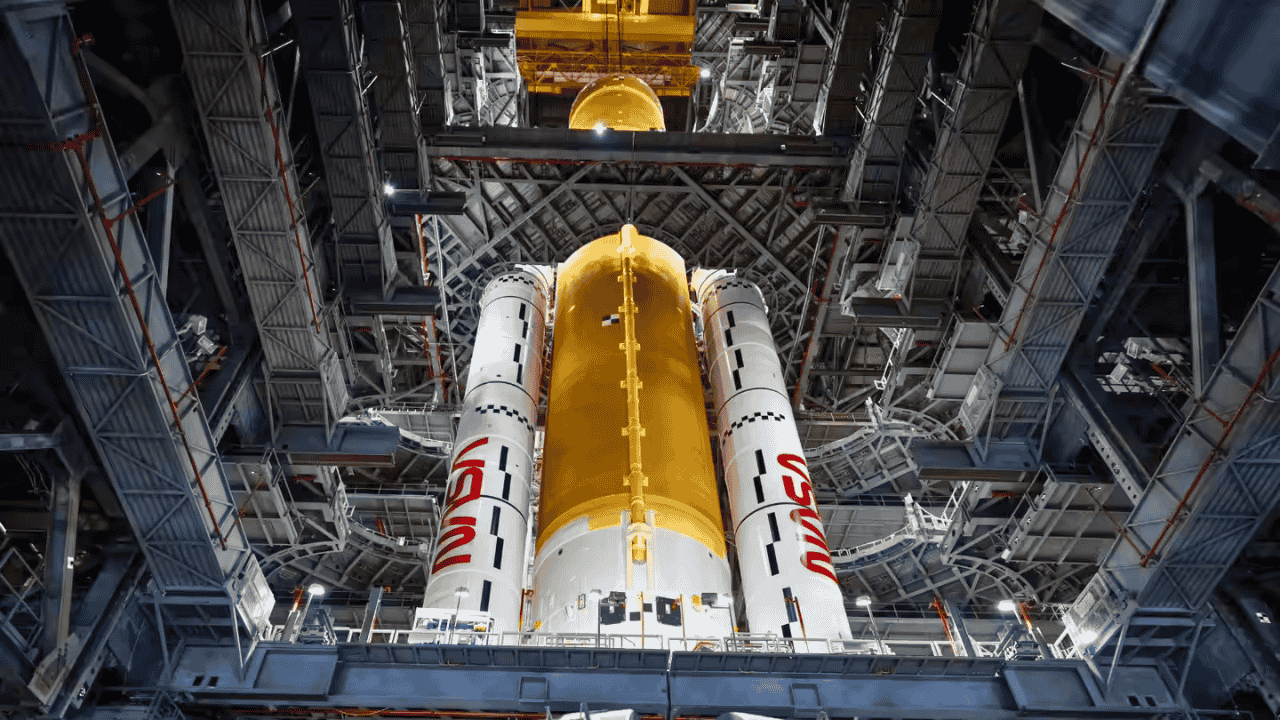
The vehicle carrying Artemis-II into space is the Space Launch System (SLS), currently considered the most powerful rocket in the world. This rocket is specifically designed for deep space missions. Its technical capacity can be understood through the following data:
Characteristics of the Space Launch System (SLS)
The SLS Block 1 rocket stands approximately 322 feet tall and generates 39.1 million Newtons of thrust at the time of launch. To understand its lift-off power, we can use the thrust equation:
$$F = \dot{m} \cdot v_e + (p_e - p_a) \cdot A_e$$
Here, $F$ is the total thrust generated by the four RS-25 engines of the rocket's core stage and the two Solid Rocket Boosters (SRBs).
| Technical Aspect | Details |
|---|---|
| Core Stage Engines | 4 RS-25 (Powered by liquid hydrogen and oxygen) |
| Boosters | 2 Five-segment Solid Rocket Boosters |
| Maximum Thrust | 39.1 Million Newtons (15% more than Apollo's Saturn V) |
| Payload Capacity | Over 95 tons to Low Earth Orbit (LEO) |
Orion Spacecraft
The Orion spacecraft is where the astronauts will reside during their mission. It consists of the Crew Module and the European Service Module (ESM).
Crew Module: Developed by Lockheed Martin, it has 9 cubic meters of habitable space, sufficient for four astronauts. This module is equipped with an advanced heat shield for protection against extreme temperatures, capable of withstanding up to 5,000°F (approx. 2,760°C) during re-entry into Earth's atmosphere.
European Service Module (ESM): Manufactured by Airbus, it provides the mission with electrical power, propulsion, thermal control, and air and water for the crew. It features four main solar panels extending nearly 19 meters to capture energy from the sun.
Heroes of the Mission: The Crew of Artemis-II
The crew of the Artemis-II mission is historic not only for their technical expertise but also for their diversity. For the first time, a woman, a person of color, and a non-U.S. citizen will travel to the vicinity of the Moon.
| Astronaut | Role | Details |
|---|---|---|
| Reid Wiseman | Commander | Experienced NASA astronaut and former Navy pilot. Responsible for overall mission leadership. |
| Victor Glover | Pilot | Will be the first person of color to go to lunar orbit. He will manage Orion's navigation and maneuvering. |
| Christina Koch | Mission Specialist 1 | Holds the record for the longest single spaceflight by a woman. She will operate the mission's scientific systems. |
| Jeremy Hansen | Mission Specialist 2 | Member of the Canadian Space Agency (CSA) and the first non-American to go near the Moon. |
This diversity demonstrates that space exploration is no longer the privilege of a single nation or group but a shared endeavor of all humanity.
10-Day Mission Itinerary: Day-by-Day Details
The roadmap for the Artemis-II mission is extremely complex. Each day is designated for specific scientific and technical objectives.
Phase I: Earth Orbit and Systems Check (Days 1-2)
Approximately 8 minutes after launch, Orion will separate from the rocket. Initially, it will enter a High Earth Orbit (HEO).
Day 1: The crew will check Orion's Life Support Systems, such as the water dispenser, waste management, and air filters. Victor Glover will perform "Proximity Operations," manually piloting Orion close to the upper stage of the rocket (ICPS) for practice.
Day 2: Astronauts will adapt to microgravity and test exercise equipment. Christina Koch will begin preparations for the Translunar Injection (TLI), the main engine burn to head toward the Moon.
Phase II: Heading Toward the Moon (Days 3-5)
Once systems are confirmed, the TLI engine burn will push Orion toward the Moon at speeds exceeding 40,000 km/h.
Day 3: The crew will practice emergency procedures, including medical assistance (like CPR) in zero gravity.
Day 4: Astronauts will focus on photography of the lunar surface and studying geological features.
Day 5: Orion will enter the Moon's gravitational sphere of influence. The crew will test the new orange 'Orion Crew Survival System' suits, designed to keep astronauts alive for up to 6 days in an emergency.
Phase III: Lunar Flyby and Return (Days 6-10)
This is the most exciting part of the mission when the astronauts will be closest to the Moon.
Day 6: Astronauts will fly over the Far Side of the Moon. For about 41 minutes, they will lose contact with Earth. They will see surfaces not seen by anyone since the Apollo missions. Orion will be approximately 10,300 km from the Moon.
Day 7-8: Using the Moon's gravity, Orion will swing back toward Earth. The crew will conduct Radiation Protection experiments and test manual navigation.
Day 9: The crew will prepare for Re-entry. They will wear special compression garments to prevent dizziness when returning to Earth's gravity.
Day 10: Orion’s Service Module will separate, and the Crew Module will enter the atmosphere. With the help of parachutes, it will splash down in the Pacific Ocean, where the U.S. Navy will safely recover them.
Science and Innovation: O2O Laser Communication System
A major technical pillar of the Artemis-II mission is its new communication system, called the 'Orion Artemis II Optical Communications System' (O2O).
Traditionally, space missions have used radio waves. However, O2O uses Infrared Laser signals.
Benefit: It can provide data transfer speeds up to 100 times faster than radio waves, reaching up to 260 Megabits per second (Mbps).
Application: Thanks to this technology, astronauts will be able to live stream 4K high-definition video from the Moon. This is crucial not only for public engagement but also for sending high-resolution scientific data back to Earth rapidly.
Geopolitics and Space Law: The Artemis Accords
The Artemis program is not just a NASA mission; it is a global alliance. The Artemis Accords are a set of principles based on the 1967 'Outer Space Treaty,' aimed at making space exploration peaceful and transparent.
India and the Artemis Accords
India became the 27th country to sign these accords in June 2023. For UPSC candidates, it is essential to understand the implications:
Strategic Shift: This signals a major strategic shift in India’s space cooperation, moving away from a Russia-centric approach toward a U.S.-led alliance.
Technical Benefits: It provides the Indian Space Research Organisation (ISRO) with access to NASA’s advanced technologies, data, and lunar samples.
Gaganyaan and Chandrayaan-4: India's indigenous human spaceflight mission, 'Gaganyaan,' will benefit significantly from Artemis cooperation. Additionally, this collaboration will be vital for docking and sample-return technologies required for Chandrayaan-4.
Indian Space Missions 2025-26: A Comparative Perspective
While NASA prepares for Artemis-II, ISRO is also demonstrating its prowess. Major Indian missions during 2025-26 include 'NISAR,' 'SPADEX,' and 'Gaganyaan.'
| Mission | Description | Significance |
|---|---|---|
| NISAR | Joint NASA-ISRO radar mission. | Monitoring subtle changes in Earth's surface and climate studies. |
| SPADEX | Space Docking Experiment. | Essential technology for the construction of the Bhartiya Antariksha Station (BAS). |
| Gaganyaan | India's first manned mission. | Will make India the fourth country to send humans into space. |
India is no longer just a low-cost satellite launcher but has emerged as a "Global Space Power" with heavy rockets like the LVM3 and complex technologies like SPADEX.
Apollo vs. Artemis: What is the Difference?
In competitive exams, a comparison between these two programs is often asked. While both have the Moon as their destination, there is a world of difference in their philosophy and technology.
Objective: Apollo’s goal was to "get there first." Artemis’s goal is to "stay there" and prepare for the journey to Mars.
Sustainability: Apollo missions were short-lived. Artemis plans to establish a space station called 'Gateway' around the Moon and build a 'Base Camp' on the surface.
Diversity: All 12 Apollo moonwalkers were male and American. Artemis is inclusive.
Private Sector Participation: Apollo was entirely government-run. In Artemis, private sector players like SpaceX and Blue Origin are playing critical roles.
Why this matters for your exam preparation
The Artemis-II mission is of paramount importance for UPSC and other competitive exams as it covers several pillars of General Studies:
GS Paper 3 (Science and Technology): Advancements in deep space exploration, new propulsion systems, laser communication technology, and the effects of microgravity on human health. The technical differences between Artemis and Apollo are a favorite topic for the Science section.
GS Paper 2 (International Relations): The 'Artemis Accords' and Indo-U.S. space diplomacy. This is key to understanding India's global stature and the legal challenges associated with creating "Safety Zones" in space.
Prelims: Names of crew members, technical specifications of the rocket (SLS) and spacecraft (Orion), the capability of the O2O system, and the chronology of lunar missions.
Essay and Ethics (GS Paper 4): The importance of diversity in space exploration and ethical questions regarding the use of outer space resources.
The success of Artemis-II will not just be a victory for NASA but will open new possibilities for partner nations like India. As a serious candidate, you should view these global developments in the context of India's indigenous missions like 'Gaganyaan.'
Stay tuned to Atharva Examwise for more information and daily updates.