
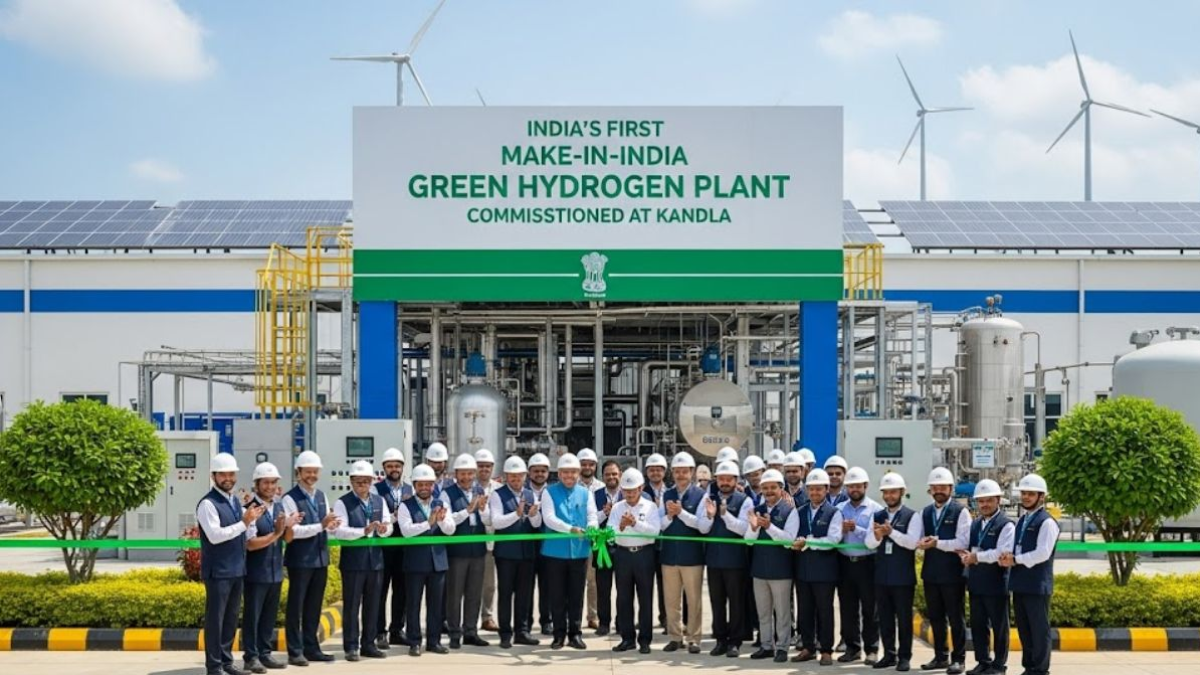
Daily UPSC Current Affairs: India’s First E-Methanol Plant, Kandla, Gujarat (26 February 2026)
Introduction: Today's Major Current Affairs News
As a significant step toward decarbonizing India's maritime transport sector, the country's first e-methanol plant is being established in Kandla, Gujarat. This project is being developed in partnership between the Deendayal Port Authority and Assam Petrochemicals Limited, with an estimated production capacity of 150 tonnes of e-methanol per day.
This news directly links to several important UPSC themes such as the Environment, Energy Security, the Blue Economy, Green Shipping, and Industrial Policy.
E-Methanol Plant: Basic Facts (Important for Prelims)
The following points can be directly framed as factual questions in Prelims and other objective-type exams:
Location: Kandla, Gujarat (under the jurisdiction of the Deendayal Port Authority).
Project Type: The country's first e-methanol plant.
Joint Initiative: Deendayal Port Authority + Assam Petrochemicals Limited.
Production Capacity: Estimated production of 150 Tonnes Per Day (150 TPD).
Primary Objective: To provide an alternative clean fuel for the maritime shipping sector and accelerate decarbonization.
Strategic Significance: Kandla's coastal location will enable the direct supply of e-methanol to international vessels.
What is E-Methanol? (Concept-based Understanding)
E-methanol is a "carbon-neutral" or low-carbon liquid fuel produced using renewable energy and captured carbon dioxide (CO₂).
While conventional methanol is typically derived from fossil fuels (like natural gas), the carbon used in e-methanol is sourced from atmospheric capture or industrial emissions.
It has the potential to replace fossil fuels across multiple sectors, including shipping, chemical manufacturing, and power generation.
Key Features of E-Methanol
Liquid State: Being a liquid at room temperature, it does not require highly expensive cryogenic storage unlike Hydrogen or LNG.
Adaptability: It can be used with existing port infrastructure and ship tanks with only minor technical modifications.
Carbon-Neutral: It falls under the carbon-neutral fuel category because the CO₂ utilized in its production is already pre-existing in the atmosphere or captured from industries.
Circular Economy and Carbon Capture Technology
The most defining feature of this plant is its underlying technology, which is based on the 'Circular Economy' and 'Carbon Capture'.
How does the process work?
CO₂ emitted from industrial chimneys is directly captured (Carbon Capture).
Simultaneously, 'Green Hydrogen' is produced from water using an electrolyzer powered by renewable energy (solar/wind).
The captured CO₂ and Green Hydrogen are then combined through a chemical synthesis process to produce e-methanol.
In this manner, polluting carbon already present in the environment is converted into a high-energy, clean liquid fuel. This makes the process highly compliant with both circular economy principles and net-zero targets.
Economic and Technological Benefits for the Shipping Sector
The international shipping industry is a major contributor to global CO₂ emissions. In this context, utilizing e-methanol as an alternative fuel offers several economic and technological advantages:
1. Ease of Storage and Handling
E-methanol can be stored in liquid form at normal temperatures and atmospheric pressures.
Unlike hydrogen or LNG, it does not require heavily insulated and expensive cryogenic tanks.
2. Utilization of Existing Infrastructure
The existing tank and pipeline systems for liquid fuels at many ports and on vessels can be repurposed for e-methanol with minimal adjustments.
This significantly reduces the massive Capital Expenditure (Capex) required for building entirely new infrastructure.
3. Lower Cost of Ship Retrofitting
Transitioning from traditional fuel oil to e-methanol requires relatively limited technical retrofitting on ships.
Both the retrofitting costs and turnaround times can be lower when compared to hydrogen or LNG-based propulsion systems.
Strategic Significance for India
The e-methanol plant in Kandla is not just an industrial endeavor; it is a core component of India's broader strategy to establish itself as a 'Green Shipping Hub'.
What are the benefits for India?
India will join a select group of nations capable of producing alternative, clean marine fuels.
Thanks to Kandla's strategic maritime location, direct e-methanol bunkering for international ships will be possible, positioning India as a regional green fuel supply center.
The project heavily supports India in fulfilling its Net-Zero and global climate commitments.
Related Policies and Initiatives (Linking Points for Mains)
National Green Hydrogen Mission.
Policies linked to the Blue Economy and Port-led Development (e.g., the Sagarmala Project).
International emission reduction targets established by the IMO (International Maritime Organization) for the shipping sector. (These points can be effectively integrated into answers for GS Paper 3: Environment, Economy, Infrastructure, and GS Paper 2: International bodies and agreements.)
Probable Questions for Prelims
Potential Objective-Type Questions
Q1. Where is India's first e-methanol plant being established? a) Mumbai Port b) Kochi Port c) Kandla (Deendayal Port) d) Visakhapatnam Port
Q2. Which of the following statements is/are correct regarding e-methanol?
It is a fossil fuel-based methanol.
It can be produced from CO₂ captured from industrial chimneys and green hydrogen.
It requires cryogenic tanks for storage.
Options: a) Only 1 and 2 b) Only 2 c) Only 2 and 3 d) 1, 2, and 3
Q3. Which is the correctly matched pair in the context of this e-methanol plant? a) Deendayal Port Authority – Assam Petrochemicals Limited – E-Methanol b) Paradip Port – ONGC – Green Ammonia c) Kochi Port – GAIL – LNG Terminal d) Kandla Port – IOC – Bio-diesel Plant
(These types of questions test both immediate factual recall and deeper conceptual clarity.)
Key Points for Mains Answer Writing
In UPSC Mains GS Paper 3, this news can be linked across the following dimensions:
Decarbonization and Climate Change: The adoption of alternative marine fuels directly supports India's climate action goals.
Circular Economy: Capturing industrial CO₂ emissions and converting them into viable fuel is a prime example of 'waste to wealth' and resource efficiency.
Energy Security and Reduced Import Dependency: Domestic production of alternative fuels mitigates heavy reliance on imported fossil fuels.
Blue Economy and Port-Led Development: Transforming ports like Kandla into green shipping hubs gives a sustainable new direction to India's maritime economy.
(Candidates can use this case study as a contemporary, data-driven example to enrich their Mains answers.)
Why this matters for your exam preparation
For UPSC Prelims, this news forms an excellent base for factual, matching-type, and assertion-reason questions.
For Mains, it serves as a highly relevant, contemporary example for GS Paper 3 (Environment, Economy, Infrastructure, Energy) and GS Paper 2 (International bodies, Maritime security).
In the Essay Paper, while tackling topics like climate change, sustainable development, energy transition, or the blue economy, utilizing keywords like e-methanol, circular economy, and green shipping as case studies will make the essay stand out.
It is also a crucial current affairs topic for other competitive exams (State PCS, SSC, Banking, Railways, etc.), particularly for science-tech and environment sections.
Therefore, students must not just memorize the project's location, partners, and capacity, but comprehensively grasp the underlying technology (Carbon Capture, Green Hydrogen, Circular Economy) and policy context (Net-Zero targets, Blue Economy, Maritime emissions).