UPSC Current Affairs 25 February 2026 – 90-Day Free HPV Vaccination Drive for 14-Year-Old Girls
HPV Vaccination Drive for 14-Year-Old Girls: Key UPSC Current Affairs Update
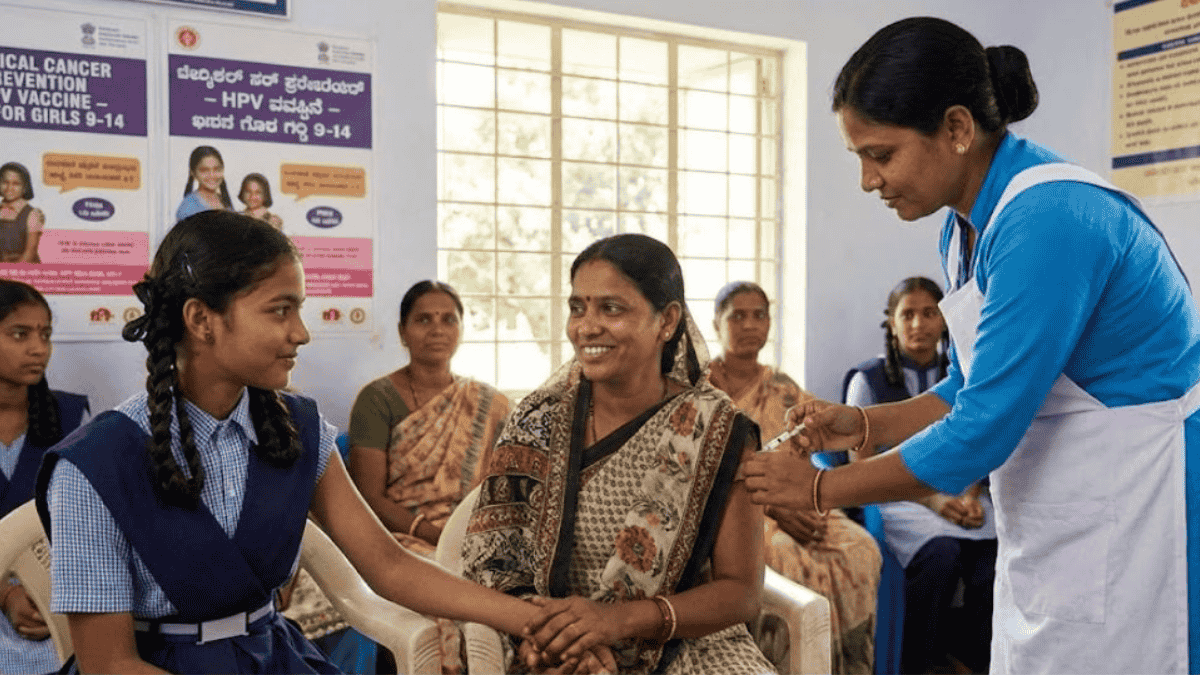
The Union Government is set to launch a nationwide 90-day special HPV vaccination campaign for 14-year-old girls to prevent cervical cancer, with doses provided free of cost at government health facilities. This single-dose campaign will be tracked digitally via the U-WIN portal and is expected to cover an annual cohort of around 1.15 crore girls across India.
Background: Cervical Cancer Burden in India
Cervical cancer is the second most common cancer among women in India, affecting nearly 1.25 lakh women and causing around 75,000 deaths every year. India accounts for roughly one-fifth of global cervical cancer cases and nearly one-fourth of deaths, making it a major public health challenge.
Persistent infection with high-risk HPV types, particularly types 16 and 18, is responsible for approximately 70–85 percent of cervical cancer cases globally and in India. Due to low screening coverage and limited earlier vaccination, India continues to show a high cervical cancer burden, with projections of rising deaths if strong preventive action is not taken.
Key Features of the 90-Day HPV Vaccination Campaign
The current announcement relates to a special time-bound campaign rather than routine Universal Immunisation Programme (UIP) activity, though it aligns with NTAGI’s recommendation to bring HPV vaccine into the UIP.
Key points for exams:
Target group: Girls who are 14 years old at the time of the campaign (annual cohort of ~1.15 crore).
Duration: Initial 90-day special drive across all States and Union Territories.
Dose schedule: Single-dose HPV regimen, in line with WHO’s Strategic Advisory Group of Experts (SAGE) recommendations.
Cost to beneficiary: Completely free at designated government health and wellness centres.
Digital tracking: Registration, slot booking and reporting through the U-WIN portal.
Scale: Government has secured about 2.6 crore HPV vaccine doses, with more than 1 crore doses already supplied to India under the Gavi partnership.
For a broader context on health schemes, aspirants can also refer to:
National Health Programmes in India for UPSC
Women and Child Health Schemes in India
Which HPV Vaccine Will Be Used?
The campaign will use Gardasil-4 (quadrivalent HPV vaccine) manufactured by Merck & Co (MSD outside the US and Canada). Gardasil-4 provides protection against four HPV types: 16 and 18 (major oncogenic types causing most cervical cancers) and 6 and 11 (commonly associated with genital warts).
In the private market, Gardasil-4 typically costs in the range of about ₹3,000–₹4,000 per dose, but under this campaign it will be provided free of cost at government facilities. India has also developed an indigenous HPV vaccine, Cervavac, but it is still in the process of wider global approvals and programme integration, while this campaign will initially rely on Gardasil-4.
Role of Gavi and Vaccine Supply
The Government of India is procuring HPV doses with support from Gavi, the Vaccine Alliance. Under this arrangement, approximately 2.6 crore doses of Gardasil are expected to be supplied by 2027 to sustain the programme.
Officials indicate that more than 1 crore doses have already reached India and have been distributed to all States and Union Territories, along with training for health workers to administer the vaccine. This advance stock and capacity-building is expected to help achieve rapid coverage during the initial 90-day window.
For exam-oriented reading on global health partnerships, you can review:
International Health Organisations and India – UPSC Notes
Registration and Slot Booking via U-WIN Portal
Beneficiaries (or their guardians) will be able to register and book vaccination slots through the U-WIN digital platform. U-WIN is the government’s immunisation tracking portal, designed to record vaccination details and monitor coverage across campaigns and routine immunisation.
Process (as reported so far):
Eligible 14-year-old girls will need to provide age-verification documents during registration.
After verification, a slot can be booked at the nearest government health and wellness centre via the portal.
The vaccine will be administered on designated immunisation days, with post-vaccination observation as per standard protocols.
For digital health initiatives and portals, see:
U-WIN Portal and Digital Health Initiatives – UPSC Notes
Public Health and Policy Context
Cervical cancer prevention through vaccination, screening and early treatment is a pillar of the WHO’s global strategy to eliminate cervical cancer as a public health problem. WHO’s ‘90-70-90’ targets aim for 90 percent of girls to be fully vaccinated against HPV by age 15, 70 percent of women to be screened at least twice in their lifetime, and 90 percent of identified cases to receive treatment.
In India, the National Technical Advisory Group on Immunization (NTAGI) has recommended HPV vaccine introduction into the Universal Immunisation Programme, with a one-time catch-up for 9–14-year-old girls followed by routine vaccination at 9 years of age. The present 90-day drive for 14-year-old girls is a key transitional step towards integrating HPV vaccination more systematically into India’s public health framework.
Exam-Relevant Data and Facts (Quick Revision)
Use the following points for prelims MCQs and mains value addition:
Disease focus: Prevention of cervical cancer (second most common cancer among Indian women).
Causative agent: High-risk types of Human Papillomavirus (HPV), especially types 16 and 18.
Annual burden (India): About 1.23–1.27 lakh new cases and around 75,000–80,000 deaths annually.
Campaign target group: Girls aged 14 years (single cohort), with an estimated 1.15–1.2 crore beneficiaries annually.
Vaccine used: Gardasil-4 (quadrivalent HPV vaccine) – protects against HPV types 16, 18, 6 and 11.
Dosing: Single-dose regimen recommended, in line with WHO SAGE guidance.
Cost: Free at government health facilities; in private market, Gardasil-4 costs roughly ₹3,000–₹4,000 per dose.
Digital platform: U-WIN portal for registration, booking and tracking of vaccinations.
Supply source: Around 2.6 crore doses to be supplied with support from Gavi; over 1 crore doses already delivered.
You can deepen your understanding with:
National Immunisation Programme – UPSC Summary
Linkages with Women’s Health and Social Policy
The drive is being highlighted under broader initiatives such as the “Swastha Nari” vision, which emphasises preventive and equitable healthcare for women. It complements other schemes related to women’s health, nutrition and reproductive care, contributing to Sustainable Development Goals on health (SDG 3) and gender equality (SDG 5).
By reducing the future incidence of cervical cancer, the programme can significantly lower out-of-pocket expenditures and the long-term economic burden on families, especially in low-income households where late-stage cancer treatment is unaffordable. This has direct relevance for questions in social justice, health policy, and inclusive growth.
Why this matters for your exam preparation
For UPSC Prelims, this topic is important under Polity and Governance, Social Sector Initiatives, and Schemes related to Health and Women & Child Development; questions can test details like target group, vaccine type, digital platform (U-WIN), and the role of Gavi. It also links to static areas such as international health organisations (WHO, Gavi), Universal Immunisation Programme, and disease prevention strategies.
For UPSC Mains (GS II and GS III), this campaign provides material for answers on public health policy, preventive healthcare, women’s health, demographic dividend, and the intersection of technology (digital portals) with service delivery. In Essay and interview, you can use this as a contemporary example of how targeted vaccination and global partnerships are used to tackle a high-burden, gender-specific disease in India.