Current Affairs 21 February 2026: MANAV Vision for AI, Supreme Court on Freebies, Gold Investment Craze & India-Bangladesh Relations — UPSC Daily GK Update | Atharva Examwise
The Indian Express UPSC Key for 20 February 2026 covers four major exam-relevant topics: India's MANAV vision for AI governance, the Supreme Court's observations on state freebies, the surge in Indians' gold investment through ETFs, and the evolving India-Bangladesh bilateral relationship. Each of these topics carries significant weight for both UPSC Preliminary and Main examinations across General Studies Papers II and III.
India Unveils 'MANAV' Vision for AI at India AI Impact Summit 2026
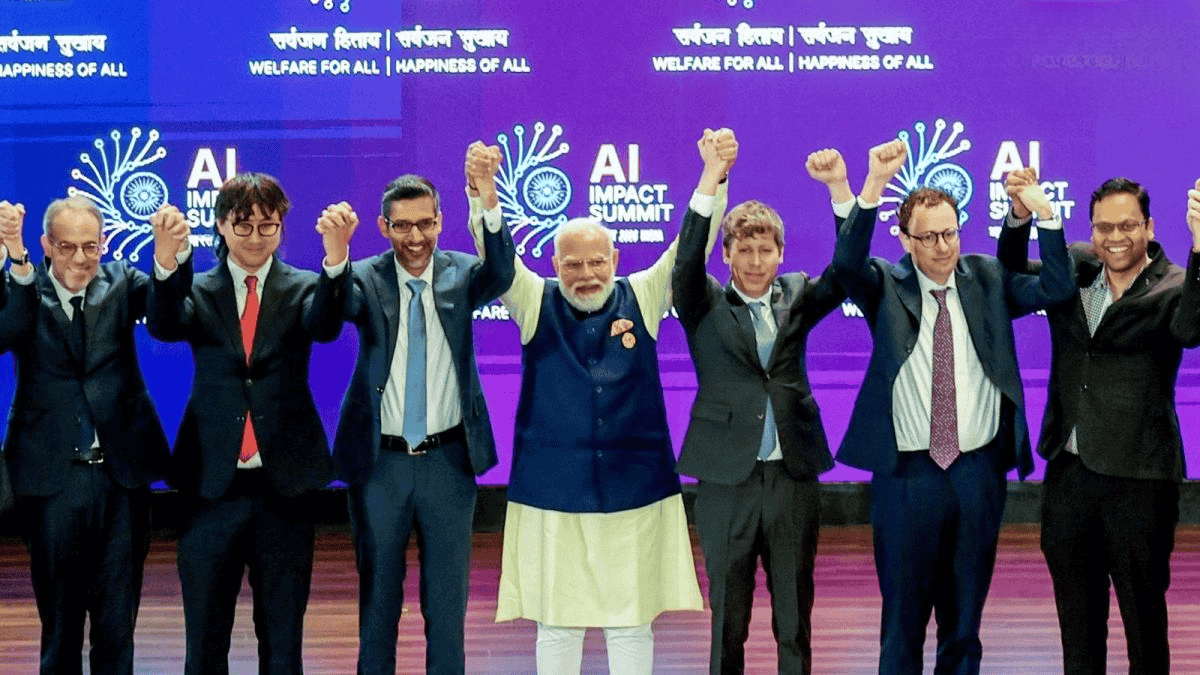
Prime Minister Narendra Modi unveiled the M.A.N.A.V. vision at the India AI Impact Summit 2026, held at Bharat Mandapam, New Delhi, from 16–21 February 2026. The summit was the first global AI summit hosted in the Global South and the fourth in a series after Bletchley Park (2023), Seoul (2024), and Paris (2025).
What is M.A.N.A.V.?
M.A.N.A.V. stands for a five-pillar, human-centric AI governance framework:
PillarFull FormCore FocusMMoral and Ethical SystemsAI built on ethical guidelines, fairness, transparency, and human oversightAAccountable GovernanceTransparent rules, robust oversight via IndiaAI Mission (₹10,300+ crore outlay)NNational SovereigntySecure data, domestic compute capacity, indigenous AI models; India joined the US-led Pax Silica Initiative
AAccessible and Inclusive AIDemocratise AI through Digital Public Infrastructure, MeghRaj GI Cloud, IndiaAI Compute PortalVValid, Safe and Legitimate SystemsVerifiable, lawful, transparent AI; combat deepfakes and synthetic media threats
Key Facts for Prelims
The IndiaAI Mission has been approved with an outlay exceeding ₹10,300 crore.
India plans to add more than 20,000 GPUs to its existing base of 38,000 under the IndiaAI Compute Portal.
Microsoft announced US$50 billion investment by end of decade to bring AI to lower-income countries.
India set a Guinness World Record for the highest number of AI responsibility pledges — 2,50,946 pledges in 24 hours.
PM Modi emphasised "Jiska data, uska adhikar" (whose data, their right) advocating data sovereignty.
Sarvam AI launched 30-billion and 105-billion parameter large language models at the summit.
UPSC Relevance
GS Paper II: Government policies, governance, transparency, and accountability.
GS Paper III: Science & Technology, IT, Artificial Intelligence, ethical concerns.
Essay: Themes like "AI and Human Dignity," "Technology as a Force Multiplier for Inclusive Growth."
For more on India's digital governance strategy, read related articles on Atharva Examwise — Science & Technology.
Supreme Court Flags 'Appeasement' in Poll-Time Freebies
The Supreme Court (CJI Surya Kant bench) chastised state governments for distributing freebies indiscriminately, questioning whether states are following an "appeasement" policy ahead of elections without regard for the public exchequer.
Key Points
The Court questioned why freebies benefit the affluent disproportionately: "Why do freebies come to [the affluent's] pockets first?"
States running on fiscal deficit continue distributing free goods, crowding out capital expenditure.
India's state fiscal deficit rose to 3.2% of GDP in FY25.
Over the past decade, India's welfare system has shifted from ration shops and public works to digital transfers and women-focused income support, particularly accelerating after 2020.
The Freebies Debate — Multi-Dimensional View
Arguments For FreebiesArguments Against FreebiesAddresses poverty & inequality
Fiscal stress on deficit-ridden states
Free education, health = human capital investmentCrowds out capital expenditure
DPSP mandate (Articles 38, 39, 41)
Benefits affluent disproportionately
Targeted schemes reduce deprivationElectoral motivation over policy rationale
Way Forward (as suggested by experts)
Strengthen means-testing using Jan Dhan–Aadhaar–Mobile (JAM) trinity for targeted delivery.
States should publish "Freebie Fiscal Reports" showing cost, coverage, and crowding-out impact.
Empower State Finance Commissions and CAG to audit welfare vs. populist spending.
Use conditional cash transfers instead of blanket freebies for efficient resource allocation.
UPSC Relevance
GS Paper II: Welfare schemes, role of judiciary, separation of powers.
GS Paper III: Government budgeting, fiscal policy, inclusive growth.
Previous Year Question (UPSC 2022): "Distinguish between a 'right' and a 'freebie'. Critically examine the welfare implications of freebies."
For detailed analysis on governance topics, visit Atharva Examwise — Polity & Governance.
Indians' Gold Investment Craze: ETF Inflows Surge
Indians' gold investment behaviour is undergoing a structural shift, with investment demand increasingly replacing jewellery demand and placing pressure on the economy through rising gold imports.
Key Data Points
In January 2026, Indians invested more in gold ETFs than equity mutual funds for the first time — gold ETF inflows hit an all-time high of ₹24,040 crore, while equity mutual fund investments fell to ₹24,029 crore.
India's gold ETFs bought a record 15.52 tonnes of gold in January 2026, nearly equal to the previous three months combined.
Gold imports tripled from December to $12.07 billion in January 2026.
In 2025, gold ETF investments surged by 283% year-on-year.
Jewellery demand dropped 24% in 2025, totalling 430.5 metric tonnes — the lowest in nearly 30 years (excluding COVID year 2020).
Investment demand rose 17% in 2025 to 280.4 tonnes, representing a record ~40% of India's overall gold consumption (versus the typical 25%).
Why Are Indians Rushing to Gold?
Equity market underperformance: India's Nifty50 saw only a 10.5% increase in 2025 compared to gold's 76% domestic price surge.
Global volatility: Geopolitical conflicts, tariff uncertainties, and policy unpredictability are pushing investors toward safe-haven assets.
Discontinuation of Sovereign Gold Bonds (SGBs): The SGB scheme was discontinued in early 2024 as rising gold prices made it expensive for the government (paying ~₹18,000 crore/year in interest and maturing bonds).
RBI's own gold accumulation: India's gold reserves rose to 880 tonnes in 2025, accounting for 13.9% of total forex reserves.
Economic Impact
The surge in gold purchases is "tantamount to exports of capital from the country", according to Kotak Institutional Equities analysts.
Household savings are shifting: bank deposits fell from 35% of financial assets (2022-23) to 33% (2024-25), while mutual fund and equity investments doubled from 7% to 15%.
UPSC Relevance
GS Paper III: Indian economy — savings, capital formation, current account deficit, forex reserves.
Prelims: World Gold Council, Sovereign Gold Bonds, Gold ETFs, Gold Monetisation Scheme.
Previous Year Question (UPSC 2016): "What is/are the purpose/purposes of the Government's 'Sovereign Gold Bond Scheme' and 'Gold Monetization Scheme'?"
Explore more economy-focused content at Atharva Examwise — Economy.
India-Bangladesh Relations: Navigating the Post-Hasina Reset
The BNP's landslide victory in Bangladesh's 12 February 2026 elections — with a two-thirds parliamentary majority — marks a major turning point for India-Bangladesh bilateral relations.
Recent Developments
Tarique Rahman was sworn in as Bangladesh's new Prime Minister after the Bangladesh Nationalist Party (BNP) won decisively.
PM Modi promptly congratulated Rahman, signalling India's readiness to engage constructively.
India's historically close ties with the Awami League under Sheikh Hasina, and Hasina's continued presence in India, remain politically sensitive.
India halved its financial assistance to Bangladesh in its latest budget, reflecting strained ties.
The Jamaat-e-Islami saw a significant rise in seats.
Key Challenges for India
Hasina Extradition Issue: Bangladesh sentenced Hasina to death; India has refused extradition on grounds of "political character" of the offence.
Anti-India Sentiment: Growing anti-India rhetoric and attacks on minorities (including Bangladesh's 13 million-strong Hindu population) have escalated tensions.
China's Growing Influence: BNP has historically prioritised closer links with China; Bangladesh's outreach to Beijing and Islamabad is a concern.
Security Concerns: Risks of insurgent groups using Bangladeshi soil; India maintains zero-tolerance policy.
Opportunities for Bilateral Engagement
Bangladesh is India's largest trading partner in South Asia, with strong ties in textiles, energy, and connectivity projects.
Infrastructure and connectivity projects linking Northeast India to Bangladesh must continue.
Strengthening people-to-people ties through improved visa regimes for medical tourism and education.
India's Neighbourhood First policy is being tested; pragmatic diplomacy and clear security "red lines" are essential.
UPSC Relevance
GS Paper II: India and its neighbourhood — bilateral relations, diplomacy, regional security.
Prelims: India-Bangladesh treaties, Teesta water dispute, Land Boundary Agreement, connectivity projects.
Mains: Analyse the impact of political transitions in Bangladesh on India's neighbourhood policy.
Read more on international relations at Atharva Examwise — International Relations.
Why This Matters for Your Exam Preparation
These four topics from the Indian Express UPSC Key (20 February 2026) are directly aligned with the UPSC Civil Services syllabus and are highly likely to feature in both Prelims MCQs and Mains answer-writing questions:
MANAV Vision for AI connects to Science & Technology (GS-III) and Governance (GS-II). With the India AI Impact Summit 2026 being the first global AI summit in the Global South, expect questions on India's AI policy framework, ethical governance, and digital public infrastructure.
Supreme Court on Freebies is a perennial UPSC favourite. The welfare-vs-populism debate touches fiscal policy (GS-III), constitutional provisions like DPSPs (GS-II), and judiciary's role in governance. Practice answer writing on this theme using the multi-dimensional arguments outlined above.
Gold Investment Surge is critical for understanding India's current account dynamics, household savings patterns, and forex reserves management. Key terms like Gold ETFs, SGBs, Gold Monetisation Scheme, and World Gold Council are important for Prelims.
India-Bangladesh Relations test understanding of India's Neighbourhood First policy, the geopolitics of South Asia, and the implications of political transitions in neighbouring countries. This is a high-probability topic for GS-II Mains.
Pro Tip: For Mains preparation, practice writing 250-word answers on each of these topics using data points and analytical frameworks discussed above. Bookmark this page and revisit it as part of your daily current affairs revision on Atharva Examwise.
This article is part of the daily current affairs series by Atharva Examwise (www.atharvaexamwise.com) — your trusted companion for UPSC and competitive exam preparation. For more daily GK updates, exam strategies, and subject-wise preparation resources, visit our website.