Biggest Solar Storm in 23 Years Strikes Earth: Current Affairs for UPSC January 2026
Introduction: A Celestial Reminder of Earth's Vulnerability
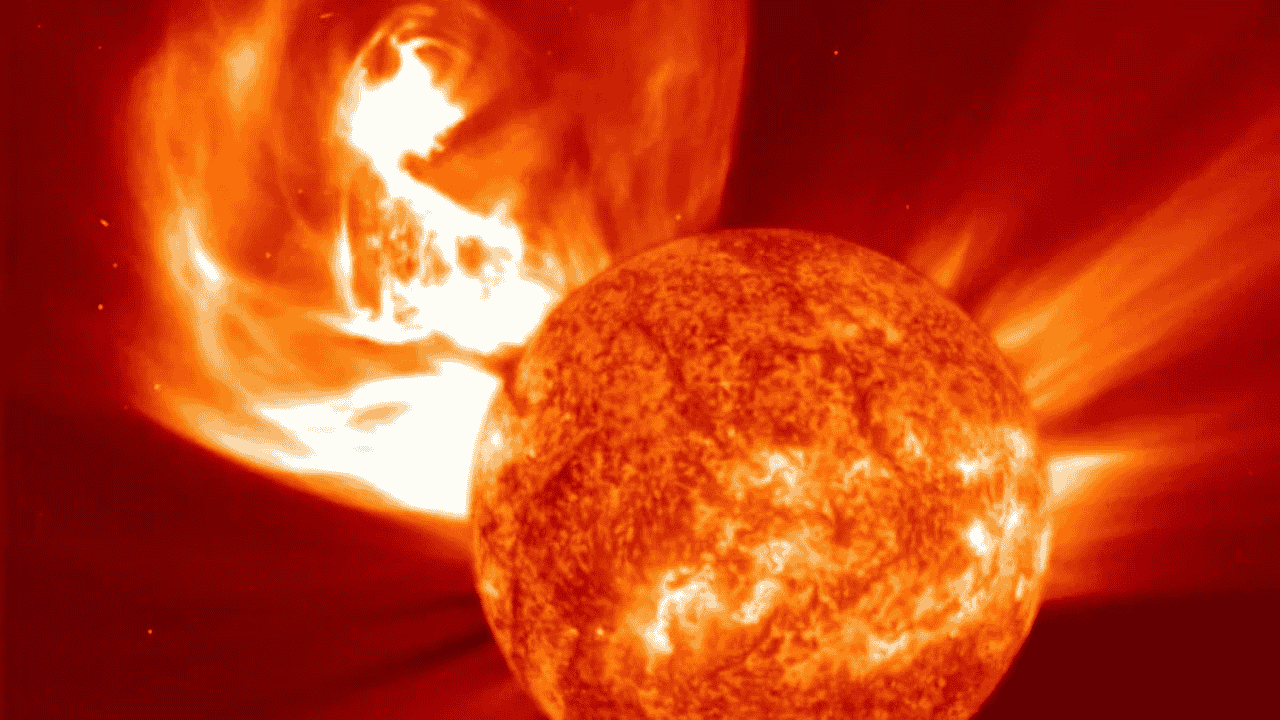
On January 18-20, 2026, Earth experienced an extraordinary cosmic event—the strongest solar radiation storm in over two decades. The National Oceanic and Atmospheric Administration (NOAA) confirmed a severe S4-level solar radiation storm following a powerful X1.9 class solar flare and its associated coronal mass ejection (CME). The geomagnetic disturbance that followed produced spectacular auroras visible across unexpected latitudes, from the United States Midwest to the United Kingdom, reminding humanity of the Sun's immense power and our dependence on space weather forecasting. For UPSC aspirants, this event underscores critical concepts in Science & Technology (GS Paper III), particularly regarding space weather, solar physics, and India's emerging capabilities in solar observation through the Aditya-L1 mission.
Understanding Solar Storms: The Physics Behind the Phenomenon
What are Solar Flares and Coronal Mass Ejections?
A solar flare is a sudden, explosive release of electromagnetic radiation from the Sun's surface, typically occurring above sunspots—dark regions where twisted magnetic fields become unstable. The energy released is equivalent to millions of nuclear bombs, sending high-speed particles and radiation across space at speeds approaching the speed of light.
A Coronal Mass Ejection (CME) is distinct yet often accompanies solar flares. It is a large eruption of magnetized plasma from the Sun's outer atmosphere (corona) that can eject billions of tons of material into interplanetary space at speeds exceeding 1,700 km/s. During the January 2026 event, the CME was observed by SOHO satellites traveling at approximately 1,700 km/s, reaching Earth's magnetosphere within 25 hours of its release.
Key distinction: Not all solar flares produce CMEs, and not all CMEs originate from flares, though they are often correlated through the process of magnetic reconnection—the sudden realignment of solar magnetic field lines that release accumulated electromagnetic energy.
Solar Radiation Storms: The January 2026 Event
The solar radiation storm of January 18-20, 2026, reached S4 (Severe) severity on NOAA's five-point scale (S1 to S5), making it the strongest recorded since October 2003. Key facts about this event:
| Aspect | Details | Reference |
|---|---|---|
| Classification | S4 Severe (second-highest on 5-point scale) | |
| Trigger Event | X1.9 class solar flare (most powerful type) | |
| Associated CME | Yes, observed by SOHO on January 18 | |
| Travel Speed | ~1,700 km/s (initial estimate: 1,400 km/s) | |
| Arrival at Earth | January 19-20, 2026, within 25 hours | |
| Geomagnetic Storm Level | G4 (Severe) reached twice (2:38 PM EST Jan 19; 3:23 AM EST Jan 20) | |
| Last Comparable Event | October 2003 (also S4-level radiation storm) | |
| Duration | Multiple hours of intense activity | |
Why does this matter? High-energy solar particles in radiation storms are composed of protons, electrons, and alpha particles capable of damaging spacecraft electronics, producing secondary particles in Earth's atmosphere that cause errors in electronic systems, and posing health risks to astronauts in space.
The Role of Solar Cycles: Why 2026 is a Peak Activity Year
Solar activity follows an approximately 11-year cycle, tracked by counting sunspots—dark patches on the Sun caused by concentrated magnetic fields. The current cycle (Cycle 25) began in December 2019 and unexpectedly became much stronger than initially predicted.
Solar Cycle 25 Timeline:
Start: December 2019
Peak: October 2024 (smoothed sunspot number: 161)
Expected End: ~2030
2024 Activity: Over 50 X-class solar flares recorded
2025 Activity: 19 X-class flares by November (lower than 2024 but still significant)
January 2026: Continued active period despite passing technical peak
The Sun approaches solar maximum differently than terrestrial maxima—it remains highly active for extended periods. This explains why January 2026 still produces severe storms months after the technical peak. Scientists emphasize that Cycle 25 has defied weak-cycle predictions, delivering a stronger cycle than Cycle 24.
Aurora Formation: When Solar Wind Meets Earth's Magnetosphere
The January 2026 solar storm produced one of the most visually stunning consequences—auroras visible at unusually low latitudes, including parts of the United States Midwest, California, and northern Europe.
The Science of Auroras
Auroras form through a complex sequence of interactions:
Solar Wind Interaction: The Sun continuously emits a stream of charged particles (solar wind). During geomagnetic storms, this solar wind increases dramatically in speed and intensity.
Magnetospheric Connection: When the interplanetary magnetic field (IMF) embedded in the solar wind aligns southward—opposite to Earth's magnetic field—magnetic reconnection occurs. This creates "open" magnetic field lines connecting Earth's magnetosphere to the solar wind.
Particle Acceleration: Magnetospheric electrons already trapped by Earth's magnetic field are accelerated to high energies by electric fields in the auroral acceleration region.
Atmospheric Collision: These accelerated electrons follow Earth's magnetic field lines toward the north and south magnetic poles, bombarding the upper atmosphere at altitudes of 100-300 km.
Light Emission: When high-energy electrons collide with atmospheric gases—primarily nitrogen (N₂) and oxygen (O₂)—they ionize and excite these atoms, causing them to emit light in various colors:
Green and red: Oxygen emissions (most common)
Blue and purple: Nitrogen emissions
Rare red auroras: High-altitude oxygen excitation
Why visible at low latitudes? During extreme geomagnetic storms (G4 and G5 levels), the auroral oval—the ring-shaped region centered on magnetic poles—expands dramatically equatorward, bringing auroras to populated regions that rarely experience them.
Space Weather Impacts: Beyond the Beautiful Auroras
While auroras inspire awe, solar storms pose genuine risks to modern infrastructure and operations. The January 2026 event demonstrated these vulnerabilities:
Satellite and GPS Systems
High-energy particles can directly damage satellite electronics, while atmospheric heating during geomagnetic storms causes satellite drag. The increased atmospheric density extends hundreds of kilometers above Earth, slowing satellites and altering their orbits. GPS receivers experienced temporary errors and signal degradation, affecting navigation-dependent systems.
Power Grids and Electrical Infrastructure
Geomagnetic storms induce electrical currents in long power transmission lines, causing voltage fluctuations and potential transformer failures. The 2003 Halloween Storms (G5 level) caused significant blackouts across North America and Europe. Ground-based infrastructure with long conductors is particularly vulnerable.
Aviation and Radiation Exposure
Airlines operating polar routes—which save significant fuel and time—were forced to reroute flights during the storm to reduce crew and passenger radiation exposure. Astronauts in the International Space Station require additional shielding during severe events.
Communication Systems
Shortwave radio communications used by aircraft over polar regions were disrupted, and satellite-based communication systems experienced temporary outages.
Critical Point for Exam Preparation:
Contrary to popular misconceptions, solar storms do NOT cause tsunamis, earthquakes, or forest fires on Earth's surface. Solar radiation is absorbed by Earth's protective magnetosphere and thick atmosphere, preventing direct surface impact.
India's Response: The Aditya-L1 Mission
As the January 2026 solar storm unfolded, India's first dedicated solar mission, Aditya-L1, positioned 1.5 million kilometers away at the Sun-Earth Lagrange Point 1 (L1), provided unprecedented observations of the event. This mission represents India's strategic response to space weather challenges.
Mission Objectives and Unique Positioning
Launched on September 2, 2023, Aditya-L1 orbits in a halo pattern around the Sun-Earth L1 point—a gravitationally balanced region where a satellite can maintain position with minimal fuel expenditure. This location offers advantages over Low Earth Orbit observations:
Continuous monitoring: Uninterrupted view of the Sun without Earth's blocking (unlike terrestrial satellites)
Early warning: 30-60 minutes advance notice of dangerous solar wind conditions before reaching Earth
Scientific precision: Allows tracking solar storms from their origin on the Sun's surface
Aditya-L1 Payloads and Capabilities
The mission carries seven scientific instruments—four for remote sensing and three for in-situ measurement:
| Remote Sensing Payloads | Function |
|---|---|
| Visible Emission Line Coronagraph (VELC) | Studies solar corona dynamics; observes CME development; simulates Moon's size to continuously study corona (unique advantage) |
| Solar Ultraviolet Imaging Telescope (SUIT) | Captures photosphere and chromosphere in near-UV wavelengths; measures solar irradiance variations |
| Aditya Solar Wind Particle Experiment (ASPEX) | Studies solar wind particles and energetic ions; analyzes energy distribution |
| Plasma Analyzer Package for Aditya (PAPA) | Measures plasma characteristics in interplanetary space |
Critical capability during solar storms: Unlike other solar observatories, Aditya-L1's VELC coronagraph can measure the temperature and energy of CMEs in visible light, providing critical information about CME strength before they reach Earth.
2026: A Banner Year for Aditya-L1
For the first time, Aditya-L1 observes the Sun at solar maximum, coinciding with Cycle 25's peak. Scientists are analyzing the largest CMEs recorded by the mission in collaboration with NASA to refine space weather forecasting. The January 2026 event provided real-world validation of the mission's capabilities.
Why This Matters for Your Exam Preparation
UPSC Syllabus Relevance
This topic intersects multiple GS Paper III domains:
1. Science & Technology (Space Exploration)
Understanding solar missions and India's space capabilities
Positioning of space infrastructure (Lagrange points, halo orbits)
Instrumentation and scientific methodology
2. Environment & Climate Change
Space weather's impact on Earth's systems
Solar radiation and atmospheric dynamics
Climate observation satellite disruptions
3. Infrastructure and Development
Space weather preparedness for critical infrastructure
Insurance and risk management implications
Technological resilience
Expected UPSC Prelims Questions (Pattern Analysis)
Based on UPSC's 2022 Question 40 (solar flares), potential 2026-2027 questions may include:
Question Type 1: Multi-Statement (UPSC Prelims 2022 Pattern)
"If a major solar storm reaches Earth, which of the following are possible effects?
GPS and navigation systems could fail
Auroras could occur at unusual latitudes
Power grids could experience voltage fluctuations
Tsunamis could occur at equatorial regions
Satellite orbits could be disturbed"
Correct Answers: Statements 1, 2, 3, and 5 (NOT 4—tsunamis are not caused by solar storms)
Question Type 2: Mission-Specific (Given Aditya-L1's Prominence)
"With reference to Aditya-L1, which of the following statements is/are correct?
It is positioned at the Sun-Earth Lagrange Point 1 (L1)
It provides 30-60 minutes of advance warning for space weather events
Its primary objective is mapping lunar craters
It carries only remote-sensing instruments"
Correct Answers: Statements 1 and 2 only
Question Type 3: Concept-Based (Likely for Mains)
"Space weather forecasting is as much an economic and disaster-management need as a scientific pursuit. Discuss India's approach to space weather resilience, including the role of Aditya-L1 and necessary policy frameworks."
Mains Answer Structure:
Context: Recent solar storms and infrastructure vulnerabilities
Risks: GPS, power grids, aviation, communication systems
Aditya-L1 capabilities: Early warning, continuous monitoring, advanced instrumentation
Roadmap: Observe → Model → Deliver forecasts → Industrialize applications → International cooperation
Policy needs: Standardized warning systems, resilience protocols, coordination with NOAA/ESA
Key Concepts to Master
Solar Cycle: 11-year cycle of magnetic activity; Cycle 25 peaked October 2024
Solar Flares: X-class (most powerful), M-class, C-class, B-class classifications
CME vs. Flares: Related but distinct phenomena; not always correlated
Geomagnetic Storm Scale: G1 (Minor) to G5 (Extreme); January 2026 reached G4
Solar Radiation Storm Scale: S1 (Minor) to S5 (Extreme); January 2026 was S4
Auroras: Result of solar wind-magnetosphere interaction, not caused by solar surface events
Lagrange Points: Gravitationally balanced positions in Earth-Sun system (L1 most useful for solar observation)
Space Weather Impacts: Satellites, GPS, power grids, aviation, communications—BUT NOT surface weather/earthquakes
Common Misconceptions to Avoid
❌ Auroras are caused by radiation directly from solar flares
✅ Auroras result from solar wind interaction with magnetospheric particles
❌ Solar storms cause surface weather changes or tsunamis
✅ Solar storms affect upper atmosphere and near-Earth space only
❌ All solar flares produce CMEs
✅ CMEs sometimes accompany flares; their relationship remains incompletely understood
❌ Aditya-L1's primary mission is lunar observation
✅ Aditya-L1 is dedicated to solar corona study and space weather monitoring
Global and Indian Context
International Space Weather Monitoring
The January 2026 event was tracked by multiple agencies:
NOAA Space Weather Prediction Center (SWPC): Real-time classification and forecasting
ESA Space Weather Office: European Space Agency monitoring and data analysis
NASA Solar Dynamics Observatory (SDO): Continuous solar imaging via AIA instrument
SOHO: Joint ESA-NASA solar observatory already positioned at L1
India's Strategic Positioning
Aditya-L1 represents India's entry into solar physics as an independent capability, complementing global efforts and providing crucial data for Indian infrastructure protection. The mission demonstrates:
ISRO's ability to execute complex deep-space missions
India's expertise in spacecraft design and instrumentation
Capacity for long-term scientific observation missions
Positioning to contribute to global space weather knowledge
Conclusion: From Observation to Action
The January 2026 solar storm—one of the strongest in 23 years—demonstrated both the Sun's awesome power and humanity's vulnerability in an increasingly technology-dependent world. It also showcased the value of space weather forecasting infrastructure. India's Aditya-L1 mission, observing the solar system's most energetic events from its optimal vantage point, exemplifies how scientific investment translates to national resilience.
For UPSC aspirants, mastering this topic requires understanding the physics of solar phenomena, appreciating India's technological capabilities, and recognizing the intersection of science, infrastructure, and policy. The increasing frequency of space weather events as Solar Cycle 25 remains active ensures this will remain current affairs—and likely examination—fodder for years to come.
Why This Matters for Your Exam Preparation
Relevance Score: ⭐⭐⭐⭐⭐ (High Priority)
Current Affairs Connection: January 2026 event is extremely recent and UPSC often tests recent, globally significant scientific events
Aditya-L1 Momentum: India's space missions consistently appear in UPSC questions; Aditya-L1 is India's newest major mission
Infrastructure Impact: Government sensitivity to critical infrastructure protection aligns with UPSC's focus on development and governance
Multi-Disciplinary: Touches GS Paper III (science), environmental science, technology, and policy
Historical Questions: UPSC previously asked about solar flares (2022 Q40); repetition with updated context is likely
Interview Material: Strong answer potential for personality test interviews discussing India's tech capabilities
Preparation Strategy:
Memorize Aditya-L1's mission parameters, payloads, and unique advantages
Understand the distinction between solar flares, CMEs, and geomagnetic storms
Practice UPSC-style MCQ questions on this topic
Develop a mains answer framework linking space weather to India's policy priorities
Follow NOAA and ISRO updates as Solar Cycle 25 remains active through 2026-2027