
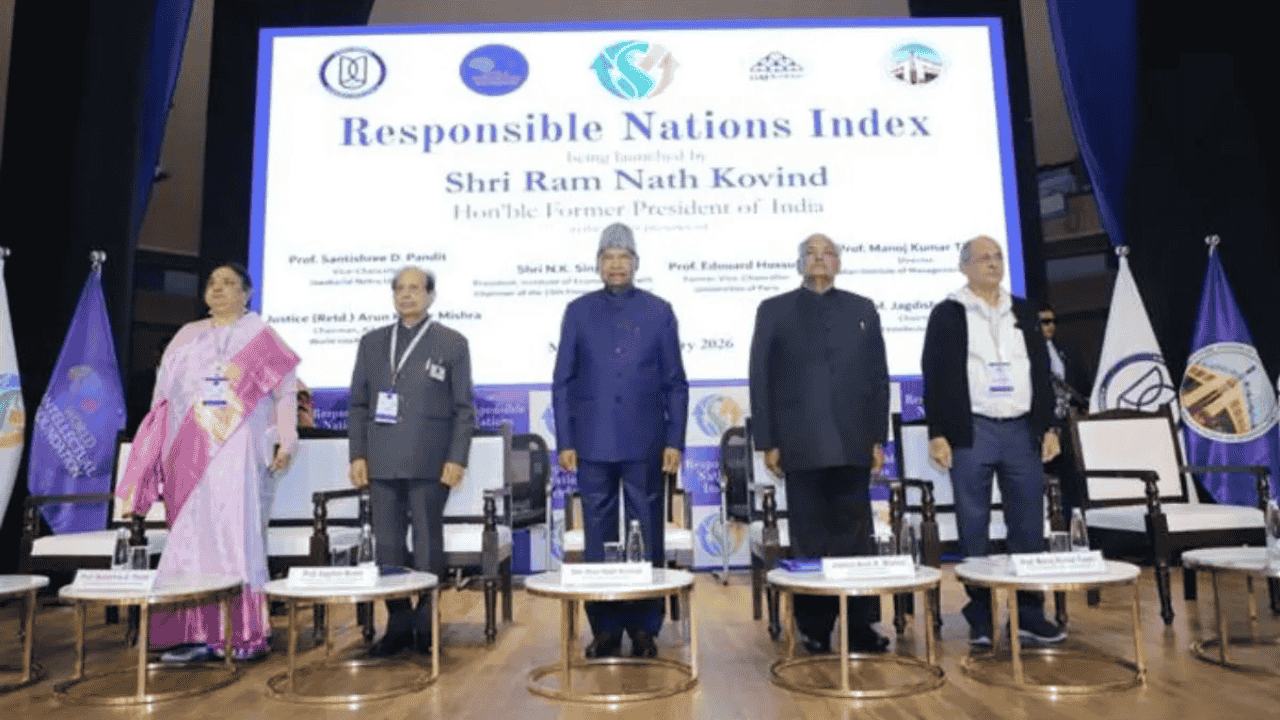
India Ranks 16th in Responsible Nations Index 2026: Current Affairs for UPSC & Competitive Exams
Understanding the Responsible Nations Index (RNI)
The Responsible Nations Index is a comprehensive global assessment framework that evaluates how countries fulfill their responsibilities toward three critical stakeholders: citizens, the environment, and the international community. Developed by the World Intellectual Foundation, this index ranks 154 nations based on their commitment to sustainable development, accountability, and global cooperation.
What Does the RNI Measure?
The index assesses national responsibility across multiple dimensions:
Citizen welfare: Healthcare, education, social security, poverty reduction
Environmental stewardship: Climate action, biodiversity conservation, pollution control, sustainable resource management
International commitments: UN conventions compliance, diplomatic participation, development assistance, peacekeeping contributions
RNI Scoring Scale: How It Works
| Score Range | Classification | Interpretation |
|---|---|---|
| 0.55 and above | Good | Strong responsibility record |
| 0.45–0.55 | Moderate | Mixed performance across dimensions |
| Below 0.45 | Poor | Significant accountability gaps |
This scoring mechanism helps aspirants understand that nation-building isn't just about domestic development—it requires balanced attention to environmental sustainability and international cooperation.
India's Position: 16th Rank with 0.56 Score
India's current standing:
Global Rank: 16th out of 154 countries
Score: 0.56 (classified as "Good")
Significance: India's score exceeds the 0.55 threshold, placing it firmly in the "responsible nations" category
This ranking reflects India's multi-dimensional development efforts:
Citizen-centric policies: NREGA, AYUSH, Skill India, Jan Dhan Yojana
Environmental initiatives: Renewable energy targets (500 GW by 2030), Green India Mission, National Action Plan on Climate Change
Global leadership: G20 presidency (2023), BRICS membership, UN Security Council participation, developmental assistance to Global South nations
Key insight for exam takers: India's 16th rank demonstrates that despite development challenges, the nation is recognized globally for balancing growth with responsibility—a critical theme in UPSC General Studies (GS) Paper 2 and Paper 3 on governance and sustainability.
Global Top 5: How India Compares
| Rank | Country | Score | Key Characteristics |
|---|---|---|---|
| 1st | Singapore | 0.619 | City-state governance excellence, strict environmental regulations |
| 2nd | Switzerland | 0.586 | Prosperity, neutrality, strong social systems |
| 3rd | Denmark | 0.583 | Green energy transition, high quality of life |
| 4th | Cyprus | 0.577 | EU integration, environmental focus |
| 5th | Sweden | 0.573 | Welfare state, renewable energy leadership |
| 16th | India | 0.56 | Large-scale development with responsibility |
Analysis: The top performers are predominantly developed nations with strong institutions, high per-capita income, and advanced welfare systems. India's 16th rank is notable because it achieved this score while managing:
A population of 1.4+ billion
Regional development disparities
Climate vulnerability as a developing nation
Dual responsibility as a climate victim and emerging economy
How Major Nations Compare on Responsibility Index
| Country | Rank | Score | Context |
|---|---|---|---|
| Germany | 12 | 0.557 | EU leader in environmental policy |
| United Kingdom | 25 | 0.538 | Post-Brexit governance challenges |
| Japan | 38 | 0.529 | Aging population, cautious international role |
| United States | 66 | 0.508 | Polarized domestic policies, unilateral decisions |
| China | 68 | 0.505 | Large economy, environmental concerns, sovereignty-focused approach |
Critical observations:
Developed nations dominate: 8 of the top 10 are developed economies
China's position: Tied with USA at 0.505, reflecting tensions between economic growth and environmental responsibility
USA's lower rank: Reflects divergent policies on climate change and international commitments
India's competitiveness: India outranks major powers like Japan (38), USA (66), and China (68), positioning it as a "responsible emerging economy"
What Makes India's Ranking Significant?
1. Emerging Economy Leadership
India's 0.56 score places it among the most responsible large developing nations. Unlike developed countries, India must balance:
Lifting 415 million people out of poverty (World Bank, 2023)
Creating jobs for a demographic dividend of 1.4 billion
Meeting climate commitments while ensuring energy security
2. Environmental Commitments
India's ranking reflects concrete actions:
Paris Agreement target: 43% reduction in emissions intensity by 2030 (baseline: 2005)
Renewable energy: 200+ GW installed capacity; target: 500 GW by 2030
International Solar Alliance: Leadership in global green energy coordination
National Biodiversity Action Plan: Protection of 5% of land area through conservation
3. Social Responsibility Programs
NREGA: 275 million person-days of employment (2023-24)
Ayushman Bharat: Free healthcare to 550+ million citizens
Mid-Day Meal Scheme: Nutrition support to 100+ million children
Right to Education Act: Near-universal school enrollment
4. International Commitments
UN Peacekeeping: India deploys 5,900 personnel across operations
G20 presidency: Advocating for sustainable development finance
South-South cooperation: Development assistance to 160+ countries
Climate finance mobilization: Supporting vulnerable nations
Limitations and Critiques of the RNI
While the Responsible Nations Index provides valuable insights, aspirants should be aware of its limitations:
| Limitation | Impact on Analysis |
|---|---|
| Methodology opacity | World Intellectual Foundation doesn't fully disclose weighting of indicators |
| Data availability gaps | Some developing nations may have outdated statistics |
| Developed-nation bias | Index may favor countries with advanced reporting systems |
| Context blindness | Doesn't account for nations recovering from conflict or disaster |
| Single snapshot | Annual rankings don't capture progress over time |
For exam purposes: While this index is useful for current affairs, candidates should cross-reference it with other development metrics (HDI, GPI, Environmental Performance Index) for comprehensive analysis.
Implications for India's Global Standing
Positive Signals
Soft power boost: Responsible nations rating enhances India's diplomatic credibility
FDI confidence: Shows institutional stability to foreign investors
Climate leadership: Supports India's positioning as a climate-conscious economy
Emerging market appeal: Attracts ESG-focused capital and partnerships
Areas for Improvement (Based on Ranking)
Narrowing development gaps: Regional inequality still persists
Judicial efficiency: Case backlogs impact governance score
Air quality: Delhi-NCR and industrial regions need stricter enforcement
Waste management: Urban sanitation requires acceleration
Gender equality: Women's safety and workforce participation need attention
Why This Matters for Your UPSC & Competitive Exam Preparation
1. Current Affairs Relevance
This index appears frequently in UPSC CSE Mains (GS Paper 2 & 3) related to governance, development, and international relations
Competitive exams often ask: "Which country ranked #1 in Responsible Nations Index?" or "What is India's responsibility score in RNI?"
2. Interconnected Themes for Exam Success
GS Paper 2 (Governance & International Relations):
National responsibility frameworks
India's role in global governance
Accountability mechanisms in democracy
CSR and corporate governance
GS Paper 3 (Economic & Environmental Development):
Sustainable development goals (SDGs) alignment
Climate action commitments
Development programs and their impact
Environmental conservation policies
GS Paper 1 (History & Culture):
India's historical responsibility toward neighboring nations
Cultural diplomacy and soft power
3. Answer-Writing Strategy
When answering exam questions, use this framework:
Cite India's specific rank and score
Compare with global peers
Link to India's development goals (SDGs, National Action Plan on Climate Change)
Mention concrete programs (NREGA, Ayushman Bharat)
Discuss policy implications
Sample exam question:
"Evaluate India's performance on national responsibility metrics. How does India's responsibility index ranking reflect its development strategy?"
Expected answer elements:
RNI rank and score
Key responsibility dimensions
Comparative analysis with developed and developing nations
India's unique development challenges
Policy responses and outcomes
4. Interview Preparation (UPSC IAS Interview)
Responsible Nations Index discussions in the interview can showcase:
Understanding of global development frameworks
Knowledge of India's social and environmental policies
Awareness of international cooperation mechanisms
Critical thinking on development trade-offs
5. Optional Reading for Depth
World Intellectual Foundation reports (primary source)
UN Sustainable Development Report
India's Nationally Determined Contributions (NDCs)
State of India's Environment report by CSE
Quick Revision Checklist
Before your exam, ensure you can answer:
What is India's rank and score in the Responsible Nations Index?
Name 3 countries in the top 5 of RNI
How does RNI scoring work? (What is the "good" threshold?)
How does India's ranking compare to China and USA?
What are India's key responsibility initiatives (environmental, social, global)?
Which UPSC paper typically covers national responsibility frameworks?
How do India's development programs contribute to its RNI ranking?
Conclusion
India's 16th position in the Responsible Nations Index with a 0.56 score is a significant testament to the nation's commitment to balanced development. While developed nations like Singapore and Switzerland lead in responsibility metrics, India's achievement is notable given its scale, complexity, and development challenges.
For UPSC and competitive exam aspirants, the RNI framework offers a comprehensive lens to evaluate national development, governance quality, and India's role in global affairs. By understanding this index and its implications, you'll be better prepared to answer nuanced questions on India's development strategy, environmental commitments, and international standing.
Stay updated with Atharva Examwise for daily current affairs coverage and in-depth analysis tailored for your exam success.