
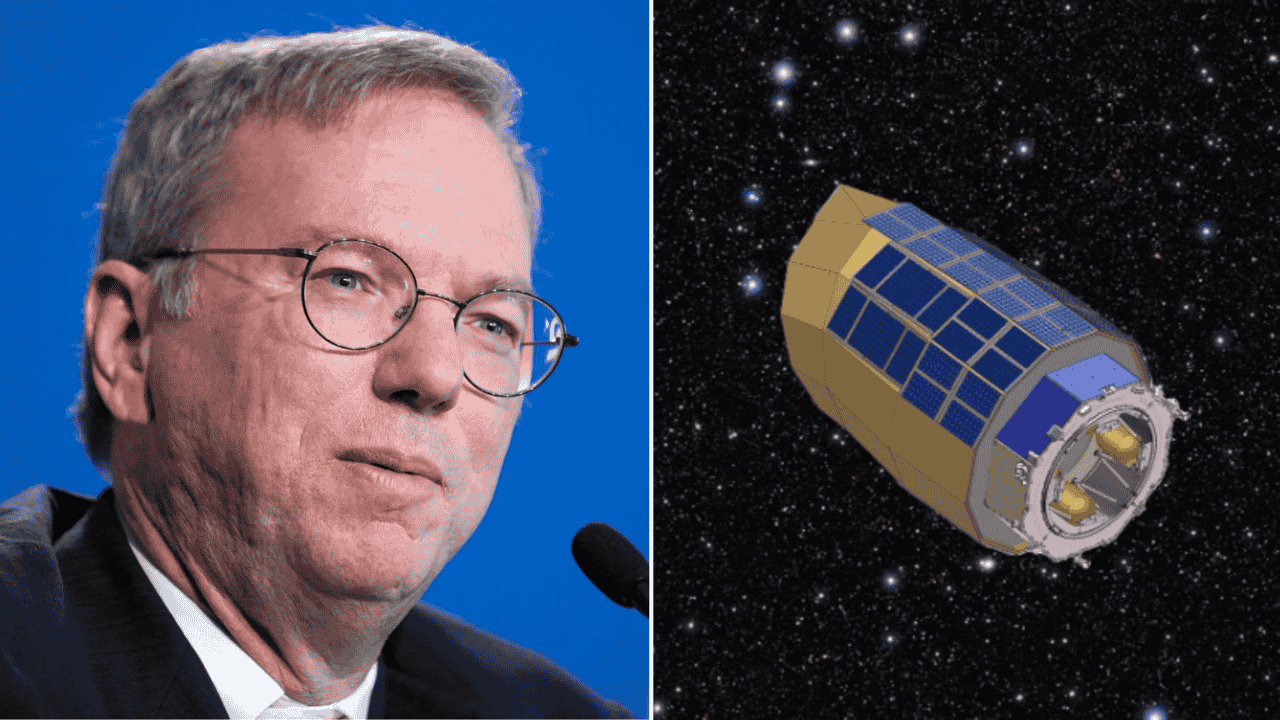
Eric Schmidt's Cosmic Observatory: Google's Former CEO's Revolutionary Space Telescope & Observatory Network | UPSC Current Affairs 2026
Eric Schmidt's Cosmic Observatory: A Game-Changing Approach to Modern Astronomy
Last updated: January 14, 2026
Introduction: The "Cosmic Search Engine" Concept
In January 2026, at the American Astronomical Society's 247th meeting, Eric Schmidt, former CEO of Google, and his wife Wendy Schmidt announced a groundbreaking initiative through their organization Schmidt Sciences. Rather than building a single observatory, they are funding an integrated network of four telescopes—one space-based and three ground-based—that together function like a "cosmic search engine" for the universe. This startup-like approach to astronomy represents a paradigm shift from traditional, decades-long NASA missions, aiming to accelerate scientific discovery with faster timelines and lower costs while maintaining open-access data for the global research community.
This initiative has profound implications not just for astronomy, but for understanding fundamental mysteries of the cosmos—including dark energy, distant galaxies, supernovae, and potentially habitable exoplanets.
The Four-Telescope Network: Components & Functions
Schmidt Sciences is coordinating four distinct observatory projects:
1. Lazuli Space Telescope
What It Is:
Lazuli is a space-based optical telescope designed as a next-generation successor to the NASA Hubble Space Telescope. With a 3-meter mirror—approximately 70% more collecting area than Hubble's 2.4-meter mirror—Lazuli will operate from space to observe distant astronomical phenomena with unprecedented clarity.
Key Specifications:
Mirror diameter: 3 meters (larger than Hubble, smaller than originally proposed 20-foot design)
Planned launch: 2028–2029 (remarkably fast for space telescope development)
Development timeline: Three-year design cycle (compared to decades for NASA missions)
Estimated cost: Hundreds of millions of dollars (far less than NASA flagship observatories like JWST)
Scientific Capabilities:
Exoplanet detection and characterization: Features a high-contrast coronagraph to directly image Jupiter-sized exoplanets
Atmospheric spectroscopy: Can analyze exoplanet atmospheres to search for biosignatures
Distant galaxies & supernovae: Will observe fainter, more distant objects than Hubble
Dark energy research: Will measure supernova properties to understand the universe's accelerating expansion
Nobel Laureate Connection:
Lazuli was developed under the leadership of Dr. Saul Perlmutter, the 2011 Nobel Prize winner in Physics who discovered the acceleration of the universe's expansion through supernova observations. His team realized that advanced space telescopes could be built "for pennies" compared to traditional NASA approaches.
2. Argus Array (Ground-Based)
What It Is:
The Argus Array is a network of 1,200 small telescopes working in concert to function as a single 8-meter class telescope. It will monitor the entire northern sky continuously, creating what researchers describe as a "deep, high-speed movie of the Northern Sky."
Key Specifications:
Number of telescopes: 1,200 individual units
Equivalent aperture: 8-meter class telescope
Coverage: Entire accessible northern sky observed simultaneously
Data output: Millions of 120-gigapixel images
Funding: Co-funded by Schmidt Sciences and British financial trader Alex Gerko (50-50 partnership)
Scientific Function:
Real-time monitoring of cosmic transients (sudden, time-limited events)
Discovery and tracking of supernovae, kilonovae, and gravitational wave counterparts
Detection of previously unknown cosmic phenomena
All data publicly available with rapid release cycles
3. Deep Synoptic Array (DSA) – Radio Telescope
What It Is:
A cutting-edge radio telescope array consisting of 1,650 radio dishes (formerly called DSA-2000) positioned across a 20 km × 16 km valley in Nevada. It will scan the radio sky with unprecedented sensitivity and speed.
Key Specifications:
Number of antennas: 1,650 steerable 6.15-meter diameter dishes
Frequency range: 0.7–2 GHz
Survey area: ~31,000 square degrees (entire viewable sky)
Expected detections: >1 billion radio sources in initial five-year survey
Real-time capability: Produces images in real-time using a "radio camera" approach, bypassing traditional computationally intensive correlators
Scientific Objectives:
Discovery of fast radio bursts (FRBs) and sources of gravitational waves
Pulsar detection and timing (22,000 new pulsars expected)
Detection of over 100,000 FRBs localized to sub-arcsecond precision
Complementary radio observations to optical surveys
4. ALFASTS – Optical Spectrograph Array
While less detailed in public announcements than other three projects, ALFASTS will measure the optical spectra (color fingerprints) of stars and planets, enabling identification of rapid, transient astronomical events.
Primary Function:
Spectroscopic follow-up observations of cosmic transients discovered by Argus
Identification and characterization of newly discovered phenomena
Real-time spectral analysis to trigger multi-wavelength follow-up observations
Why This Approach Differs from NASA Missions
| Aspect | NASA Missions | Schmidt Sciences Approach |
|---|---|---|
| Development Timeline | 10–20+ years from concept to launch | 3–5 years (Lazuli: 3 years) |
| Mission Design Philosophy | Develops cutting-edge technology; slower but comprehensive | Leverages existing technology; agile and rapid |
| Cost Structure | Billions of dollars per flagship mission | Hundreds of millions (more efficient resource allocation) |
| Data Model | Mixed: proprietary time + open data | 100% open data, merit-based time allocation |
| Risk Approach | Low-risk, extensively tested systems | Higher innovation tolerance for rapid deployment |
According to Dr. Arpita Roy, director of the Astrophysics and Space Institute at Schmidt Sciences: "I think of the NASA path as this slow trajectory that lifts the whole field up because they build all this non-existent technology along the way. We are leveraging that development to fly things quickly."
The Dark Energy & Supernova Connection
A critical scientific goal of these observatories—particularly Lazuli—is advancing our understanding of dark energy, the mysterious force driving the accelerating expansion of the universe.
Historical Context: The 1998 Nobel Prize Discovery
In 1998, two independent teams of astronomers (led by Saul Perlmutter, Adam Riess, and Brian Schmidt) observed distant Type Ia supernovae and discovered something shocking: the universe's expansion is accelerating, not decelerating as Einstein's general relativity predicted. This discovery revealed the existence of dark energy, an unknown force comprising ~68% of the universe.
How Supernovae Reveal Dark Energy:
Type Ia supernovae occur when white dwarf stars explode. Because they have consistent intrinsic brightness ("standard candles"), their apparent dimness reveals their distance. By measuring the redshift and brightness of distant supernovae, astronomers can determine how fast the universe was expanding at different times in cosmic history—thereby mapping dark energy's effects.
Why Lazuli Matters for Dark Energy Research
Dr. Saul Perlmutter and his team designed Lazuli specifically to advance dark energy cosmology. By measuring Type Ia supernova colors and distances more precisely, scientists can:
Determine whether dark energy is truly constant (Einstein's cosmological constant) or varies over time
Test fundamental theories of gravity and quantum mechanics
Understand whether the universe's acceleration will continue forever or eventually reverse
Operational Philosophy: Open Science & Real-Time Discovery
All four observatories will operate under merit-based, open-access data models—a departure from traditional observing programs where specific institutions or researchers receive exclusive observation time.
Key Principles:
No reserved observation time for any institution, nationality, or research group
Data released rapidly to the scientific community (typically within months)
All observatories coordinate to enable multi-wavelength, multi-messenger astronomy
Global scientists can compete for observation time based solely on scientific merit
This approach democratizes access to cutting-edge observatories and accelerates discovery across the international astronomical community.
Complementarity with NASA & ESA Missions
Schmidt Sciences explicitly positions these observatories as complementary, not competitive with government-funded projects. Notably:
Lazuli + NASA's Nancy Grace Roman Space Telescope (launching 2027): Both will search for exoplanets and study dark energy, but with different instrumental capabilities. Roman has a 100x wider field of view; Lazuli offers superior contrast for exoplanet detection.
Argus Array + Vera C. Rubin Observatory: Rubin monitors the optical transient sky from Chile; Argus provides complementary rapid response from the Northern hemisphere
DSA + ngVLA & SKA: The Deep Synoptic Array serves as a radio precursor to next-generation radio facilities, providing real-time all-sky monitoring
Timeline & Construction Status (January 2026)
As of January 2026, all four projects have received approval and construction has begun:
| Project | Status | Expected Operational Date |
|---|---|---|
| Lazuli | Design phase; component procurement underway | 2028–2029 |
| Argus Array | Construction begun; site development ongoing | 2027–2028 |
| Deep Synoptic Array | Site preparation in Nevada valley underway | 2027–2028 |
| ALFASTS | Design phase progressing | 2027–2028 |
Why This Matters for Your Exam Preparation
UPSC General Studies Relevance
This initiative connects to multiple UPSC examination topics:
1. Science & Technology (GS-3)
Space exploration & technology: Understanding next-generation telescope technology, private investment in space science, and India's own space ambitions
Key questions: How do space telescopes differ from ground-based observatories? What is the significance of open-data models in scientific research?
2. Current Affairs & International Developments (GS-2)
Philanthropic models in science funding: Understanding how private funding complements government investment in scientific research
Global scientific collaboration: The international nature of astronomical research and data sharing
India's role: India is a signatory to many international astronomy initiatives; these developments contextualize India's Astrosat and future lunar/Martian observatories
3. Physics & Cosmology (Optional but relevant)
Dark energy: Understanding the 1998 Nobel Prize discovery and its implications for fundamental physics
Supernova cosmology: How Type Ia supernovae serve as "standard candles" for measuring cosmic distances
Exoplanet research: The importance of direct imaging technology for finding potentially habitable worlds
Exam-Focused Key Takeaways
Must-Know Facts:
The "Cosmic Search Engine" → Four integrated telescopes (1 space + 3 ground-based) functioning as a coordinated observatory network
Lazuli Specifications → 3-meter mirror, ~70% more collecting area than Hubble, planned launch 2028–2029, cost: hundreds of millions (vs. NASA's billions)
Argus Array → 1,200 telescopes monitoring entire northern sky simultaneously, discovering cosmic transients in real-time
Deep Synoptic Array → 1,650 radio dishes in Nevada, detecting >1 billion radio sources, capable of locating fast radio bursts and pulsars
Saul Perlmutter Connection → 2011 Nobel laureate (discovered accelerating universe expansion) leading Lazuli design
Open Data Model → All observatories operate on 100% merit-based, public data access—no institutional monopolies
Startup Approach → 3-year design cycles vs. NASA's 10–20 year timelines; leverages existing technology for rapid innovation
Dark Energy Research → Type Ia supernovae observations will advance understanding of dark energy and cosmic acceleration
Potential Exam Questions
"Eric Schmidt's cosmic observatory initiative is based on which novel approach to astronomy?"
Answer: Rapid, agile development using existing technology; private funding; open-data model; real-time transient discovery
"What role do Type Ia supernovae play in dark energy research?"
Answer: They serve as standard candles—objects with consistent intrinsic brightness—allowing astronomers to measure cosmic distances and determine the universe's expansion history
"Name the space telescope component of Schmidt Sciences' observatory network."
Answer: Lazuli
"Which 2011 Nobel laureate is directing the Lazuli space telescope project?"
Answer: Dr. Saul Perlmutter
"How many telescopes constitute the Argus Array?"
Answer: 1,200
Why UPSC Aspirants Should Know This
Science & Tech awareness: Demonstrates private sector innovation in frontier science
International cooperation: Shows India's positioning within global scientific frameworks
Current affairs depth: Recent announcement (January 2026) with immediate relevance to GS-3 preparation
Long-term thinking: Reflects broader trends in space exploration, government-private partnerships, and scientific democratization through open data
Interview potential: Strong material for personality test/interview discussions on India's scientific ambitions and global collaboration
Conclusion
Eric Schmidt's cosmic observatory initiative represents a paradigm shift in how cutting-edge science can be funded, developed, and operated. By combining a space telescope with complementary ground-based radio and optical arrays, coupled with rapid development cycles and open-data policies, Schmidt Sciences is positioned to accelerate our understanding of dark energy, transient phenomena, and exoplanet habitability.
For UPSC aspirants, this story encapsulates multiple critical themes: technological innovation, international scientific collaboration, private sector engagement in frontier science, and the ongoing quest to answer fundamental questions about our universe. Understanding this initiative demonstrates sophisticated awareness of contemporary developments in science and technology—essential preparation for General Studies Paper 3 and potential interview discussions.