
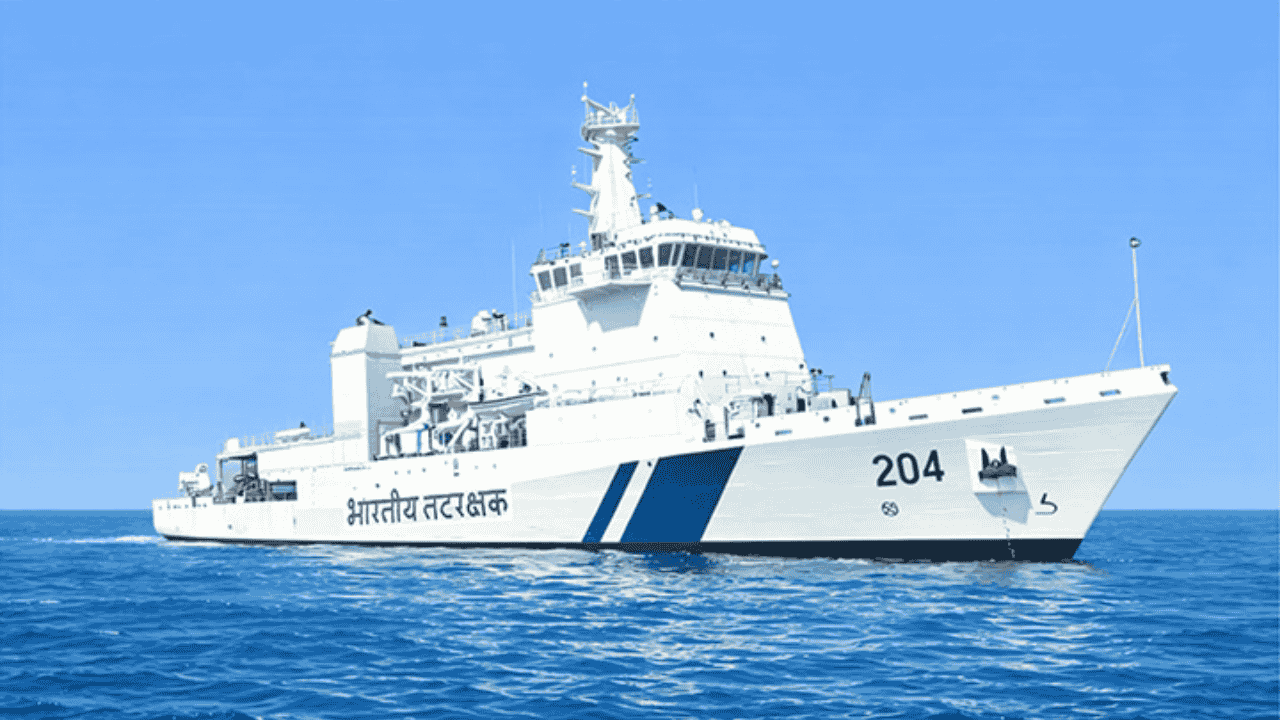
ICGS Samudra Pratap: India's First Indigenous Pollution Control Vessel – Current Affairs January 2026
India Commissions ICGS Samudra Pratap: A Milestone in Maritime Self-Reliance
On January 5, 2026, Defence Minister Rajnath Singh commissioned India's first indigenously designed and built pollution control vessel, ICGS Samudra Pratap, at Goa Shipyard Limited in Goa. This historic moment represents a watershed achievement in India's pursuit of Atmanirbhar Bharat (self-reliance) in defence shipbuilding and marks a transformative shift in the nation's maritime environmental security infrastructure.
Named "Samudra Pratap" (Majesty of the Seas), this vessel stands as a testament to India's growing capability to design, engineer, and manufacture sophisticated maritime platforms entirely within its borders. With over 60% indigenous content, the vessel reflects the government's commitment to reducing dependence on foreign technology while building a robust domestic defense industrial base.
Key Specifications: India's Largest Coast Guard Ship
ICGS Samudra Pratap is the largest ship ever inducted into the Indian Coast Guard fleet, significantly surpassing the operational reach of its predecessor vessels.
| Technical Parameter | Specifications |
|---|---|
| Length | 114.5 meters |
| Beam (Width) | 16.5 meters |
| Displacement | 4,170 tonnes |
| Maximum Speed | 22+ knots (40+ km/h) |
| Endurance | 6,000 nautical miles |
| Power Plant | Two 7,500 kW diesel engines |
| Propulsion | Indigenously developed Controllable Pitch Propellers |
| Crew Complement | Officers: 14 / Sailors: 115 (including 2 women officers) |
| Home Port | Kochi (Coast Guard District HQ No. 4) |
The vessel's impressive dimensions and advanced propulsion systems enable it to operate effectively across India's expansive maritime zones, from coastal waters to offshore operational areas.
Advanced Capabilities: From Pollution Response to Maritime Security
Primary Mission: Pollution Detection and Response
ICGS Samudra Pratap represents a quantum leap in India's ability to respond to marine pollution incidents with scientific precision and operational speed. The vessel is equipped with industry-leading pollution detection and recovery systems:
Oil Fingerprinting Machine: Identifies the chemical signature and origin of oil spills
Gyro-Stabilized Standoff Active Chemical Detector: Enables precise detection of pollutants from a distance
High-Capacity Skimmers and Booms: Facilitates containment and recovery of crude oil, even viscous grades
Portable Barges: Stores recovered pollutants safely during extended operations
On-Board Pollution Control Laboratory: Analyzes contaminants and water separation in real-time
Multi-Mission Operational Advantages
Beyond pollution control, the vessel integrates sophisticated systems that make it a versatile maritime platform:
Dynamic Positioning System (DP-1): Enables precise station-keeping in rough sea conditions without anchor, crucial for maintaining position during oil spill containment
Integrated Bridge System (IBS): Advanced navigation and command automation
Integrated Platform Management System (IPMS): Optimizes ship's operational efficiency
Automated Power Management System (APMS): Ensures stability and reliability even under challenging conditions
FiFi-2/FFV-2 Firefighting Notation: High-capacity external firefighting systems for offshore industrial accidents and maritime fires
Security and Enforcement Capabilities
The vessel combines environmental stewardship with maritime security, equipped with:
30mm CRN-91 Gun: Primary armament for maritime law enforcement
Two 12.7mm Stabilized Remote-Controlled Guns: Integrated fire control systems for precision operations
Helicopter Hangar and Aviation Support Facilities: Extends surveillance and response reach across the Indian Ocean Region
These integrated capabilities make ICGS Samudra Pratap a "multi-platform" asset, capable of executing coastal patrol, search and rescue, anti-smuggling operations, and maritime law enforcement simultaneously.
Atmanirbhar Bharat: Shipbuilding Self-Reliance in Action
The commissioning of ICGS Samudra Pratap exemplifies the government's Atmanirbhar Bharat initiative in the defense sector, demonstrating India's maturing defense industrial ecosystem.
Indigenous Content Achievement
With over 60% indigenous content, the vessel represents a significant advancement in India's shipbuilding prowess. Defence Minister Rajnath Singh emphasized the government's commitment to increase indigenous content in future ships to nearly 90%, reflecting India's trajectory toward complete self-reliance in maritime defense manufacturing.
Goa Shipyard Limited's Role
Goa Shipyard Limited (GSL), India's premier public sector shipbuilder, designed and constructed ICGS Samudra Pratap entirely in-house, meeting the specific operational requirements of the Indian Coast Guard. GSL is concurrently building the second pollution control vessel in the series, ICGS Samudra Prachet, which was launched in July 2025 and will be commissioned in coming months.
Broader Shipbuilding Ecosystem
India's shipbuilding sector is experiencing a renaissance:
60+ Naval Vessels currently under construction across Mazagon Dock Shipbuilders Limited (MDL), Garden Reach Shipbuilders and Engineers (GRSE), and GSL
INS Vikrant (Indigenous Aircraft Carrier): Commissioned in 2022
INS Vikramaditya (Aircraft Carrier): Operational since 2013
Kalvari-Class Submarines: Six indigenous Scorpene-class submarines under Project 75
Shipbuilding Development Scheme: ₹44,700 crore government outlay to strengthen domestic shipbuilding capacity and global competitiveness
Strategic Significance: Environmental Sovereignty and Maritime Security
Protecting India's Exclusive Economic Zone (EEZ)
India's Exclusive Economic Zone spans over 2.2 million square kilometers, making it the 5th largest EEZ globally. The increasing density of international shipping, offshore drilling, and maritime commerce has exponentially increased the risk of oil spills and marine pollution. ICGS Samudra Pratap directly addresses this vulnerability.
Environmental and Economic Impact
Marine pollution incidents threaten India's critical maritime assets:
Fisheries and Livelihoods: India's fishing industry supports over 5 million people; oil spills devastate coastal communities
Coral Reefs and Mangroves: Ecological catastrophes undermine biodiversity and carbon sequestration
Blue Economy: Port operations, shipping, and tourism sectors worth billions of rupees depend on clean marine environments
Climate Resilience: Marine ecosystems are frontline defenders against rising sea levels and extreme weather events
The vessel's deployment significantly reduces response time to pollution incidents, preventing cascading environmental damage.
Regional Maritime Leadership
ICGS Samudra Pratap positions India as a responsible maritime power capable of assisting neighboring Indian Ocean Region (IOR) nations during marine calamities. This strengthens India's diplomatic influence and reinforces its role as the region's security provider.
Gender Inclusion: A New Standard for Indian Armed Forces
In a historic first, ICGS Samudra Pratap has two women officers appointed to its complement—a symbolic and practical acknowledgment of women's growing role in India's defense services.
Defence Minister Rajnath Singh praised this development, noting that women are no longer confined to support roles but serve as "frontline warriors." The Indian Coast Guard's rapid progress toward gender-inclusive operations aligns with the government's broader vision of equal opportunity across all defense branches.
Operational Deployment and Coverage
ICGS Samudra Pratap will operate under the administrative and operational control of Coast Guard District Headquarters No. 4, headquartered at Kochi. This placement strategically positions the vessel to cover the Arabian Sea, Western Coast, and approaches to India's western maritime boundary.
The vessel's 6,000-nautical-mile endurance enables extended surveillance and response missions, allowing rapid deployment across India's maritime zones without frequent port calls for refueling—a critical advantage for environmental emergency response.
Why This Matters for Your UPSC Exam Preparation
GS Paper III: Defense, Industrial Policy, and Blue Economy
Question Framework: Expect questions on:
Role of Atmanirbhar Bharat in defense manufacturing and strategic autonomy
India's Exclusive Economic Zone (EEZ) management and environmental governance
Shipbuilding industry's contribution to employment, infrastructure, and export potential
Coastal security architecture and multi-agency coordination
Sample UPSC Mains Question Type:
"Examine the strategic importance of indigenous pollution control capabilities for India's maritime security and blue economy. How does ICGS Samudra Pratap reflect India's commitment to Atmanirbhar Bharat in the defense sector?"
GS Paper II: Governance and Gender Inclusion
The appointment of women officers to ICGS Samudra Pratap exemplifies India's institutional progress toward gender parity in critical sectors. UPSC questions increasingly focus on gender mainstreaming in armed forces, civil services, and public institutions.
Prelims Multiple-Choice Potential
You may encounter Prelims questions like:
"ICGS Samudra Pratap is India's first indigenously designed vessel of what type?"
A) Aircraft Carrier B) Submarine C) Destroyer D) Pollution Control Vessel ✓
"Which shipyard built ICGS Samudra Pratap?"
A) Cochin Shipyard B) Goa Shipyard Limited ✓ C) Mazagon Dock D) GRSE
"The Shipbuilding Development Scheme has a total government outlay of ___."
A) ₹15,000 crore B) ₹28,500 crore C) ₹44,700 crore ✓ D) ₹60,000 crore
Key Concepts to Master
Atmanirbhar Bharat (Self-Reliant India): Launched 2020; focuses on defense manufacturing, infrastructure, and reducing import dependency. Related schemes include Shipbuilding Financial Assistance (SBFA) and Shipbuilding Development Scheme (SDS).
Maritime Atmanirbharata: India's strategic vision to indigenously design, develop, and manufacture naval warships, submarines, and specialized vessels. Compare India's progress (INS Vikrant, Kalvari-class submarines) with global naval powers.
Exclusive Economic Zone (EEZ) Management: India's 2.2+ million sq km EEZ requires sophisticated monitoring for:
Oil spill response
Illegal fishing prevention
Maritime law enforcement
Environmental protection
Blue Economy: Ocean-based economic activities (fishing, shipping, tourism, offshore renewable energy) worth ₹300+ billion annually. Environmental protection is foundational to sustainable blue economy growth.
Indian Coast Guard's Multi-Dimensional Role:
Pollution control and environmental protection
Search and rescue operations
Maritime law enforcement and anti-smuggling
Coastal security and counter-terrorism
Disaster response and humanitarian assistance
Linked Current Affairs Topics
Studying ICGS Samudra Pratap connects to broader UPSC themes:
INS Vikrant (Indigenous Aircraft Carrier): India's defense manufacturing prowess
Information Fusion Centre-Indian Ocean Region (IFC-IOR): Regional maritime security coordination
Exclusive Economic Zone (EEZ) governance: Balancing resource exploitation with environmental protection
Defense Export Policy: India's emerging role in exporting naval vessels to friendly nations
Shipbuilding Development Scheme: Infrastructure policy and industrial growth strategy
Recent Context: Why This Vessel Now?
India has witnessed significant maritime pollution incidents in recent years that highlight the urgency of specialized response capabilities:
June 2025: Container ship incidents in Indian waters caused major ecological damage to coral reefs and coastal ecosystems
Recurring Oil Spills: Offshore drilling operations and international shipping create persistent pollution risks
Climate Change Imperative: Rising sea levels and extreme weather events increase the likelihood of maritime disasters
ICGS Samudra Pratap directly responds to these emerging threats, positioning India to proactively manage environmental crises rather than reactively respond to disasters.
Conclusion: A Vessel Symbolizing India's Maritime Future
ICGS Samudra Pratap is far more than a pollution control vessel. It embodies India's maturation as a defense manufacturing nation, its commitment to environmental stewardship, and its vision of strategic autonomy in critical maritime infrastructure.
For UPSC aspirants, this vessel represents the convergence of multiple examination themes: Atmanirbhar Bharat, blue economy, maritime security, gender inclusion, and environmental governance. Understanding ICGS Samudra Pratap's significance—from its technical specifications to its strategic implications—will enhance your competitive exam preparation and provide depth in answers across GS Papers II and III.
As India continues to expand its indigenous shipbuilding capacity (with plans for 90%+ content in future vessels), ICGS Samudra Pratap sets a precedent for technological excellence and self-reliant defense innovation.
Quick Reference: Key Facts for Quick Revision
| Aspect | Details |
|---|---|
| Commissioned | January 5, 2026 |
| Commissioned By | Defence Minister Rajnath Singh |
| Type | Pollution Control Vessel (PCV) |
| Builder | Goa Shipyard Limited (GSL) |
| Indigenous Content | 60%+ |
| Length | 114.5 meters (largest ICG ship) |
| Displacement | 4,170 tonnes |
| Speed | 22+ knots |
| Endurance | 6,000 nautical miles |
| Unique Feature | First ICG ship with Dynamic Positioning (DP-1) |
| Armament | 30mm gun + two 12.7mm RCGs |
| Key Innovation | Integrated multi-mission platform (pollution + maritime security) |
| Home Port | Kochi |
| Part of Two-Ship Series | Sister ship: ICGS Samudra Prachet (to be commissioned soon) |
| Significance | Atmanirbhar Bharat milestone; environmental sovereignty; gender inclusion |
About Atharva Examwise: Atharva Examwise is India's leading platform for UPSC Civil Services, State PSC, and competitive exam preparation. Our expert-authored current affairs articles, daily news summaries, and comprehensive study materials are designed to help aspirants understand complex topics with exam-centric clarity. Subscribe to our newsletter for daily GK updates and follow our YouTube channel for in-depth current affairs analysis.