
India Reaches 3rd Position in Global AI Index 2025: Current Affairs Update for UPSC Aspirants
Introduction
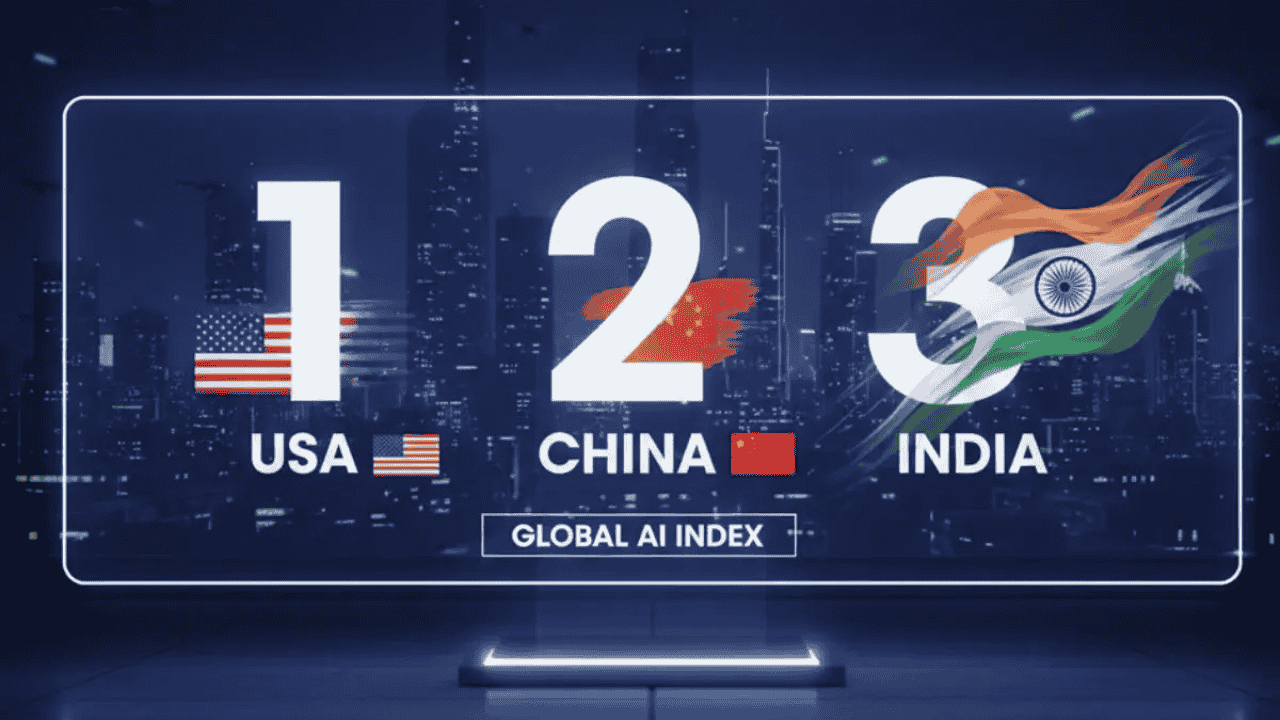
In a landmark achievement for India's technological advancement, the country has surged to third place in Stanford University's 2025 Global AI Vibrancy Tool, marking a remarkable leap from its seventh position just one year ago. This extraordinary climb—overshadowing established tech powerhouses like the United Kingdom and South Korea—signals India's transformation into a global AI heavyweight. With a score of 21.59, India now trails only the United States (78.60) and China (36.95), establishing itself as the undisputed leader in AI innovation among emerging economies.
This significant milestone is essential knowledge for UPSC aspirants, as it reflects India's evolving technological landscape, government policy priorities, and role in the global digital economy—all crucial topics in the GK and current affairs sections of competitive exams.
What is the Stanford Global AI Vibrancy Index?
The Global AI Vibrancy Tool, developed by Stanford University, provides a data-driven assessment of nations' positions in the artificial intelligence landscape. The index evaluates countries using 42 indicators spread across eight key pillars:
Research and Development (R&D)
Talent Development
Infrastructure
Private Investment
Policy and Governance
Public Engagement
AI Model Development
Economic Impact
The tool assesses 36 countries globally, offering insights into each nation's capacity for innovation, technological maturity, and AI ecosystem vibrancy. By measuring these dimensions, the index provides a comprehensive understanding of which countries are positioned as leaders in the rapidly evolving AI revolution.
India's Remarkable Ascent: From 7th to 3rd in One Year
Key Performance Metrics
| Ranking Position | India | United States | China | South Korea | United Kingdom |
|---|---|---|---|---|---|
| 2024 Rank | 3rd | 1st | 2nd | 4th | 5th |
| 2023 Rank | 7th | 1st | 2nd | — | 6th |
| Global Score | 21.59 | 78.60 | 36.95 | 17.24 | 16.64 |
| Position Jump | ↑ 4 Places | Stable | Stable | — | ↑ 1 Place |
India's ascent from 7th to 3rd position represents the most dramatic year-on-year improvement among major economies, reflecting "renewed major initiatives" to strengthen the nation's AI position.
What Drove India's Rapid Growth in AI Rankings?
1. Thriving Startup Ecosystem and Private Sector Innovation
India's AI renaissance is anchored in its vibrant startup and enterprise ecosystem. Organizations and startups across the country have rapidly embraced AI applications in critical sectors:
Finance & FinTech: AI-driven financial analysis, fraud detection, and personalized banking solutions
Healthcare: Diagnostic systems, drug discovery, and patient management platforms
Agriculture: AI-powered crop prediction, pest management, and yield optimization
Logistics & E-commerce: Supply chain optimization, route planning, and demand forecasting
Education: Personalized learning platforms and adaptive educational tools
This sector-wide AI adoption is supported by India's massive digital markets and the active participation of domestic enterprises in AI-driven innovation.
2. Unparalleled Talent Pool and AI Skill Development
India emerged as a global leader in AI talent concentration, with several standout achievements:
#1 Global Ranking in AI Skill Penetration: India scored 2.8 globally—surpassing the United States (2.2) and Germany (1.9)
Highest Year-on-Year Growth in AI Hiring: India witnessed the most significant increase in AI-related job placements globally
263% Growth in AI Talent Concentration: Since 2016, India's AI workforce has expanded dramatically
Second-Largest AI Contributor on GitHub: In 2024, India became the second-largest contributor to AI-related projects on GitHub, demonstrating a thriving engineering community
375,000+ AI-Skilled Professionals: India has over 375,000 professionals with AI expertise as of 2025
This talent advantage is powered by:
Premier institutions like IITs, NITs, and ISI contributing cutting-edge research
FutureSkills PRIME program upskilling IT professionals in emerging technologies
Women in Technology initiatives driving 1.7 score in AI skill penetration for women—outshining global counterparts
3. Government's Strategic IndiaAI Mission
Launched in March 2024 by the Ministry of Electronics and Information Technology (MeitY), the IndiaAI Mission represents a transformative Rs 10,372 crore investment in building a comprehensive AI ecosystem. The mission operates across seven interconnected pillars:
a) IndiaAI Compute
Establishment of AI-ready data centers with advanced infrastructure
Procurement of high-performance GPUs (graphics processing units)
Target capacity: Over 10,000 GPUs to support research and development
Union Budget 2024-25 allocation: Rs 551.75 crore for GPU procurement and infrastructure enhancement
b) IndiaAI Datasets Platform
Centralized repository providing quality, non-personal datasets
Seamless access for startups, researchers, and enterprises
Focus on datasets covering major Indian languages for priority sectors
c) IndiaAI FutureSkills
Large-scale AI skill-building programs across undergraduate, master's, and Ph.D. levels
Establishment of 27 Data and AI Labs in Tier 2 and Tier 3 cities
IndiaAI Fellowship for top NIRF-ranked research institutes and students
Model IndiaAI Data Lab at NIELIT, Delhi serving as a reference point
d) IndiaAI Innovation Center
Dedicated hub for AI research and development
Estimated investment: Rs 2,000 crore for establishment and operations
e) IndiaAI Startup Financing
Rs 2,000 crore allocated for deep-tech AI startup financing
Streamlined funding access for innovative projects across growth stages
f) Safe & Trusted AI Projects
AI Bias Mitigation frameworks
Explainable AI (XAI) development
AI Ethical Certification programs
Algorithm Auditing Tools
Deepfake detection and watermarking initiatives
g) Policy and Governance Framework
IndiaAI Competency Framework for public sector officials
Guidelines ensuring responsible and inclusive AI adoption
4. Research Output and Academic-Industry Collaboration
India has demonstrated visible improvement in AI-related research metrics:
Increased AI Publications: Growing contributions to peer-reviewed AI research
Rising Patent Filings: More Indian patents in AI and machine learning domains
Academic-Industry Partnerships: Collaborations between IITs, ISI, IISc, and private sector organizations
AI Competency Framework: Launched March 6, 2025, equipping public sector officials with AI skills
While still trailing the US and China in absolute research output, India's trajectory shows rapid acceleration in research productivity and innovation capacity.
5. Enhanced Infrastructure and Computing Capacity
Recent government initiatives have strengthened India's AI infrastructure:
National Data Center Capacity: Projected to reach 1,263 MW by April 2025
AI-Specific Infrastructure Investment: Rs 107.3 billion (US$1.24 billion) approved for AI-ready data centers on March 7, 2024
Advanced Data Center Features: Liquid cooling, high floor loads (up to 2,500 kg/m²), energy-efficient architecture
Indigenous Hardware Development: Over 375,000 AI-skilled professionals supporting domestic design of accelerators and AI chips
AI Cluster Development: 8 AI clusters established across India with 493,000 AI chips, ranking 3rd globally in AI chip count
Global Rankings: Complete Top 10 Overview
| Rank | Country | Score | Change from 2023 | Key Strength |
|---|---|---|---|---|
| 1 | United States | 78.60 | Stable | R&D Leadership, Private Investment, Model Development |
| 2 | China | 36.95 | Stable | Research Publications, Patents, Model Launches |
| 3 | India | 21.59 | ↑ 4 (from 7th) | Talent, Startup Ecosystem, Skill Penetration |
| 4 | South Korea | 17.24 | ↓ 1 | Advanced Manufacturing, Tech Adoption |
| 5 | United Kingdom | 16.64 | ↑ 1 | Research, Policy Framework |
| 6 | Singapore | — | Stable | Regional Hub, Infrastructure |
| 7 | Japan | — | — | Robotics, Industrial AI |
| 8 | Germany | — | — | Industrial AI, Engineering |
| 9 | Canada | — | — | AI Research, Talent |
| 10 | France | — | — | Public Engagement, Policy |
India's AI Potential and Future Outlook
Economic Impact Projections
GDP Contribution: Generative AI is forecast to contribute US$400 billion to India's GDP by 2030
Growth Rate: Compound Annual Growth Rate (CAGR) of 28 percent through 2030
Market Expansion: India's AI infrastructure market poised for exponential growth driven by expanding AI workloads and national compute missions
Government Vision: "India Techade"
The Government of India envisions the next decade as the "India Techade," transforming the nation into a global hub for emerging technologies. Key initiatives supporting this vision include:
Digital India Program
Make in India initiative
Smart Cities Mission
GI Cloud (MeghRaj) platform
Global INDIAai Summit
Why India Ranks 3rd Despite Remaining Challenges
Strengths
✅ Largest talent pool globally with highest skill penetration
✅ World's fastest-growing AI job market
✅ Thriving startup ecosystem with diverse AI applications
✅ Strong government commitment and funding (Rs 10,372 crore IndiaAI Mission)
✅ Second-largest AI contributor on GitHub
✅ Leadership in women's participation in AI
Remaining Gaps and Challenges
❌ Limited cutting-edge AI research: India still trails US and China in fundamental AI research and foundational models development
❌ Lower private investment: Venture capital flows in AI remain significantly below US and China levels
❌ Data quality bottlenecks: Challenges in acquiring high-quality, large-scale datasets for training advanced models
❌ Geographic concentration: AI development and talent concentration primarily in major urban centers
❌ Responsible AI regulation: Need for stronger frameworks ensuring inclusive access and ethical AI adoption beyond major cities
Why This Matters for Your Exam Preparation
Relevant for UPSC Mains Essays and Paper II (GK)
India's position in the Global AI Index 2025 reflects broader policy priorities and technological development covered extensively in UPSC exams. This topic is directly relevant for:
1. General Studies Paper II (Governance & Policies)
Government schemes and policy frameworks: IndiaAI Mission exemplifies India's strategic policy-making in emerging technologies
Constitutional provisions related to digital rights, data governance, and AI regulation
Role of government in fostering innovation and private sector collaboration
2. General Studies Paper III (Economy & Technology)
Technological advancement and its role in economic growth
Skill development and employment generation in emerging sectors
Infrastructure development and capital investment in high-tech sectors
India's position in the global tech economy
3. Essay Topics
"India's Digital Revolution: From Aspirations to Achievements"
"Inclusive Growth Through Emerging Technologies"
"Balancing Innovation with Responsibility: India's AI Approach"
"Bridging the Digital Divide: Tier 2 and Tier 3 City Initiatives"
Current Affairs for Daily GK Updates
UPSC Current Affairs Focus: Government initiatives, bilateral relations, economic development, and technological advancement
News Comprehension: Understanding how national policies translate into global competitiveness
Prelims MCQ Topics: AI definitions, government schemes, startup ecosystem, infrastructure projects, and economic projections
Connections to Previous UPSC Questions
This development relates to several previous UPSC exam topics:
FutureSkills PRIME and workforce development initiatives
Digital India and Make in India programs
Startup India and innovation policies
Women in Technology and gender inclusivity
Data protection and responsible AI governance
Key Takeaways for Aspirants
India's AI Ascent: From 7th to 3rd in one year—driven by talent, startups, and government support
Stanford AI Vibrancy Index: Measures AI ecosystem health across 42 indicators and 8 pillars across 36 countries
IndiaAI Mission (Rs 10,372 crore): Seven-pillar initiative transforming India's AI infrastructure and talent development
Global Leadership: Ranks #1 in AI skill penetration (2.8) and 2nd largest AI contributor on GitHub
Future Potential: $400 billion AI contribution to GDP by 2030 at 28% CAGR
Persistent Challenges: Limited foundational research, geographic concentration, data quality, and investment gaps
Vision 2030: "India Techade" positioning India as a global hub for emerging technologies