
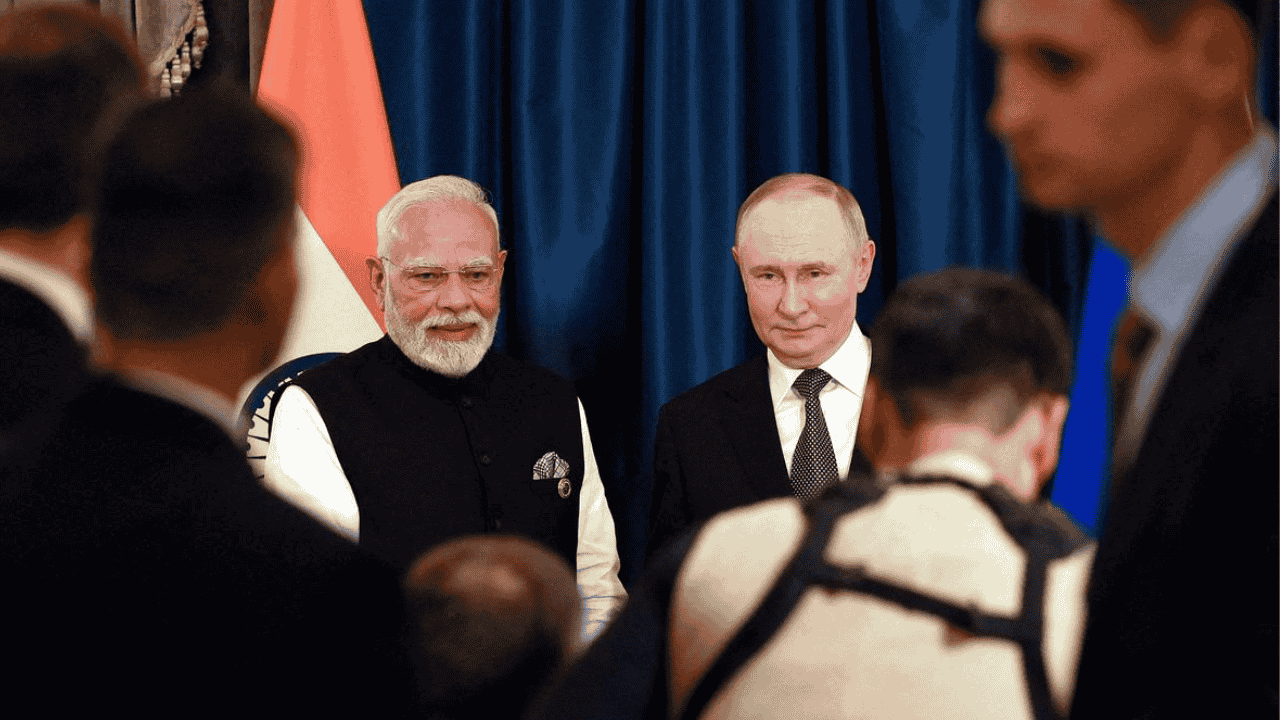
India-Russia RELOS Agreement 2024: Complete Current Affairs Guide for UPSC Exam Preparation
Introduction
The Reciprocal Exchange of Logistic Support (RELOS) agreement between India and Russia marks a strategic milestone in defence cooperation. On December 3, 2024, Russia's lower house of parliament, the Duma, officially ratified this long-pending military pact—a day before Vladimir Putin's two-day state visit to New Delhi (December 4-5, 2024). This development strengthens India-Russia strategic ties and opens new dimensions for India's military capabilities, particularly its Arctic operations and Indian Ocean presence.
For UPSC aspirants, this agreement represents a pivotal moment in understanding India's foreign policy, defence partnerships, and geopolitical positioning in an increasingly multipolar world.
What is the RELOS Agreement?
The Reciprocal Exchange of Logistic Support (RELOS) is a bilateral military logistics pact that enables both countries to provide mutual support for their armed forces. Unlike traditional defence treaties focused on weapon systems or technology sharing, RELOS addresses the operational backbone of modern warfare: logistics.
Key Features of RELOS:
Mutual facility access: Military aircraft, ships, and armed forces personnel from both nations can use each other's military facilities and infrastructure
Logistical support services: Fuel, oil, spare parts, maintenance support, berthing rights, and air base access
Operational scope: Joint exercises, training programmes, humanitarian operations, and disaster-relief missions
Regulatory framework: The agreement standardizes all reciprocal logistic services and formalizes existing ad-hoc practices
Deployment limits: Maximum of 5 warships, 10 aircraft, and 3,000 military personnel can be simultaneously stationed in partner territory for a 5-year period (extendable for another 5 years)
Airspace and port access: Authorization to use each other's airspace and ports, including warship visits
Timeline of the Agreement:
| Event | Date |
|---|---|
| Approval of draft agreement | June 2024 |
| Formal signing in Moscow | February 18, 2025 |
| Russian Parliament (Duma) ratification | December 3, 2024 |
| Putin's state visit to India | December 4-5, 2024 |
Strategic Benefits for India
1. Arctic Region Access and Operational Reach
The most significant advantage for India is unrestricted access to Russian naval port facilities in the Arctic, particularly along the Northern Sea Route extending from Vladivostok to Murmansk. This is transformative for Indian Navy operations because:
India currently lacks a permanent presence in Arctic waters
Russian ports provide strategic refueling and maintenance hubs for Indian naval assets
Indian warships can now operate in polar waters with continuous logistical support
The Indian Navy can expand its operational reach beyond the Indian Ocean and Indo-Pacific regions
The Manohar Parrikar Institute for Defence Studies and Analyses (IDSA) notes that RELOS will enhance the Indian Navy's experience in polar waters—a critical skill as Arctic geopolitics intensifies due to climate change and melting ice.
2. Scientific and Arctic Ambitions
Beyond military applications, RELOS supports India's civilian Arctic research agenda:
India maintains a permanently-manned Arctic Research Station on Spitsbergen (Svalbard)
The agreement facilitates logistics for Indian scientists conducting Arctic research
Access to Russian ports strengthens India's scientific infrastructure in the region
Enhanced Arctic presence aligns with India's broader climate and environmental research objectives
3. Hardware and Equipment Continuity
A significant portion of India's military hardware originates from Russia:
Sukhoi fighter jets (Su-30MKI, Su-57)
T-90 main battle tanks
S-400 air defence systems
Submarine technology
Integration with Russian logistics networks ensures continuity of supply, maintenance, and technical support for these systems. RELOS eliminates bureaucratic delays in obtaining spare parts and maintenance services critical for operational readiness.
4. Long-Distance Naval Deployments
Indian Navy operates 12-15 warships independently across the Indo-Pacific for multi-mission deployments including:
Monitoring critical chokepoints in the Indian Ocean
Ensuring safe passage of international trade
Maritime domain awareness
Humanitarian assistance and disaster relief (HADR)
Counter-terrorism and anti-piracy operations
Previously, each warship required dedicated logistics support ships. RELOS provides friendly ports with logistical facilities, eliminating this requirement and increasing operational efficiency.
Strategic Benefits for Russia
1. Indian Ocean Region (IOR) Access
While India gains Arctic access, Russia secures entry points and support hubs across the Indian Ocean Region, enabling Moscow to:
Project military strength in Asia-Pacific despite Western sanctions
Counter Chinese influence in strategic waters
Maintain global reach without establishing expensive permanent military bases
Access Indian ports for refueling and maintenance of Russian naval vessels
2. Circumventing Western Sanctions
With Western nations imposing sanctions due to the Ukraine conflict, RELOS provides Russia:
Alternative logistics networks beyond Western-controlled regions
Continued global military presence and operational capability
Strategic partnerships to offset geopolitical isolation
3. Cost-Effective Military Projection
Rather than establishing permanent military bases (which require significant time and financial investment), Russia can:
Deploy naval and air assets to the Indian Ocean on a temporary basis
Utilize Indian facilities for maintenance and resupply
Project power strategically without long-term commitments
How RELOS Differs from Similar Agreements
India has signed comparable logistics agreements with multiple countries, establishing a pattern of strategic partnership:
| Country | Agreement | Year |
|---|---|---|
| United States | LEMOA (Logistics Exchange Memorandum of Agreement) | 2016 |
| United Kingdom | RELOS-equivalent | Post-2016 |
| France | Logistics agreement | Post-2016 |
| Japan | Acquisition and Cross-Servicing Agreement (ACSA) | Post-2016 |
| Australia | Logistics agreement | Post-2016 |
| Singapore | Logistics agreement | Post-2016 |
| Vietnam | Logistics agreement | Post-2016 |
| South Korea | Logistics agreement | Post-2016 |
| Russia | RELOS | 2024-2025 |
LEMOA Context: India signed its first major logistics agreement (LEMOA) with the United States in 2016, realizing the strategic value of such pacts after observing China's assertiveness in the Indo-Pacific. RELOS with Russia follows the same strategic logic.
Significance of RELOS in India-Russia Relations
Historical Context
The RELOS agreement comes at a critical juncture for India-Russia relations:
2024 marks the 25-year anniversary of the India-Russia Strategic Partnership (established 2000)
The partnership was elevated to "Special and Privileged Strategic Partnership" in December 2010
This is Putin's first visit to India since the 2022 Ukraine invasion, signaling sustained commitment despite geopolitical tensions
The ratification timing—just before Putin's visit—demonstrates tangible progress in defence cooperation
Expert Perspective
Defence analyst Girish Linganna writes: "If done right, Relos could give India the logistical backbone to truly become a global naval power." This encapsulates the transformative potential of the agreement for India's maritime ambitions.
Why RELOS Matters: Operational Efficiency
According to the Observer Research Foundation (ORF), logistics agreements like RELOS provide several operational advantages:
Saves enormous time in military operations
Eliminates bureaucratic delays associated with obtaining logistical support from partner nations
Streamlines processes for refueling, berthing, and use of aviation infrastructure
Enables rolling settlement of costs and fees rather than requiring constant paperwork and formal approvals
This efficiency is crucial during joint exercises, humanitarian missions, and emergency deployments.
Timing and Geopolitical Context
Why December 2024?
The ratification timing is significant:
Putin's state visit (December 4-5) demonstrates unified intent between Moscow and New Delhi
25-year partnership anniversary warrants affirmation of commitment
Western pressure on India regarding Russia relations—RELOS shows India's strategic autonomy
Arctic warming and climate change make Arctic cooperation increasingly relevant
Indo-Pacific tensions require India to strengthen partnerships and expand operational reach
India's Strategic Autonomy
While Western nations pressure India to "pick sides" in geopolitical contests, RELOS demonstrates that India pursues strategic autonomy:
India maintains partnerships across the Global North and Global South
India prioritizes pragmatic bilateral relations based on mutual benefit
India balances partnerships with the US, Russia, and other nations without compromising independence
Specific Military Hardware and Arctic Operations
Indian Vessels and Arctic Capabilities
RELOS particularly benefits platforms like:
INS Vikramaditya (Aircraft Carrier)
Talwar-class Frigates
Scorpene-class Submarines
Survey vessels conducting Arctic research
These platforms now have certified logistical support in Arctic ports, enabling extended operations and research missions.
Energy Security Dimension
India already imports Liquefied Natural Gas (LNG) from Russia's Yamal Peninsula in the Arctic. RELOS ensures that:
Indian naval assets protecting energy supply chains can operate in Arctic waters
Logistical security is guaranteed for protecting critical economic infrastructure
India's energy diversification strategy is supported by military logistics
Implications for India-China Relations
While not explicitly mentioned in the agreement, RELOS carries implications for India-China dynamics:
Enhanced Indian Navy presence in global waters counters Chinese maritime expansion
Arctic access allows India to monitor and participate in Arctic geopolitics as China increases Arctic involvement
Russia-India partnership creates a counterweight to potential China-Russia dominance in Arctic affairs
Indian Ocean operations with Russian support balance Chinese activities in the region
Related Current Affairs for UPSC Aspirants
To contextualize this agreement, aspirants should understand:
India's Arctic Policy – India's dual role as a climate researcher and geopolitical player
Indo-Pacific Strategy – India's broader maritime doctrine and security framework
Russia-Ukraine War Impact – How sanctions affect India-Russia cooperation
India-US Defence Relations – LEMOA and other foundational agreements
Climate Change and Arctic – Geopolitical implications of melting Arctic ice
Northern Sea Route – Commercial and strategic importance for global trade
Multi-alignment Foreign Policy – India's strategy in a multipolar world
Why This Matters for Your Exam Preparation
UPSC Relevance
The RELOS agreement directly relates to several UPSC examination themes:
1. International Relations and Foreign Policy
Strategic partnerships: How India balances relationships with multiple powers
Bilateral agreements: Understanding mutual benefit and strategic alignment
Geopolitical positioning: India's role in Indo-Pacific, Arctic, and global security architecture
Non-alignment tradition: Contemporary interpretation of strategic autonomy
2. Defence and Security
Military logistics: Understanding modern naval operations and support requirements
Armed forces modernization: Integration of Russian military hardware in Indian forces
Maritime security: Indian Navy's expanding operational reach and capabilities
Joint military cooperation: Mechanisms for coordinated defence operations
3. Geopolitics and Global Politics
Arctic geopolitics: Climate-driven geopolitical competition in polar regions
US-Russia tensions: How India navigates between Western and non-Western powers
Sanctions regime: Impact of Western sanctions on strategic partnerships
China factor: How India-Russia partnership affects regional balance of power
4. Infrastructure and Connectivity
Northern Sea Route: New maritime corridors and their strategic significance
Port development: Strategic importance of port facilities in logistics
Climate change: How environmental shifts create new geopolitical opportunities and challenges
5. Science and Technology
Arctic research: India's civilian scientific programs in polar regions
Technology cooperation: Russian technology in Indian military platforms
Climate science: Arctic monitoring and climate research initiatives
Potential Exam Questions
UPSC candidates should be prepared for questions such as:
"Explain the significance of the India-Russia RELOS agreement in the context of India's Arctic ambitions."
"How do logistics agreements like RELOS enhance operational capabilities of navies engaged in distant deployments?"
"Analyze the strategic implications of RELOS for India-China relations in the Arctic region."
"Discuss India's strategy of maintaining strategic partnerships across the Global North and Global South, with RELOS as a case study."
"How does the RELOS agreement address India's energy security concerns in the Arctic?"
"Compare India's logistics agreements with different nations (US LEMOA, Russia RELOS). What common threads emerge?"
Key Takeaways for Aspirants
Strategic autonomy is paramount: India pursues partnerships with all major powers without subordinating independence
Logistics is critical infrastructure: Modern military power depends on supply chains and maintenance networks, not just weapons systems
Arctic is the new frontier: Climate change is reshaping geopolitics; Arctic cooperation will define 21st-century rivalries
Long-term thinking: The RELOS agreement, though signed in February 2025, was in negotiations for nearly 6 years—demonstrating patience in strategic planning
Win-win frameworks: Effective international agreements provide mutual benefits, not zero-sum arrangements
Diversification of partnerships: India's multiple logistics agreements prevent overdependence on any single power
Research Strategy for UPSC Preparation
When studying RELOS and related topics:
Read foundational texts: Study India's Arctic Policy, National Security Strategy, and foreign policy documents
Follow expert analysis: Monitor think tanks like IDSA, ORF, and Brookings Institution for strategic commentary
Track bilateral developments: Follow India-Russia military cooperation, Indo-US defence relationships, and emerging Arctic policies
Connect to broader themes: Link RELOS to India's maritime doctrine, China containment strategy, and global positioning
Understand precedents: Compare with LEMOA and other agreements to identify patterns in Indian strategic thinking
Conclusion
The India-Russia RELOS agreement represents a watershed moment in India's strategic positioning. By securing logistics access to Russian Arctic facilities, India gains operational reach in polar waters, scientific research capabilities, and a crucial logistical partner for its global naval presence. Simultaneously, Russia maintains relevance in Asian geopolitics despite Western sanctions.
For UPSC aspirants, this agreement exemplifies how modern international relations blend defence, logistics, climate change, and strategic autonomy. Understanding RELOS provides insights into India's foreign policy decision-making, maritime strategy, and positioning in a multipolar world—all critical themes for competitive examinations.
As India's military modernization accelerates and Arctic geopolitics intensifies, agreements like RELOS will define the nation's capacity to project power, conduct humanitarian operations, and participate in emerging strategic frontiers like the Arctic region.
Atharva Exam Wise Coaching Platform provides comprehensive coverage of current affairs, geopolitics, and defence topics essential for UPSC and competitive exam success. Explore our dedicated sections on International Relations, Indian Armed Forces, and Global Strategic Developments for deeper analysis of current affairs topics.
Last Updated: December 4, 2025
Category: Current Affairs | Defence | International Relations | UPSC Preparation