
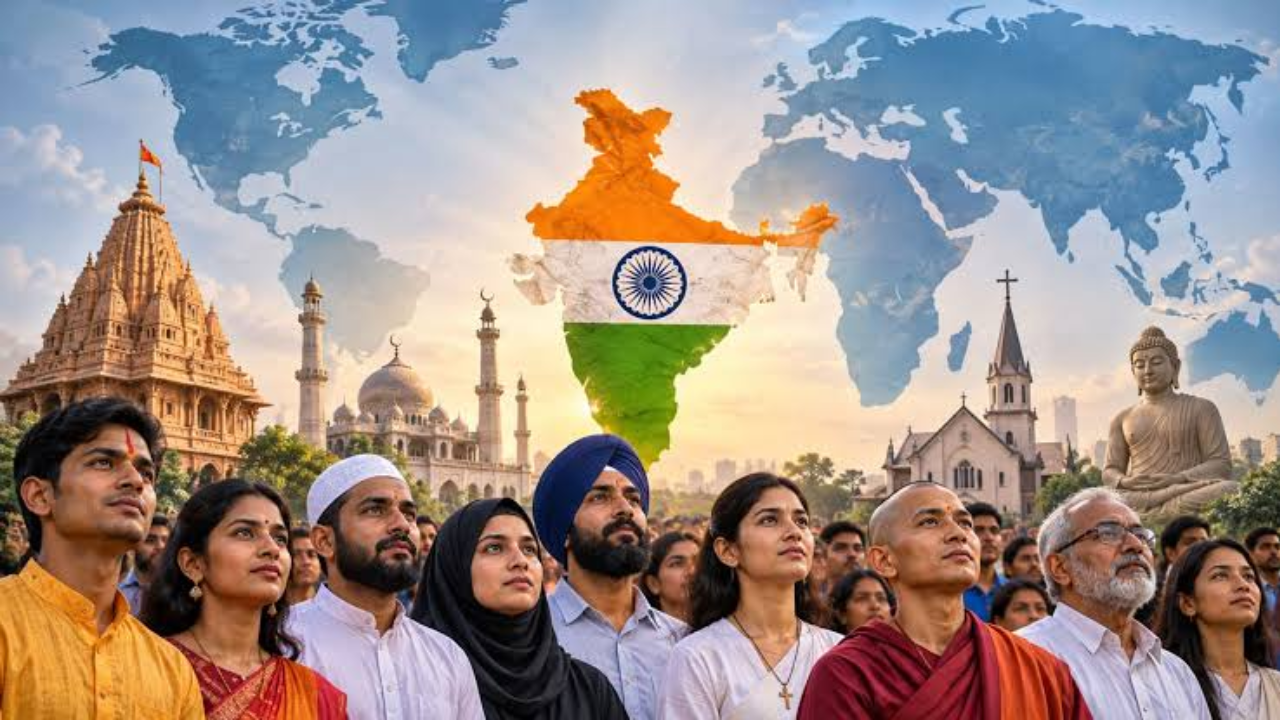
UPSC Current Affairs 28 November 2026: What Will India’s Hindu-Muslim Population Look Like by 2070? Pew Research Report, Census 2027 and Daily GK Fact Check
Published: 28 November 2026
Category: Indian Society | Population & Demography | Polity & Governance
Useful for: UPSC CSE, MPPSC, State PCS, SSC, Banking and other competitive examinations
What Is New in the Context of This News?
On 18 November 2026, the Pew Research Center published a new global demographic projection study titled The Future of World Religions: Population Growth Projections, 2020–2070. Therefore, it would be incorrect to describe this study merely as an extension of Pew's earlier 2015 report.
The primary projection horizon of the 2015 study was 2050. When its demographic model was extended beyond that period, it indicated that Muslims and Christians could account for approximately equal shares of the global population by 2070. However, the new 2026 study provides separate and detailed demographic projections up to 2070, using an updated 2020 baseline.
The new study models the population of Christians, Muslims, Hindus, Buddhists, Jews, followers of other religions and religiously unaffiliated people across 201 countries and territories.
It incorporates several important demographic variables, including age structure, fertility, mortality, migration and religious switching.
The estimates for 2010 and 2020 are derived from Pew's 2025 global religious landscape dataset, whereas the figures from 2030 to 2070 are demographic projections rather than actual census counts.
This distinction is particularly important from an examination perspective. Pew's 2020 figures, such as 79.4%, 15.2% or 21.3 crore, cannot be described as Census of India 2020 data because India did not conduct a census in 2020.
Pew prepared its 2020 baseline estimates using available census records, surveys and demographic modelling. In India's case, Census 2011 was the latest available comprehensive census baseline.
What Does Pew's New Report Actually Say About India?
According to Pew's country-level demographic projections, the proportion of Hindus in India's population could decline from an estimated 79.4% in 2020 to 75.8% in 2070, while the Muslim population share could increase from 15.2% to 19.6% during the same period.
In simple terms, the Muslim population share is projected to increase by approximately 4.4 percentage points, while the Hindu population share is projected to decline by approximately 3.6 percentage points.
This is a demographic projection covering a period of 50 years, not an estimate of the sudden replacement of any religious community.
According to Pew, India's Muslim population was estimated at approximately 213 million (21.3 crore) in 2020 and is projected to reach approximately 334 million (33.4 crore) by 2070.
Under the same demographic scenario, Pakistan could become the country with the world's largest Muslim population, with approximately 461 million Muslims (46.1 crore), while India could occupy the second position.
At the global level, the new study projects that the Muslim population could increase from approximately 2.02 billion in 2020 to 3.64 billion in 2070.
Under the same baseline scenario, the global Muslim population is projected to surpass the Christian population around 2035. However, this remains a demographic projection rather than a definitive prediction.
Regarding the United States, available Pew data indicates that the Hindu population stood at approximately 3 million (30 lakh) in 2020, with an additional increase of approximately 4 million (40 lakh) projected by 2070.
Pew's 2070 scenario also indicates that Hindus could account for approximately 2% of the US population, while Jews could account for approximately 1.2%. Therefore, the possibility of Hindus outnumbering Jews in the United States is consistent with the new study.
However, the precise figure of 7.4 million (74 lakh) mentioned in the original editorial was not explicitly available in Pew's principal narrative pages. Consequently, it has not been repeated here as an independently verified figure.
Key Facts for Competitive Examinations
Research institution: Pew Research Center.
Publication date: 18 November 2026.
Projection period: 2020–2070.
Geographical coverage: 201 countries and territories.
India's Hindu population share: Projected to decline from 79.4% to 75.8%.
India's Muslim population share: Projected to increase from 15.2% to 19.6%.
India's Muslim population: Projected to increase from 213 million to 334 million.
Largest Muslim population by 2070: Pakistan, with approximately 461 million Muslims, followed by India.
Global religious composition: Muslims are projected to outnumber Christians around 2035.
Nature of data: Demographic projections, not actual census counts or guaranteed future outcomes.
Census 2011 vs Pew's 2020 Estimates: Which Figures Are Official?
The latest official census-based data on India's religious composition remains Census 2011.
According to official figures released by the Registrar General and Census Commissioner of India, the country's total population in 2011 was approximately 1.2109 billion (121.09 crore).
Of this population, Hindus accounted for 966.3 million (96.63 crore), or 79.8%; Muslims accounted for 172.2 million (17.22 crore), or 14.2%; Christians accounted for 27.8 million (2.78 crore), or 2.3%; and Sikhs accounted for 20.8 million (2.08 crore), or 1.7%.
The Buddhist population stood at approximately 8.4 million (84 lakh), while the Jain population stood at approximately 4.5 million (45 lakh).
Comparison of India's Religious Population: 2011–2070
| Indicator | Official Census 2011 | Pew 2020 Estimate | Pew 2070 Projection |
|---|---|---|---|
| Hindu population share | 79.8% | 79.4% | 75.8% |
| Muslim population share | 14.2% | 15.2% | 19.6% |
| Muslim population | 17.22 crore | 21.3 crore | 33.4 crore |
| Nature of data | Actual census count | Modelled estimate | Future projection |
The 2011 figures represent official census data, whereas the 2020 and 2070 figures represent Pew's demographic estimates and projections, respectively. Therefore, these figures should not be placed in the same statistical category.
This distinction is particularly useful while writing UPSC Mains answers.
For example, stating that "Muslims currently constitute 15.2% of India's population" would be technically incomplete.
A more accurate formulation would be:
"According to Pew Research Center's 2020 estimate, Muslims constituted approximately 15.2% of India's population, whereas the latest official Census 2011 recorded their population share at 14.2%."
Understanding Fertility, Age Structure and Population Momentum
Religious population shares are not determined by fertility rates alone. Pew's demographic model incorporates age structure, births, deaths, migration and religious switching.
When a population group has a comparatively younger age structure, a larger number of individuals continue to enter their reproductive years, even when fertility rates gradually decline.
This phenomenon is known as population momentum.
Consequently, long-term population growth cannot be understood solely by examining the current Total Fertility Rate (TFR).
Declining Fertility Rates in India
Fertility rates across all major religious communities in India have declined significantly over the past few decades.
According to the National Family Health Survey (NFHS-5), conducted during 2019–2021, India's overall Total Fertility Rate was approximately 2.0.
Religion-wise fertility estimates recorded a TFR of approximately 1.94 among Hindu women and 2.36 among Muslim women.
| Population category | Total Fertility Rate (NFHS-5) |
|---|---|
| National average | 2.00 |
| Hindu women | 1.94 |
| Muslim women | 2.36 |
Although a fertility gap continues to exist, both fertility rates are considerably lower than their historical levels.
NFHS data also indicates significant differences in fertility rates based on education, place of residence and household wealth. Therefore, religion alone cannot be considered the sole explanatory variable behind fertility differences.
In its earlier analysis of India's religious composition, Pew Research Center also highlighted that fertility rates had declined across religious groups, with a particularly rapid decline among Muslims.
This gradual narrowing of fertility differences, known as fertility convergence, contributes to relatively gradual changes in religious population composition.
Percentage vs Percentage Points
An increase from 15.2% to 19.6% should be described as a 4.4-percentage-point increase, rather than a 4.4% increase.
Percentage and percentage-point change are two different statistical concepts.
Similarly, a decline in a religious group's share of the total population does not necessarily indicate a decline in its absolute population.
Under Pew's demographic scenario, India's Hindu population is projected to increase by approximately 176 million (17.6 crore) between 2020 and 2070, even though its share of the national population is projected to decline slightly.
This demonstrates the importance of distinguishing between absolute population growth and changes in the proportional share of the population.
Census 2027: Will the Results Be Released in 2027 Itself?
The claim that new census figures will become available in 2027 should be interpreted with caution.
The Government of India has formally notified the process for the Census of India 2027. However, the enumeration year and the final data publication date are not necessarily the same.
No official notification has guaranteed that the complete religious composition tables will be published within 2027 itself.
Census 2027: Timeline and Major Phases
Census 2027 is being conducted in two broad phases.
| Census activity | Scheduled period |
|---|---|
| Phase I: Houselisting and Housing Census | April–September 2026 |
| Phase II: Main Population Enumeration | 25 January–28 February 2027 |
| Revisional round | 1–5 March 2027 |
| General census reference date | 1 March 2027 |
A separate schedule and reference date apply to snow-bound regions.
Population enumeration in certain election-bound states is also being conducted ahead of the main national schedule.
Therefore, competitive examination aspirants should remember that Census 2027 refers to the census exercise and its reference year. The publication of final statistical tables is a separate administrative process.
For additional reading, aspirants can explore the Current Affairs section of Atharva Examwise and the related article on Caste Enumeration in the Next Census and Social Inclusion.
These internal resources were identified through the website search conducted during the original research.
Why Is It Incorrect to Directly Link Demographic Projections with Electoral Outcomes?
The original editorial attempts to derive possible vote shares and electoral outcomes for the 2029 Lok Sabha elections from demographic projections.
Such deterministic conclusions should not be treated as established facts in examination-oriented analysis.
According to the Election Commission of India's 2024 data, the Bharatiya Janata Party (BJP) secured approximately 36.56% of the national vote share, while the Indian National Congress secured approximately 21.19%.
The BJP won 240 Lok Sabha seats, whereas the Congress won 99 seats.
The Election Commission of India has also published detailed party-wise statistical reports for the 2024 general elections.
However, there is no fixed mathematical rule stating that the BJP must secure more than 40% of the national vote share to obtain a majority of 272 seats in the Lok Sabha.
India follows the First-Past-The-Post (FPTP) electoral system for Lok Sabha elections.
Under this system, every parliamentary constituency constitutes a separate electoral contest, and the candidate receiving the highest number of votes is declared the winner.
Consequently, the relationship between national vote share and seat share depends on several factors, including the geographical distribution of votes, opposition fragmentation, political alliances, victory margins and regional concentration of electoral support.
Historical Comparison of Lok Sabha Election Results
Historical data from the Election Commission of India clearly illustrates this relationship.
| Election year | Political party | National vote share | Seats won |
|---|---|---|---|
| 2004 | Indian National Congress | 26.53% | 145 |
| 2014 | Bharatiya Janata Party | 31.34% | 282 |
| 2019 | Bharatiya Janata Party | 37.70% | 303 |
| 2024 | Bharatiya Janata Party | 36.56% | 240 |
| 2024 | Indian National Congress | 21.19% | 99 |
In 2014, the BJP won 282 Lok Sabha seats with approximately 31.34% of the national vote share. In 2019, it secured 303 seats with approximately 37.7% of the national vote share.
Similarly, the Congress secured 145 seats with a vote share of 26.53% in 2004 and subsequently formed a government with coalition support.
Therefore, formulas such as "40% vote share guarantees a parliamentary majority" or "25% vote share guarantees a particular coalition outcome" cannot be considered established empirical or constitutional rules.
Religious Identity and Voting Behaviour
Similarly, treating Hindu, Muslim or Christian voters as homogeneous national voting blocs is analytically weak.
Voting behaviour is influenced by multiple factors, including region, caste, economic class, gender, individual candidates, political alliances, welfare delivery, local issues and political competition.
Pew Research Center's religious-demography study is not an electoral forecasting study. Its stated objective is to model changes in population composition.
Therefore, its demographic projections cannot be directly used to establish future electoral outcomes.
Unverified Claims Regarding Global Racial Demography
The original editorial also refers to claims that the share of the white population in the world could decline from 36% in 1900 to 6% in 2100, along with warnings attributed to Elon Musk concerning racial survival.
These claims have not been incorporated into this article as established demographic facts.
Pew's 2026 study does not provide global population projections based on race or ethnicity. Instead, it focuses on seven broad categories of religious affiliation.
The specific global racial population projection claiming a decline from 36% to 6% could not be independently verified through the available authoritative primary demographic sources.
Therefore, reproducing such a claim as an established fact would be inappropriate.
UPSC Perspective: Indian Society, Secularism and Public Policy
The constitutional significance of population projections lies not in treating any religious community as a threat or a uniform electoral bloc, but in understanding their implications for public policy planning.
Demographic factors such as age structure, fertility transition, urbanisation, education, healthcare demand, employment, migration and regional population distribution significantly influence welfare-state planning.
Pew's demographic projections can help policymakers and researchers understand this broader demographic context. However, these projections do not predetermine future public policies or political outcomes.
For UPSC General Studies Paper I, this topic is associated with Indian society, population and associated issues, demographic transition and population distribution.
For General Studies Paper II, it can be examined in the context of constitutional secularism, equality, fundamental rights and religious freedom.
Important Constitutional Provisions
| Constitutional Article | Provision |
|---|---|
| Article 14 | Equality before law and equal protection of laws |
| Article 15 | Prohibition of discrimination on grounds of religion, race, caste, sex or place of birth |
| Article 25 | Freedom of conscience and free profession, practice and propagation of religion |
| Article 26 | Freedom to manage religious affairs |
| Article 27 | Freedom from payment of taxes for the promotion of any particular religion |
| Article 28 | Freedom regarding attendance at religious instruction or religious worship in certain educational institutions |
A balanced formulation for a UPSC Mains answer could be:
Changes in religious population composition constitute a demographic phenomenon that must be examined in conjunction with fertility convergence, educational attainment, age structure and population momentum, rather than being automatically interpreted as a source of political conflict or a determinant of electoral outcomes.
Relevant resources available on Atharva Examwise include the articles on the National Commission for Minorities and Census Demographics and Delimitation, Census and Lok Sabha Representation.
Reliable References for Further Reading
1. Pew Research Center
Aspirants can refer to the original research publication and country-specific demographic projections for a comprehensive understanding of the subject.
The Future of World Religions: Population Growth Projections, 2020–2070
Religion in India: Projected Change, 2020–2070
Both sources distinguish between the modelled baseline estimates for 2020 and demographic projections for the period from 2030 to 2070.
2. Census of India
Official Indian population statistics and Census 2027 notifications are available through the Census of India portal.
Official Census of India Website
Census 2011 – C-01: Population by Religious Community
The Census 2011 C-01 table remains an authoritative source for understanding the distribution of India's population across religious communities.
3. National Family Health Survey (NFHS-5)
The NFHS-5 national report for 2019–2021, published under the Ministry of Health and Family Welfare, is an important primary source for understanding India's fertility rates, demographic transition, family planning and socioeconomic determinants of fertility.
NFHS-5 India National Report, 2019–2021
4. Election Commission of India (ECI)
Official electoral statistics, party-wise vote shares, constituency-level results and historical Lok Sabha election data can be accessed through the Election Commission of India's official website.
General Elections – Election Commission of India
Election Results and Statistical Reports
5. Constitution of India
Aspirants should refer to the official Constitution of India for a detailed understanding of fundamental rights, secularism, equality and freedom of religion.
Legislative Department – Ministry of Law and Justice, Government of India
Editorial Verification Note: The religion-wise fertility table of NFHS-5 is available in the authoritative PDF report. During the original research, the web-based PDF screenshot retrieval returned a 403 error. However, the searchable text of the official report contained the Hindu TFR of 1.94 and Muslim TFR of 2.36. Therefore, these figures were taken from the primary report.
Translation note: This English version retains the original article's substantive information, numerical figures, references and verification limitations. The language and formatting have been refined for readability and SEO without independently conducting a new fact-check.
Why this matters for your exam preparation
This topic is relevant to UPSC and other competitive examinations not merely because it provides numerical projections about the future religious composition of India, but because it develops data interpretation skills, demographic understanding and conceptual clarity.
Aspirants must understand the difference between an actual census count, a survey-based estimate and a future demographic projection. They should also distinguish between percentage growth and percentage-point changes and understand important demographic concepts such as fertility convergence, population momentum and demographic transition.
Equally important is the ability to avoid interpreting demographic projections as definitive electoral predictions or narratives of social threats.
Pew Research Center describes its figures as conditional projections. Their applicability depends on whether future demographic trends broadly remain consistent with the assumptions underlying the research model.
UPSC Prelims Relevance
Important factual areas include Census 2011 religious composition, Census 2027 timelines, NFHS-5 fertility rates, the Pew Research Center's 2026 demographic study and its projection horizon, population momentum, fertility convergence and India's First-Past-The-Post electoral system.
UPSC Mains GS Paper I Relevance
The topic can be studied under Indian society, religious and social diversity, population and associated issues, demographic transition, population policy, socioeconomic determinants of fertility, education, urbanisation and demographic change.
UPSC Mains GS Paper II Relevance
The subject is relevant to Indian polity and governance, constitutional secularism, equality and fundamental rights, minority rights, freedom of religion, electoral reforms and the First-Past-The-Post electoral system.
The Indian Constitution provides an institutional framework for equality, non-discrimination and freedom of religion. Meanwhile, the First-Past-The-Post electoral system demonstrates why national vote percentages cannot be directly converted into predetermined parliamentary seat outcomes.
For serious aspirants, the most important takeaway is that demographic changes must be analysed through credible evidence, scientific population models, constitutional principles and socioeconomic factors rather than unsupported political or social assumptions.