
Current Affairs November 28, 2026: India's Indigenous Bhargavastra Counter-Swarm Drone System Clears Pokhran Trials | UPSC Current Affairs & Daily GK Update
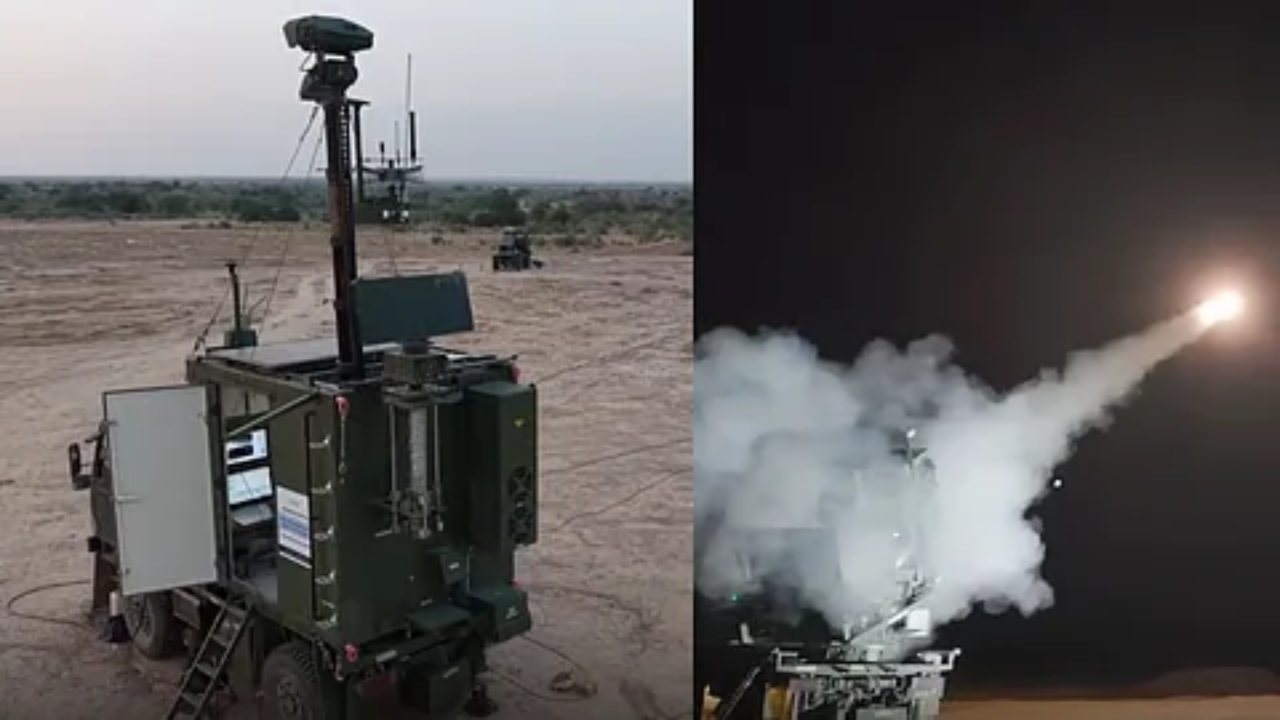
India has reached a significant milestone in indigenous air defence with the successful completion of in-house development trials of Bhargavastra, described by its developer as the country's first indigenously designed and developed two-layer, vehicle-mounted counter-swarm drone system (VMCSDS)1. Conducted by Nagpur-based private defence manufacturer Solar Defence and Aerospace Limited (SDAL) between 20 and 24 November 2026 at the Pokhran Field Firing Ranges in Rajasthan, the trials demonstrated the system's ability to detect, track, and physically destroy coordinated enemy drone swarms1. For aspirants following competitive exam news today and Atharva Examwise current news, this milestone bridges three high-weightage UPSC GS Paper III areas: indigenous defence technology, asymmetric drone warfare, and border management.
For exam precision, aspirants must distinguish between developmental testing and formal military induction. The Pokhran tests were company-run in-house development trials rather than formal Indian Army acceptance tests, and operational procurement has not yet been confirmed5. Unlike earlier munition-level trials at Gopalpur in May 2025, however, SDAL's account of the Pokhran exercise reports full validation of the detect–track–engage loop against live swarm-drone targets, positioning Bhargavastra for a deliverable-configuration prototype demonstration and handover to the Indian Army for user trials targeted for January 2027, according to defence media reports2. You can follow our daily syllabus-linked analyses on the Atharva Examwise Current Affairs Hub.
Key Facts and Exam-Relevant Highlights at a Glance
Review these high-yield facts tailored for UPSC Prelims, CDS, CAPF, MPPSC, and State Civil Services examinations:
- System Identity: Described as India's first indigenously designed and developed two-layer, vehicle-mounted counter-swarm drone system, operating primarily in kinetic hard-kill mode1.
- Developer: Solar Defence and Aerospace Limited (SDAL), the Nagpur-based defence subsidiary of Solar Industries India Limited5.
- Trial Venue and Dates: Conducted from 20 to 24 November 2026 at the Pokhran Field Firing Ranges, Rajasthan1, following earlier January and May 2025 firing trials at the Seaward Firing Range in Gopalpur, Odisha5.
- Procurement Pathway: Initiated against an Indian Army requirement issued on 9 July 2024 under the Ministry of Defence's Make-II (Buy Indian–IDDM) category of the Defence Acquisition Procedure (DAP) 2020, according to defence reporting2.
- Dual Interception Layers: Combines unguided air-defence micro-rockets (Layer 1 / Version-I) for swarm saturation with infrared-guided micro-missiles (Layer 2 / Version-II) for precision terminal homing against evasive UAVs and loitering munitions2.
- Operational Envelope: Engages hostile drones up to 2.5 km away (with an approximate 20-metre lethal radius per micro-rocket), backed by surveillance radar detection up to 10 km (about 6 km for micro-drones) and mobility across deserts, plains, and high-altitude areas up to 5,000 metres above mean sea level1.
| Parameter | Exam-Relevant Specification |
| System Type | Vehicle-Mounted Counter-Swarm Drone System (VMCSDS), 4×4 mobile platform3 |
| Developer | Solar Defence and Aerospace Limited (SDAL), Nagpur5 |
| Kill Mechanism | Kinetic Hard-Kill (modular architecture can also integrate an electronic Soft-Kill layer)1 |
| Layer 1 (Version-I) | 64-tube launcher firing unguided air-defence micro-rockets; ~20 m lethal radius5 |
| Layer 2 (Version-II) | 64-missile launcher firing guided micro-missiles with infrared (IR) seekers for terminal homing2 |
| Sensor Suite | Surveillance/cueing radar (up to 10 km; ~6 km for micro-drones), EO/IR day-night sensors, Passive RF detectors1 |
| Command & Control | AI-enabled C2 / C4I hub designed to integrate with broader Armed Forces air-defence networks1 |
| Terrain & Altitude | Deserts, plains, and high-altitude mountainous terrain up to 5,000 m above mean sea level1 |
| Acquisition Category | Make-II (Buy Indian–IDDM); Army requirement reported on 9 July 20242 |
| Reported Timeline | Handover for Army user trials targeted for January 2027; single-outlet reported deadline 31 March 20272 |
Architecture and Working Mechanism of Bhargavastra
Contemporary conflicts have exposed a sharp operational gap in conventional air defence: small, inexpensive Unmanned Aerial Vehicles (UAVs) operating in coordinated swarms can saturate traditional radars and deplete high-cost surface-to-air missile inventories5. Bhargavastra addresses this challenge through a self-contained sensor-to-shooter kill chain mounted on a single road-mobile chassis, allowing frontline units to shield convoys, artillery deployments, and forward bases on the move1.

Two-Layer Kinetic Design: Saturation Meets Precision
Bhargavastra's core engineering advantage lies in its two-layer engagement architecture, which pairs distinct munitions with distinct aerial threat profiles4. In Layer 1 (Version-I), a 64-tube launcher fires unguided air-defence micro-rockets out to 2.5 km, with earlier 2025 test coverage reporting a roughly 20-metre lethal radius per rocket5. By firing salvos into an incoming formation, Version-I saturates the target airspace to neutralise multiple closely spaced swarm drones simultaneously5.
In Layer 2 (Version-II), a 64-missile launcher deploys precision guided micro-missiles equipped with autonomous guidance and infrared (IR) seekers2. Because IR seekers home onto the thermal radiation emitted by a target during terminal engagement without requiring continuous launcher commands, this second layer is well suited for manoeuvring or high-value UAVs and loitering munitions2. According to The Times of India, SDAL developed this guided micro-missile variant independently beyond the Indian Army's original rocket-based requirement12.
Why Hard-Kill Matters: Defeating Autonomous Drones and Cost Asymmetry
Counter-Unmanned Aerial Systems (C-UAS) generally employ either soft-kill or hard-kill methods5. Soft-kill systems rely on electronic warfare—jamming radio-frequency communication links or spoofing navigation signals—to disable or divert hostile drones1. While effective against remotely controlled commercial quadcopters, electronic disruption loses reliability against autonomous drones that are pre-programmed to continue executing their missions even after communication or GPS/navigation links are severed1.
Bhargavastra addresses this vulnerability through kinetic hard-kill interception—physically destroying incoming drones regardless of whether they depend on external radio links1. Its modular architecture also allows an optional electronic soft-kill layer to be added for a broader response spectrum9. Equally critical is cost asymmetry: shooting down low-cost attack drones worth a few thousand dollars with conventional surface-to-air missiles—for context, defence coaching analyses estimate an indigenous Akash missile at roughly ₹2.5 crore per unit—is financially unsustainable in protracted conflicts5. Replacing expensive interceptors with small, lower-cost micro-rockets and micro-missiles helps preserve strategic missile stocks for manned aircraft and cruise missiles5.
Sensor Fusion, AI-Enabled C4I, and All-Terrain Mobility
Detecting tiny, low-flying UAVs against ground clutter demands multi-sensor integration. Bhargavastra fuses three complementary sensing modes into an AI-enabled Command, Control, Communications, Computers, and Intelligence (C4I) hub1:
- Surveillance Radar: Measures target position and speed via reflected radio waves, providing cueing detection up to 10 km and detecting micro-drones at roughly 6 km1.
- Passive Radio-Frequency (RF) Detectors: Unlike active radar, passive RF sensors emit no signals of their own—avoiding electronic detection—while picking up control-link and telemetry emissions directly from hostile drones1.
- Electro-Optical / Infrared (EO/IR) Sensors: Maintain day-and-night visual and thermal tracking to classify aerial targets accurately1.
Acting as the system's "brain," the AI-enabled Command and Control centre aggregates real-time sensor feeds, presents operators with a live situational picture, assigns targets to the launchers, and integrates directly into the Indian Armed Forces' wider C4I air-defence networks1. (Aspirants tracking India's broader sovereign AI ecosystem for GS Paper III can also read our explainer on MeitY's Indigenous Chariot-1 Foundation Models under the IndiaAI Mission.) Mounted on a 4×4 mobile vehicle, Bhargavastra is designed to operate across deserts, plains, and high-altitude mountain regions up to 5,000 metres above mean sea level, supporting deployment along both western border sectors and high-altitude Himalayan frontiers1.
How Bhargavastra Fits into India's Multi-Layered Air Defence Ecosystem
Bhargavastra is engineered to fill a specific ultra-short-range, high-volume anti-swarm ring within India's evolving multi-layered air-defence architecture. Following the May 2025 combat experience of Operation Sindoor—where India's indigenous air-defence grid intercepted waves of hostile drones and missiles—and the Prime Minister's Independence Day 2025 announcement of Mission Sudarshan Chakra (whose formal Ministry of Defence roadmap report was completed in November 2026), India is linking kinetic, directed-energy, electronic-warfare, and automated C4I layers into a single unified shield14.

Each indigenous platform plays a distinct, non-duplicative role in this layered defence grid. The DRDO–BEL D4 System (Drone Detect, Deter, and Destroy)—jointly developed by DRDO and Bharat Electronics Limited (BEL) and listed as operationally proven by the Department of Defence Production (DDP)—performs real-time search, detection, tracking, and neutralisation of micro and small UAVs18. Defence media reports place D4's detection envelope at up to 4 km, pairing RF jamming (soft-kill) with a 10–12 kW laser (hard-kill) effective to roughly 3 km19. Above that power class sits DRDO's vehicle-mounted Mk-II(A) 30 kW Laser Directed Energy Weapon (DEW) developed by the Centre for High Energy Systems and Sciences (CHESS), Hyderabad, which was demonstrated on 13 April 2025 at Kurnool, Andhra Pradesh, with final trials concluding in August 2025 before moving toward industry-led production22. While directed-energy systems engage targets sequentially via high-energy beams, Bhargavastra's 64-tube rocket salvo and 64-missile launcher offer simultaneous kinetic saturation against dense drone swarms across varied terrain up to 5,000 metres1.
Further out in the defensive envelope, DRDO's Research Centre Imarat (RCI) developed the fourth-generation man-portable VSHORADS (Very Short Range Air Defence System), which uses a dual-band imaging infrared seeker to neutralise low-altitude helicopters, aircraft, and drones at ranges of 0.25–6 km and altitudes up to 3.5 km26. On 23 August 2025, DRDO conducted the maiden flight-tests of the all-indigenous Integrated Air Defence Weapon System (IADWS) off the Odisha coast—as documented in the official PIB release—simultaneously destroying two high-speed fixed-wing UAVs and one multi-copter drone by fusing QRSAM, VSHORADS, and a High-Power Laser DEW under a Centralised Command & Control Centre developed by DRDL30. Binding India's ground-based air defence together is Project Akashteer, BEL's automated, vehicle-mounted Air Defence Control and Reporting System (ADCRS) inducted by the Corps of Army Air Defence in April 202414. Linked to the Indian Air Force's IACCS and the Navy's Trigun network, Akashteer demonstrated its wartime value during Operation Sindoor, as highlighted in the PIB backgrounder on Project Akashteer14. Because Bhargavastra's AI-enabled C4I hub is built for network integration, it is designed to plug directly into this automated battle web1.
Defence Acquisition Procedure (DAP 2020), Make-II, and Private-Sector Indigenisation
Beyond tactical air defence, Bhargavastra illustrates India's structural transition from import dependence and public-sector exclusivity toward private-sector defence R&D. Developed under the Make-II (Buy Indian–IDDM) framework of the Defence Acquisition Procedure (DAP) 2020, the programme highlights procurement distinctions frequently tested in UPSC Prelims2:
- Make-II Procedure: Targets prototype development and import substitution funded entirely by Indian industry (including private enterprises and MSMEs), with no government R&D funding during the prototype stage2. Under the DAP 2020 amendments notified by the Ministry of Defence, Make-II timelines were compressed from 122–180 weeks to 101–109 weeks by introducing Single Stage Composite Trials11.
- Buy (Indian–IDDM): Stands for Indigenously Designed, Developed, and Manufactured—the highest-priority capital acquisition category under DAP 2020, backed by a 2023 amendment mandating at least 50% indigenous content (materials, components, and software) across procurement categories2.
- Capital vs. Revenue Procurement: DAP 2020 governs capital acquisitions (new platforms such as Bhargavastra), whereas the Defence Procurement Manual (DPM) 2025 (effective 1 November 2025) governs revenue procurement for maintenance, spares, and operational sustenance33.
These policy reforms have coincided with a rapid expansion in domestic defence manufacturing and exports, as recorded in official FY 2025–26 Ministry of Defence figures released by PIB in April 2026 and June 202635.

Connecting Bhargavastra to these FY 2025–26 official benchmarks yields three analytical points valuable for Mains answers. First, private-sector depth is expanding rapidly: private industry's share of domestic defence output rose from 22% in FY 2024–25 to a record 24% (roughly ₹42,000 crore) in FY 2025–2636. SDAL's product line—extending from Nagastra-1R (450 units delivered in a single batch to the Army) and Nagastra-2 anti-tank loitering munitions to Bhargavastra—shows private firms progressing from sub-components to complete, integrated weapon systems5. Second, building indigenous counter-drone sensors, seekers, and micro-munitions strengthens supply-chain sovereignty by helping purge imported—especially Chinese—components from military drone ecosystems, a priority sharpened by stricter Chinese export licensing rules taking effect from 18 November 20265. Domestic sourcing tools such as the Srijan DEEP portal (listing over 41,000 vendors and 2.7 lakh products as of May 2026) and 10 Positive Indigenisation Lists (5,521 items) reinforce this industrial base36.
Third, balanced UPSC answers should note the remaining execution hurdles. Completing company-run trials is a vital engineering checkpoint, not operational induction5. While defence portal Bharat Shakti has reported a contract structure involving one working prototype and twelve operational sets with a 31 March 2027 deadline, analysts emphasize that single-outlet timelines should be treated as targets rather than firm induction commitments5. Formal user trials conducted by the Indian Army under harsher operational conditions and service-chosen threat profiles will ultimately determine induction timelines5.
(External reference: Read the India Today report on Bhargavastra's Pokhran development trials for additional field-trial coverage.)
Practice Questions for UPSC Prelims and Mains
Consolidate your understanding with these exam-modeled practice questions. For monthly compilations and previous papers, explore our Current Affairs MCQ PDFs and UPSC Previous Year Questions (PYQs).
Prelims Practice Question 1
Consider the following statements regarding Bhargavastra, recently seen in the news:
- It is India's first indigenously designed two-layer, vehicle-mounted counter-swarm drone system developed by the Defence Research and Development Organisation (DRDO).
- It relies exclusively on electronic soft-kill jamming to disable incoming autonomous drones without physically destroying them.
- It has been developed under the Ministry of Defence's Make-II (Buy Indian–IDDM) category, in which prototype development is industry-funded.
Which of the statements given above is/are correct?
- (a) 1 and 2 only
- (b) 3 only
- (c) 2 and 3 only
- (d) 1, 2 and 3
Answer: (b) 3 only Explanation: Statement 1 is incorrect because Bhargavastra is developed by Nagpur-based private company Solar Defence and Aerospace Limited (SDAL), not DRDO1. Statement 2 is incorrect because Bhargavastra operates primarily in kinetic hard-kill mode (using unguided micro-rockets and IR-guided micro-missiles) to physically destroy autonomous drones immune to jamming, though its modular design can accommodate an optional soft-kill layer1. Statement 3 is correct: it was initiated under the Make-II (Buy Indian–IDDM) route, where prototype development is industry-funded2.
Prelims Practice Question 2
With reference to India's indigenous air-defence and counter-UAV systems, consider the following pairs:
| System | Primary Capability / Role |
| 1. Project Akashteer | Automated Air Defence Control and Reporting System (ADCRS) |
| 2. Mk-II(A) CHESS System | 30 kW Laser Directed Energy Weapon (DEW) |
| 3. VSHORADS | Long-range exo-atmospheric ballistic missile interceptor |
How many of the pairs given above are correctly matched?
- (a) Only one pair
- (b) Only two pairs
- (c) All three pairs
- (d) None of the pairs
Answer: (b) Only two pairs Explanation: Pairs 1 and 2 are correctly matched23. Pair 3 is incorrect because VSHORADS (Very Short Range Air Defence System) is a fourth-generation man-portable air-defence missile (MANPADS) designed for low-altitude short-range threats up to 6 km, not an exo-atmospheric ballistic missile interceptor27.
Mains Practice Question (GS Paper III — 10 Marks, 150 Words)
“Low-cost autonomous drone swarms have fundamentally altered the economics of border security and conventional air defence.” Discuss how indigenous counter-UAS platforms like Bhargavastra and Make-II defence reforms strengthen India's layered air-defence posture.
Why this matters for your exam preparation
For serious aspirants preparing for UPSC CSE 2027, MPPSC, UPPSC, CDS, CAPF, and other competitive exams, the Bhargavastra Pokhran trials connect directly to repeatedly tested themes across all stages of the examination:
- UPSC Prelims (Science & Technology and Current Affairs): UPSC steadily prioritizes conceptual distinctions over rote facts in defence technology. Recent Prelims papers have tested operational applications of drones (Prelims 2020), trajectory and propulsion differences between ballistic and cruise missiles (Prelims 2023), and fighter aircraft generations across Rafale, MiG-29, and Tejas Mk-1 (Prelims 2024)44. From this topic, prepare for conceptual questions contrasting hard-kill vs. soft-kill, active radar vs. passive RF sensing, infrared (IR) terminal homing, Make-II vs. Buy Indian–IDDM, and pair-matching across Bhargavastra, D4, VSHORADS, IADWS, and Akashteer.
- UPSC Mains GS Paper III (Internal Security, Border Management & Indigenisation of Technology): Cross-border rogue UAVs are a live Mains theme—demonstrated by the UPSC Mains 2023 GS-III question (“The use of unmanned aerial vehicles (UAVs) by our adversaries across the borders to ferry arms/ammunition, drugs, etc., is a serious threat to internal security. Comment on the measures being taken to tackle this threat.”)47. Integrating Bhargavastra's Pokhran trials (Nov 2026), DRDO's IADWS maiden test (Aug 2025), Akashteer's performance in Operation Sindoor (May 2025), and FY 2025–26 defence production (₹1.78 lakh crore; 24% private share) equips your answers with authoritative, up-to-date evidence on border security, asymmetric warfare, and Aatmanirbhar Bharat5.
- State PCS, Defence (CDS/NDA/CAPF), and Objective Competitive Exams: Direct factual items frequently ask for the developer (Solar Defence and Aerospace Limited, Nagpur), trial site (Pokhran Field Firing Ranges, Rajasthan), system distinction (two-layer, vehicle-mounted counter-swarm drone system), interception range (2.5 km), and high-altitude operational ceiling (5,000 m)1.
Continue building your GS Paper III edge with structured revision tools on Atharva Examwise: visit our UPSC Preparation Portal, download visual Revision Mind Maps and Complete Study Material, and explore our Science & Technology explainer on Japan's MMX Mission to Mars' Moon Phobos.