Current Affairs 27 November 2026: Telangana's 400-Year-Old Narayanpet Saree, Maratha Links, GI Tag and Handloom Push | UPSC Current Affairs & Daily GK Update
In today's edition of Atharva Examwise current news and competitive exam news today, we examine the historical, technical, and policy significance of Telangana's Narayanpet handloom saree—a nearly 400-year-old weaving tradition celebrated for its understated elegance, vibrant palette, and distinctive synthesis of Telugu Deccan craftsmanship with Maratha cultural aesthetics1. Protected under India's Geographical Indication (GI) framework and designated as the primary One District One Product (ODOP) for Narayanpet district, the cluster has returned to policy focus in late 2026 as regional reports confirm that Telangana's first Handloom Centre of Excellence (CoE)—built in Narayanpet by TESCO for ₹12 crore—is ready for inauguration3.
For serious aspirants tracking UPSC current affairs and State PCS developments, Narayanpet sits at a high-yield crossroads of Art & Culture (GS Paper I), Artisan Welfare Governance (GS Paper II), and Intellectual Property Rights and Rural Livelihoods (GS Paper III). Mastering this topic requires separating local oral legend from verifiable chronology, distinguishing Narayanpet's mandatory GI design rules from neighbouring Deccan weaves like Gadwal, Ilkal, and Paithani, and tracking 2025–2026 central and state handloom reforms7.
Key Facts and Exam-Relevant Data at a Glance
- Product & GI Class: Narayanpet Handloom Sarees (cotton, pure silk, and silk-cotton blends), registered under Class 25 (Handicrafts/Textiles)2.
- Geographical Origin: Narayanpet town and surrounding weaving clusters in Narayanpet district, Telangana (about 165 km by road from Hyderabad, bordering Karnataka)7.
- District Formation: Narayanpet was carved out of erstwhile Mahabubnagar district on 17 February 2019 (alongside Mulugu), raising Telangana's total to 33 districts; it comprises 1 revenue division and 13 mandals11.
- Official GI Registration: Registered on 4 March 2013 (FY 2012–13) under the GI Act, 19996; registry trackers record Application No. 214 (filed 2 August 2010) and Certificate No. 186, valid through 1 August 2030 (renewable every 10 years indefinitely)7.
- Registered Proprietor: Narayanpet Silk & Cotton Handloom Sarees Apex Society, with multiple local handloom cooperatives and the Master Weaver's Association listed among original applicants2.
- ODOP & Quality Branding: Designated Primary ODOP textile for Narayanpet district3; Narayanpet cotton sarees are also listed under the Ministry of Textiles' India Handloom Brand (IHB)15.
- Signature Loom Innovation: Instead of mounting the standard 7 yards per saree, weavers traditionally load roughly 56 yards of yarn on a single loom to weave eight sarees in one go1.
- 2026 Institutional Milestone: Regional press reports in October 2026 noted that Telangana's first Handloom Centre of Excellence, built across 5 acres in Narayanpet by TESCO (Telangana State Handloom Weavers' Co-operative Society) at a cost of ₹12 crore, is ready for inauguration4.
- District Heritage Cross-Link: Narayanpet district is also home to the Mudumal Megalithic Menhirs (dating back 3,500–4,000 BP), widely recognized as India's oldest known standing stones and a prehistoric astronomical site, inscribed on India's UNESCO World Heritage Tentative List in 2025 (Ref. No. 6802)17.
Historical Origins: The Maratha Connection and Regional Patronage
Traditional accounts—echoed in both the Narayanpet district handicraft profile and the official GI application—trace the origins of Narayanpet sarees to approximately 1630 CE, linking them to Chhatrapati Shivaji Maharaj camping in the region during a Deccan journey1. According to this local narrative, several weavers accompanying his entourage remained behind when he moved on, settling in Narayanpet and introducing Maratha weaving sensibilities that blended organically with local Telugu craftsmanship1. Over subsequent generations, the craft flourished and reached its commercial peak under the regional patronage of the Lokapalli (Lokayapalli) Samasthanam, a Nayak principality that later functioned as a feudatory estate under the Asaf Jahi Nizams of Hyderabad2.
For UPSC History and Culture precision, however, aspirants must note an important chronological caveat. Chhatrapati Shivaji Maharaj was born on 19 February 1630 at Shivneri Fort, initiated his military campaigns in 1646 with the capture of Torna Fort, and led his major southern campaign into Karnataka and Gingee in 167721. Historical assessments therefore caution that the 1630 CE Shivaji encampment narrative should be treated as an enduring local historical tradition preserved in official folklore rather than an independently corroborated contemporary primary-source event for that exact year7.
What is historically well documented is Narayanpet's character as a multilingual cultural bridge situated along the Telangana–Karnataka–Maharashtra corridor11. Historically, residents and guild networks across Narayanpet spoke Telugu, Marathi, Kannada, Urdu, and Hindi, maintaining deep commercial ties with Solapur in Maharashtra8. This shared Deccan cultural sphere explains the strong Maharashtrian imprint on Narayanpet's disciplined geometric borders, dark maroon palettes, and 9-yard cotton weaves, as well as the enduring Maharashtrian custom of wearing Narayanpet sarees on auspicious occasions and offering them to Goddesses2. To connect this Deccan legacy with Maratha strategic heritage, read our detailed brief on Maratha Military Landscapes Inscribed as India's 44th UNESCO World Heritage Site22.
Craftsmanship, Design Grammar, and the Eight-Saree Loom Technique
Unlike heavily brocaded ceremonial weaves, Narayanpet sarees derive their distinct identity from structural clarity, lightweight comfort across warm climates, durability, and everyday affordability1. Every step of traditional production takes place manually on pre-set handlooms without power machinery, sustained by a specialized inter-regional raw material chain documented in the GI application2.

The raw material chain and preparation protocol reflect meticulous regional division of labour. Pure cotton varieties use fine 80s count combed cotton yarn (80s × 80s warp and weft) sourced from spinning mills around Vijayawada; pure silk varieties use 18/20 denier twisted silk from Bengaluru; gold zari is procured from Surat; and cotton-silk (sico) blends pair a pure silk warp with a pure cotton weft1. Cotton yarns undergo hand-sizing (never street-sizing) and starch gumming, whereas raw silk omits sizing and is degummed by boiling in caustic soda to make the finished fabric airy and light2. Yarns are dyed at high temperatures in vivid shades of red, yellow, green, purple, and pink—as well as striking double-shade blends like pink-purple and maroon-mustard—using durable naphthol and vat dyes (with natural vegetable dyeing also noted in select traditional accounts) and dried strictly in the shade; the GI specification explicitly credits Narayanpet's local water quality with enhancing color vibrancy and fastness1.
On the loom, Narayanpet's hallmark is its simultaneous eight-saree warp technique: instead of mounting 7 yards for a single saree, weavers mount roughly 56 yards of yarn (traditionally silk) at one time to weave eight sarees in a single run, with a full warp beam yielding up to 30 sarees—and continuous cotton weaves producing 45 to 60 sarees cut to required lengths (5.5 m without blouse, 6.20 m with blouse, or 8.25 m for traditional formats)1. Using traditional interlocked-weft weaving, artisans deploy a dobby mechanism specifically for the border threads and zari, while pallu zari is wound onto a bobbin, transferred to a kandi, and inserted into the shuttle1.
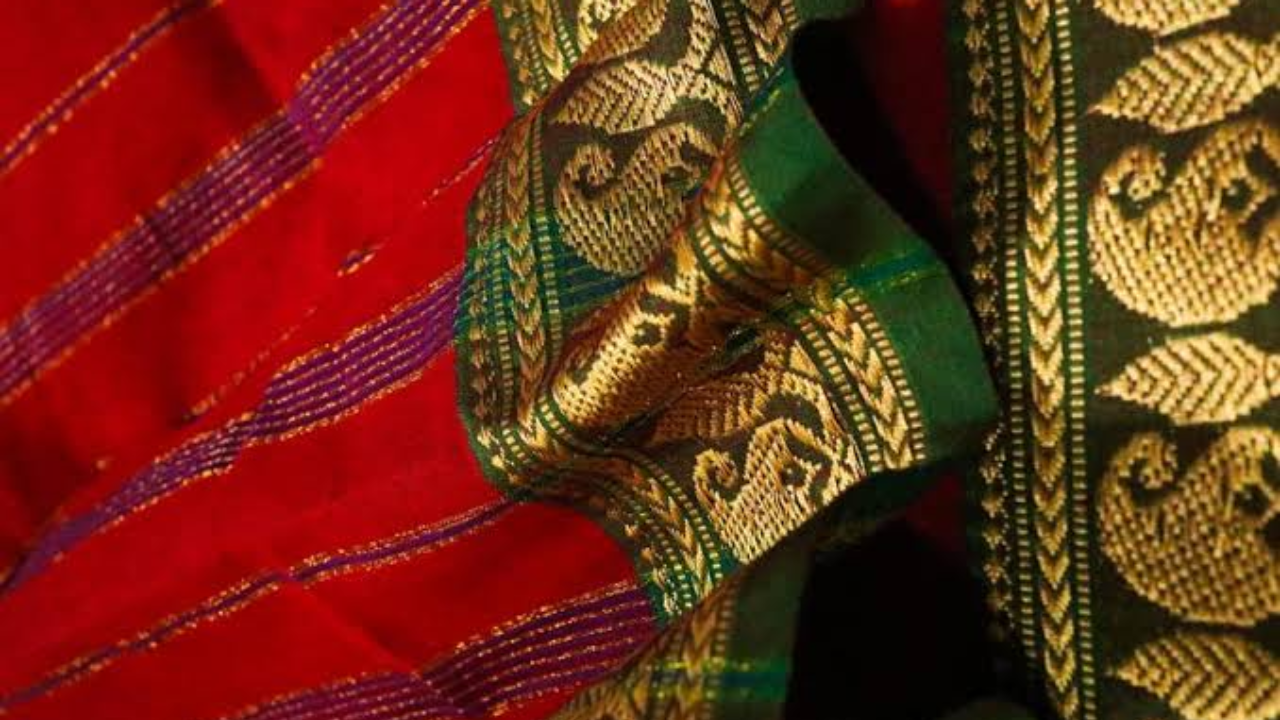
Equally exam-relevant are the mandatory GI design distinctions between cotton and silk Narayanpets. Every cotton saree must feature all-over body checks woven with 5 to 25 double threads (so the grid remains crisp against the ground color) and carry no floral or animal buttis2. Both cotton and silk variants must have matching twin borders (3 to 5.5 inches wide) running along both long edges and stopping cleanly where the pallu begins—typically presenting a flat stretch of deep maroon, chocolate red, or crimson divided by fine white lines and golden zari ribbons bearing geometric, swan, mango, or leaf motifs1. While cotton pallus (minimum 60 cm) stand out for their alternating red, deep maroon, and white horizontal bands with zari accents, pure silk Narayanpets compulsorily incorporate a thicker temple border (mogu)—woven with 6 threads per reed—and a double-pointed arrowhead theni pallu, where tie-and-dye yarn treatment is permitted exclusively in the pallu section1.
Comparative Table: Narayanpet vs. Neighbouring Deccan GI Sarees
Because UPSC and State PCS exams routinely test regional textile attribution by pairing neighbouring Deccan weaves with mismatched states or loom techniques26, the matrix below contrasts Narayanpet with its closest peers.
| Feature | Narayanpet Handloom Saree | Gadwal Saree | Ilkal (Irkal) Saree | Paithani Saree |
| GI Registered State | Telangana (also woven in Solapur, MH)6 | Telangana (Jogulamba Gadwal)6 | Karnataka (Bagalkot)8 | Maharashtra (Yeola / Paithan)8 |
| Primary Fabric | 80s combed cotton, pure silk, silk-cotton2 | Cotton body with silk border & pallu (also pure silk)28 | Cotton body with art/pure silk border & pallu8 | Heavy pure silk and real zari8 |
| Signature Loom Technique | 8-saree (56-yard) warp; dobby border; interlocked weft1 | Kuttu (specialized interlocking join between cotton body & silk border/pallu)28 | Tope teni (looped warp-to-warp join between body & pallu)8 | Weft-against-weft interlocked tapestry weave (no back floats; near-reversible)8 |
| Distinctive Visual Traits | Compulsory body checks (cotton); temple border & theni arrowheads (silk)2 | Contrasting rich zari borders and decorative pallu over lightweight body28 | Visible row of tope teni joining loops with traditional borders8 | Elaborate zari pallu famously featuring peacock and lotus motifs30 |
GI Legal Framework, Telangana's Handloom Map, and Certification Marks
Narayanpet's legal shield derives from the Geographical Indications of Goods (Registration and Protection) Act, 1999 (effective from 15 September 2003), enacted to meet India's obligations under Articles 22–24 of the WTO TRIPS Agreement9. Administered by the Geographical Indications Registry in Chennai under the Controller General of Patents, Designs and Trade Marks (DPIIT, Ministry of Commerce and Industry), a GI tag establishes a collective, non-transferable community right anchored permanently to a defined geographical territory—unlike a trademark, which belongs to an individual or firm and can be sold or licensed outside its region of origin9.

Two recurring Prelims traps stand out from the official GI record. First, several coaching blogs confuse Narayanpet's GI application filing date (2 August 2010) or an erroneous 2015 date with its formal registration5; the Office of the Development Commissioner for Handlooms officially lists Narayanpet's registration date as 4 March 2013 (FY 2012–13)6. Similarly, aspirants should update outdated national figures: rather than citing "over 600 GIs," PIB's 4 August 2026 backgrounder confirms India has crossed 800 registered GI products (with the official GI Registry year-wise list reaching 822 entries as of 31 March 2026, led by Uttar Pradesh with 81, Tamil Nadu with 76, and Maharashtra with 55 as of December 2025)9. Second, aspirants must clearly distinguish India's four textile certification marks, which carry very different legal and technical guarantees37:
| Certification Mark | Issuing / Implementing Body | What It Certifies | What It Does Not Prove |
| GI Tag | GI Registry, Chennai (DPIIT, Ministry of Commerce)32 | Geographical origin & collective community right under GI Act, 199914 | Does not guarantee an individual saree's authenticity unless sold by a registered Authorised User37 |
| Handloom Mark (2006) | Textiles Committee (Ministry of Textiles)37 | Fabric is genuinely handwoven in India (QR-verifiable via customer app)38 | Does not certify yarn composition (silk vs. cotton)37 |
| Silk Mark | Silk Mark Organisation of India (Central Silk Board)37 | Yarn is 100% pure natural silk (advisory scheme with numbered hologram)37 | Does not prove handloom weaving—powerloom pure silk can carry it37 |
| India Handloom Brand (2015) | Development Commissioner (Handlooms) & Textiles Committee15 | Handwoven + lab-tested quality, safe dyes, zero defect & social/environmental compliance15 | Applies only to notified niche product categories (including Narayanpet cotton)15 |
For deeper revision on India's statutory GI architecture and recent registrations, read our explainers on the Geographical Indications Act 1999 and Jharkhand's GI Products and Ambaji Temple's Mohanthal Securing GI Protection41.
Economic Pressures and 2025–2026 Policy Interventions
Despite four centuries of heritage and statutory GI recognition, Narayanpet's weaving ecosystem—historically anchored by artisan communities such as the Padmasali and Devanga weavers—has endured acute structural stress7. Field accounts and regional press reports highlight rising raw cotton and silk yarn costs, relentless competition from cheaper powerloom lookalikes, lower weaver earnings relative to neighbouring states, marketing bottlenecks, and youth migration away from the loom4. Importantly, no publicly available, up-to-date official census establishes the exact number of active handlooms in Narayanpet today; while older accounts cite roughly 50,000 looms historically, later field reports document a steep contraction, so historical estimates should not be cited as current official figures7.
To arrest this decline, state and central authorities have layered infrastructure, welfare, and market-access reforms across 2025–2026. At the cluster level, regional news reports in October 2026 confirmed that Telangana's first Handloom Centre of Excellence, built by TESCO over 5 acres in Narayanpet at a cost of ₹12 crore, is ready for inauguration4. By co-locating an administrative block, skill-training centre, weaving, dyeing, and garment units, a modern design studio, and an upcoming sales hub, the CoE aims to modernize product diversification and connect weavers directly with institutional and retail buyers4.
On the social-security front, Telangana's Chenetha Abhayahastam umbrella—approved in January 2025 with a ₹168 crore budget allocation—integrates multiple weaver welfare schemes: Nethanna Bharosa / Nethannaku Bharosa (allocated ₹48 crore for roughly 40,000 identified workers, offering ₹18,000/year to weavers operating geo-tagged looms and ₹6,000/year to ancillary workers via DBT, though a regional newspaper report in August 2026 flagged delays in releasing the second quarterly installment), Nethanna Bhadratha (₹5 lakh death insurance cover), Nethannaku Cheyutha (a thrift scheme where an 8% weaver saving is matched by a 16% state contribution), individual loan waivers up to ₹1 lakh, and yarn subsidies4. Aspirants must avoid a frequent Prelims confusion here: Telangana's ₹18,000/year Nethanna Bharosa is distinct from Andhra Pradesh's Nethanna Sevalo scheme (earlier announced as AP Nethanna Bharosa and launched on 7 August 2026), which welfare portals report provides ₹25,000/year plus 200 free electricity units per month to eligible BPL handloom families44.
Complementing state support, the Union Ministry of Textiles operates the National Handloom Development Programme (NHDP) and Raw Material Supply Scheme (RMSS), delivering upgraded looms (Hathkargha Samvardhan Sahayata), Weavers' MUDRA concessional credit (20% margin money up to ₹25,000 per individual weaver), yarn price and transport subsidies, and digital onboarding—with 5,413 weavers onboarded onto the India Handmade portal between 2023–24 and June 202646. Simultaneously, the 2025 amendment to the GI Rules reduced filing fees by roughly 80% and cut renewal fees from ₹3,000 to ₹500; an August 2026 DPIIT–MSME MoU launched a Bharat GI initiative to bring GI collectives onto ONDC and GeM toward a stated target of 10,000 GI registrations by 2030; and in June 2026, the Ministry of Textiles issued an RFP to create a unified tiered "Textiles of India" masterbrand uniting over 104 GI-tagged handlooms and national certification marks9.
To situate handloom policy within India's broader heritage infrastructure, explore our recent updates on the ₹3,230 Crore Yuge Yugeen Bharat Museum (whose inaugural gallery showcases Indian Textiles & Adornment), Assam's Historic Rang Ghar and Heritage Conservation Push, and our complete Atharva Examwise Daily Current Affairs Portal48.
Credible Official & External References
- District Administration of Narayanpet (Handicrafts): Official Narayanpet Saree Heritage Profile1
- Government of India ODOP Portal: Narayanpet Handloom Sarees – Primary GI & ODOP Listing3
- Office of the Development Commissioner for Handlooms: List of GI Registered Handloom Products under GI Act6
- Official GI Application Record: Form GI-1 Technical Specification for Narayanpet Sarees2
- Press Information Bureau (PIB): GI Tags: Scaling Traditional Wealth into Global Brands (4 August 2026)35
- UNESCO World Heritage Centre: Mudumal Megalithic Menhirs, Narayanpet District (Tentative List Ref. 6802)18
Why this matters for your exam preparation
Traditional textile clusters and Geographical Indication tags form one of the highest-yield bridges between static Art & Culture and dynamic economic current affairs across UPSC and State PCS exams. Here is how to leverage this daily GK update across every stage:
- UPSC Prelims (GS Paper I – Art & Culture, Economic Geography, IPR): UPSC regularly frames place-to-craft and GI-status elimination questions, including UPSC Prelims 2014 (Bhadrachalam, Chanderi, Kancheepuram, Karnal for traditional sarees)51, UPSC Prelims 2015 (Banaras Brocades, Rajasthani Daal-Bati-Churma, Tirupathi Laddu for GI status)52, and UPSC Prelims 2018 (Puthukkuli shawls, Sujni embroidery, Uppada Jamdani craft-state pairs)26. Prepare for multi-statement traps testing: (1) Narayanpet's GI state (Telangana, not Maharashtra despite Maratha cultural links), (2) Telangana's six GI handlooms (Pochampally Ikat, Gadwal Sarees, Siddipet Gollabhama, Narayanpet Handloom Sarees, Warangal Durries, Telia Rumal), (3) legal differences between a GI tag and a Trademark, (4) distinctions among Handloom Mark, Silk Mark, and IHB, and (5) Mudumal Megalithic Menhirs in Narayanpet district6.
- UPSC Mains (GS Paper I & GS Paper III): Under GS Paper I (Indian Heritage & Culture), Narayanpet offers a crisp case study of syncretic Deccan craft traditions, illustrating how regional patronage (Lokapalli Samasthanam) and cross-border linguistic ties shaped enduring material culture1. Under GS Paper III (IPR, MSMEs & Rural Livelihoods), use Narayanpet's ₹12 crore Handloom CoE, the 2025 GI Rules fee cut, and the 2026 Bharat GI–ONDC push to show why legal GI registration alone is insufficient—artisan incomes only rise when backed by authorised-user enrolment, post-registration quality checks, design studios, and direct digital market access4.
- State PCS (TSPSC, APPSC, MPSC) & One-Day Exams (SSC CGL, Banking, Railways): Expect direct factual MCQs on the location of Telangana's first Handloom Centre of Excellence (Narayanpet, built by TESCO, ₹12 crore), National Handloom Day (7 August, commemorating the 1905 Swadeshi Movement), Narayanpet district's creation date (17 February 2019), and separating Telangana's Nethanna Bharosa (₹18,000/yr) from Andhra Pradesh's Nethanna Sevalo (₹25,000/yr)5.
Practice Mains Question for Serious Aspirants
While India's Geographical Indication (GI) registrations have crossed 800, traditional handloom clusters continue to face powerloom imitation and stagnant weaver incomes. Using Telangana's Narayanpet handloom cluster and recent 2025–2026 policy interventions as a case study, examine how institutional design, branding, and digital market integration can translate legal GI protection into sustainable rural livelihoods. (250 words | GS Paper III)