UPSC Current Affairs November 27, 2026: MeitY Launches Indigenous Chariot-1 Foundation Models Under IndiaAI Mission | Daily GK Update
UPSC Current Affairs November 27, 2026: MeitY Launches Indigenous Chariot-1 Foundation Models Under IndiaAI Mission | Daily GK Update
Meta Description: UPSC Current Affairs Nov 27, 2026: MeitY launches Chariot-1 foundation models under IndiaAI Mission. Daily GK update on IndicShift, 10 Indian languages & GS3.
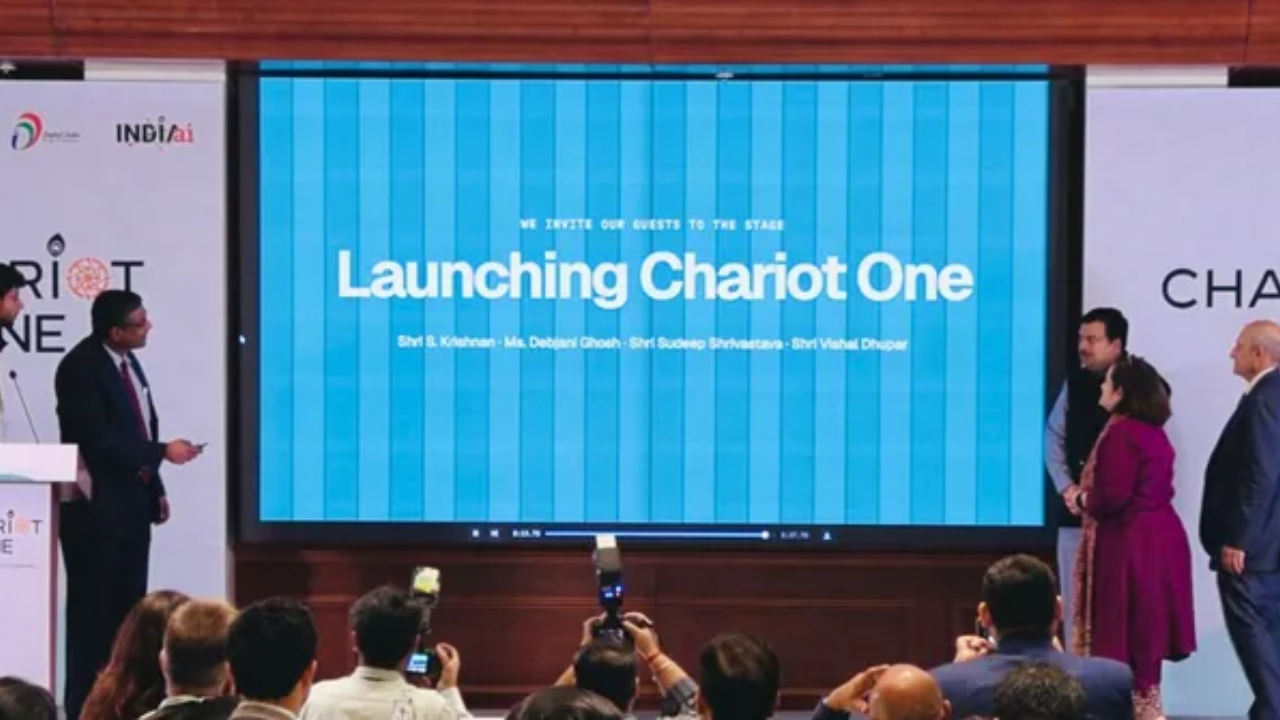
The Ministry of Electronics and Information Technology (MeitY) has formally launched the indigenous Chariot-1 Foundation Models, developed from scratch in India by Chariot Artificial Intelligence Pvt. Ltd. under the IndiaAI Mission1. Announced via an official Press Information Bureau (PIB) release on November 26, 2026, following an inauguration and research showcase by MeitY Secretary Shri S. Krishnan at Bharat Mandapam, New Delhi, the rollout marks a key milestone in India's push for sovereign artificial intelligence1. As part of today's Atharva Examwise current news and daily GK update, aspirants should note that the Chariot-1 suite pairs an 11-billion-parameter Large Language Model (LLM) with a context-aware Text-to-Speech (TTS) model supporting English and 10 Indian languages1.
What sets this development apart in competitive exam news today is that Chariot-1 is neither an adapted foreign base model nor a narrow translation utility. Both models were pre-trained from scratch domestically and embed three homegrown research innovations—IndicShift, Nested Training, and Mixture of Vocabularies—engineered to solve the token inefficiency and compute bottlenecks that have historically constrained Indian-language AI1.
Key Facts at a Glance
For rapid revision ahead of UPSC Prelims, State PSCs, SSC, and Banking examinations, retain these verified details from the official launch:
- Model Suite Launched: Chariot-1 Foundation Models, comprising Chariot-1 Large Language Model (LLM) and Chariot-1 Text-to-Speech (TTS)1.
- Developer: Chariot Artificial Intelligence Pvt. Ltd. (a Delhi-headquartered frontier AI research lab formerly known as Gan AI / Gan.ai), co-founded by Stanford University graduates Suvrat Bhooshan and Parth Sarthi1.
- Nodal Ministry and Mission: Ministry of Electronics and Information Technology (MeitY) under the IndiaAI Mission1.
- Launch Details: Inaugurated by MeitY Secretary Shri S. Krishnan at Bharat Mandapam, New Delhi (showcase held November 25, 2026; official PIB press release issued November 26, 2026)1.
- Selection Cohort: One of the first four teams (Phase 1) selected under the IndiaAI Mission to build sovereign foundation models, alongside Sarvam AI, Soket AI, and Gnani AI1.
- LLM Specifications: 11-billion-parameter Mixture-of-Experts (MoE) architecture with 4 billion active parameters per token, available in three deployable sizes: 10.7 billion, 1.7 billion, and 745 million parameters1.
- TTS Language Coverage: English and 10 Indian languages—Hindi, Bengali, Marathi, Tamil, Telugu, Kannada, Malayalam, Gujarati, Punjabi, and Odia1.
- Three Research Innovations: IndicShift (open-source shared Indian script alphabet), Nested Training (simultaneous multi-size training), and Mixture of Vocabularies (grouped vocabulary scoring)1.
- Policy Update at the Sidelines: Speaking during the launch event, MeitY Secretary S. Krishnan stated that India's AI regulation papers are in their final stages and will be released shortly10.
Inside the Chariot-1 Foundation Model Suite
The Chariot-1 release targets two interdependent layers of India's digital landscape: efficient multilingual language comprehension and natural voice generation tailored to a predominantly voice-first user base4. Rather than fine-tuning foreign open-weight checkpoints, Chariot AI pre-trained both models from scratch in India using compute access facilitated under the IndiaAI Mission1. The technical scorecard below summarizes the suite's parameter scaling, deployment footprint, and reported training efficiency gains.

Chariot-1 Large Language Model (LLM)
The Chariot-1 LLM adopts an 11-billion-parameter Mixture-of-Experts (MoE) architecture in which only 4 billion parameters are active per token1. Because an MoE model routes each token only through specialized sub-networks rather than engaging every weight simultaneously, it combines the broader linguistic capacity of a larger model with inference costs closer to those of a much smaller dense system4.
Equally significant for real-world deployment is its elastic three-tier sizing—10.7 billion, 1.7 billion, and 745 million parameters—allowing developers and government agencies to run compatible variants across cloud data centres, laptops, smartphones, and edge devices1. To see how compact, on-device AI models intersect with hardware self-reliance, read our detailed explainer on Edge AI, AI Superchips, and India's Semiconductor Mission on Atharva Examwise14.
Chariot-1 Text-to-Speech (TTS) and Context-Aware Verbalisation
Alongside the language model, Chariot-1 TTS synthesizes speech across English and 10 Indian languages: Hindi, Bengali, Marathi, Tamil, Telugu, Kannada, Malayalam, Gujarati, Punjabi, and Odia1. Conventional TTS systems often misread everyday text unless engineers build manual normalization rules to expand currencies, dates, or shorthand15. Chariot-1 TTS incorporates contextual understanding directly into speech generation, enabling it to determine how non-standard expressions—such as payment amounts, dates, measurement units, website URLs, abbreviations, or context-dependent tokens like "B+" (a blood group versus an academic grade)—should be pronounced naturally1.
On the Async TTS Pronunciation Benchmark (spanning 1,029 real-world sentences and 2,251 instances of non-standard text across 42 categories), the official launch release reported over 97% verbalisation accuracy1. In the same evaluation, Chariot-1 TTS recorded a Hindi Character Error Rate (CER) of 7.60% and an average CER of 6.47% across the other nine Indian languages—reported as the lowest among the systems tested1. Aspirants should exercise healthy analytical caution here: these benchmark figures come from reported launch and developer evaluations rather than independent third-party academic audits1. Additionally, while Chariot AI offers real-time Automatic Speech Recognition (Chariot-1-ASR Realtime) and voice APIs commercially for developers12, open-source release is explicitly confirmed for IndicShift, whereas specific licensing terms for full Chariot-1 model weights were not disclosed at launch1.
Three Core Research Innovations Behind Chariot-1
Most global foundation models are engineered around English and Latin scripts. When standard tokenisers process Indian scripts such as Devanagari, Bengali, or Tamil, they fragment words into far more tokens than equivalent English text—imposing a heavy "token tax" that drives up training costs, slows inference, and reduces usable context length12. Chariot AI addressed this structural disadvantage through three research innovations built into the Chariot-1 training stack1.

Each technique targets a distinct compute bottleneck faced by domestic AI labs operating without hyperscaler budgets:
| Innovation | Core Mechanism | Open-Source / Access | Reported Technical Outcome |
| IndicShift | Introduces a shared alphabet mapping 1,012 characters across 12 Indian scripts into 350 unified letters, capturing cross-language structural similarities1. | Explicitly open-source1 | Up to 2.5× fewer tokens on Indian text vs. OpenAI's GPT tokeniser; 5%–8% performance gain on Indian languages on identical compute while preserving English and code accuracy1. |
| Nested Training | Trains three complete model sizes (10.7B, 1.7B, and 745M) simultaneously in a single training run using one set of weights1. | Integrated into Chariot-1 training stack1 | 62% improvement in training speed compared to training the three model sizes separately; simplifies deployment across cloud and edge devices1. |
| Mixture of Vocabularies | Divides the model's vocabulary into 11 groups and scores only the relevant cluster during word selection instead of scanning all vocabulary entries1. | Integrated into Chariot-1 training stack1 | 5.7× reduction in vocabulary entries scored per word; 38% faster training on the same GPUs with negligible change in model loss1. |
Taken together, these innovations demonstrate why algorithmic efficiency is just as decisive for sovereign AI as raw GPU volume. Cutting Indian-text token usage by up to 2.5× while accelerating training by 38% to 62% enables domestic labs to extract substantially higher multilingual capability from publicly subsidized compute clusters1.
Understanding the IndiaAI Mission and Sovereign AI Ecosystem
Chariot-1 represents a concrete deliverable of the IndiaAI Mission, approved by the Union Cabinet on March 7, 2024, with a five-year outlay of ₹10,371.92 crore (approximately ₹10,372 crore)21. Anchored in the vision of "Making AI in India and Making AI Work for India," the Mission is implemented by IndiaAI, an Independent Business Division under Digital India Corporation (MeitY)22.
The Seven Pillars of the IndiaAI Mission
UPSC Prelims and Mains regularly test the institutional pillars of flagship national missions. According to official MeitY and PIB documents, the IndiaAI Mission is structured across seven pillars22:
- IndiaAI Compute Capacity: Builds a shared national AI compute pool to avoid fragmented private capacity. Surpassing its initial target of 10,000 GPUs, official PIB updates confirm over 38,000 GPUs onboarded at a subsidized rate of ₹65 per hour (alongside 1,050 TPUs, with secondary research citing mid-2026 government reports of expansion past 45,000 GPUs)22.
- IndiaAI Innovation Centre (Foundation Models): Funds indigenous Large Multimodal Models and domain-specific foundation models built on Indian datasets and languages. From over 500 proposals received, 12 teams were shortlisted across Phases 1 and 222.
- IndiaAI Datasets Platform (AIKosh): Launched on March 6, 2025, as a unified repository for non-personal datasets and models21. A July 2026 PIB factsheet reports that AIKosh hosts over 14,000 datasets and 331 AI models28.
- IndiaAI Application Development Initiative: Supports India-specific AI solutions in healthcare, agriculture, climate change, governance, and assistive learning, with 30 applications approved alongside ministry hackathons such as CyberGuard AI22.
- IndiaAI FutureSkills: Expands domestic AI human capital by supporting 500 PhD, 5,000 postgraduate, and 8,000 undergraduate fellows, alongside establishing Data and AI Labs in Tier-2 and Tier-3 cities (27 labs established and 543 more identified as per the February 2026 Rajya Sabha reply)22.
- IndiaAI Startup Financing: Facilitates risk capital and global market entry for Indian AI startups, including the IndiaAI Startups Global programme with Station F and HEC Paris22.
- Safe and Trusted AI: Drives responsible AI governance through 13 funded research projects (bias mitigation, machine unlearning, privacy-preserving ML, deepfake detection), the IndiaAI Safety Institute, and the India AI Governance Guidelines built around seven core principles (Sutras)22.
Funding Landscape: Where Chariot AI Fits Among the 12 Shortlisted Teams
Under the Foundation Models track, MeitY covers actual compute usage costs while earmarking an additional 25% of compute expenditure for ancillary expenses such as datasets and personnel27. Official figures tabled in the Rajya Sabha by Minister of State for Electronics and IT Shri Jitin Prasada on February 13, 2026, show total committed support across the 12 shortlisted teams of ₹2,194.29 crore (₹2,035.15 crore in compute support plus ₹159.14 crore in non-compute support)27. In official parliamentary records, Chariot AI is listed under its former name, Gan AI, with a total allocation of ₹110.03 crore5.

Comparing India's Sovereign Multilingual AI Initiatives
A classic UPSC Prelims trap is mixing up Chariot-1 with peer national AI initiatives such as BharatGen, Sarvam AI, and BHASHINI. The table below distinguishes their institutional anchors, technical architectures, and language scopes:
| Initiative / Model | Nodal Agency / Backing | Primary Developer | Core Capabilities & Architecture | Language Scope |
| Chariot-1 (Nov 2026) | MeitY (IndiaAI Mission; ₹110.03 Cr as Gan AI)1 | Chariot Artificial Intelligence Pvt. Ltd. (private startup, Phase 1 cohort)1 | 11B MoE LLM (3 nested sizes) + context-aware TTS; IndicShift (12 scripts), Nested Training, Mixture of Vocabularies1. | English + 10 Indian languages1 |
| Sarvam AI Models (Feb–Mar 2026) | MeitY (IndiaAI Mission; ₹246.72 Cr)27 | Sarvam AI (private startup, Phase 1 cohort)29 | Open-sourced 30B & 105B MoE LLMs (128 experts), Indus assistant, Bulbul TTS, and Saaras ASR29. | Up to 22 Scheduled Languages29 |
| BharatGen (Launched June 2025) | DST (NM-ICPS) + MeitY (IndiaAI Mission; ₹1,058.52 Cr)27 | IIT Bombay-led academic consortium22 | World's first government-funded multimodal LLM initiative (including Param2 17B MoE) integrating text, speech, and image22. | 22 Indian languages22 |
| BHASHINI (Launched July 2022) | MeitY (Digital India BHASHINI Division)22 | Government Digital Public Infrastructure (DPI) platform22 | National language-translation and speech DPI integrating 350+ AI models; partnered with CRIS (railways), RBI, and agri-tools22. | 20 Indian languages (PIB)22 |
To connect Chariot-1 with India's wider AI diplomacy and telecom roadmap, explore our related explainers on Atharva Examwise covering the AI Impact Summit 2026 and Important AI Initiatives (New Delhi, February 2026), Bharat-VISTAAR AI Tool, BHASHINI, and Agricultural Digital Public Infrastructure, and India’s 6G Vision 2030: Preparing for an AI-Powered High-Speed Network34.
Strategic Significance and Key Challenges for India
In UPSC Mains, descriptive praise alone rarely scores top marks; evaluators look for balanced synthesis that connects technological advances to socio-economic inclusion while identifying structural bottlenecks.
Strategic Significance
At a societal level, Chariot-1 directly confronts India's linguistic digital divide. Pairing an efficient shared-script tokeniser with context-aware speech synthesis across 10 major Indian languages makes AI interfaces far more accessible for citizens who navigate digital services through voice rather than English keyboards4. In public administration, accurate spoken rendering of dates, payment figures, measurement units, and official abbreviations unlocks more dependable voice-first citizen helplines, telemedicine guidance, grievance portals, and regional educational platforms1.
Strategically, the launch carries dual value for human capital and technological autonomy. MeitY Secretary S. Krishnan specifically praised Chariot AI's two Stanford-educated founders for returning to India to build frontier AI domestically, illustrating how subsidized sovereign compute and targeted grants can begin reversing high-end deep-tech brain drain1. Equally important, amid evolving foreign export controls on advanced AI chips and potential cross-border restrictions on frontier model access, nurturing domestic pre-training capability reduces India's vulnerability to external supply-chain or platform disruptions in sensitive governance and enterprise workloads26.
Persistent Challenges and Way Forward
Despite rapid progress in building working models, structural gaps remain across hardware, commercial adoption, linguistic breadth, and governance. Upstream, India's AI stack still relies heavily on imported GPUs (predominantly NVIDIA silicon); policy analyses note that under India's semiconductor push, the country's first commercial fabrication plant is not expected to be commissioned until around 20285. Downstream, moving from model launches to real-world adoption is now the decisive test: an independent policy analysis noted that on one developer routing platform, 94% of Indian developer traffic still flowed to US or Chinese models26.
Equally critical is expanding linguistic and ethical coverage. While Chariot-1 TTS serves 10 major Indian languages and IndicShift covers 12 scripts, India recognizes 22 Scheduled Languages alongside hundreds of regional and tribal dialects1, underscoring the need to expand clean, curated datasets on AIKosh for low-resource languages27. Finally, highly realistic speech synthesis and voice-cloning capabilities heighten risks of audio deepfakes, impersonation scams, and copyright disputes15. Operationalizing the Digital Personal Data Protection (DPDP) Act, 2023 (Rules notified November 2025), scaling the IndiaAI Safety Institute, and releasing MeitY's forthcoming AI regulation papers will be essential to anchor sovereign AI in public trust11.
Official and Credible References
Aspirants seeking primary government records for verification and Mains citations can consult these authoritative sources:
- Press Information Bureau (PIB) – IndiaAI Mission-Supported Chariot-1 Foundation Models Launched (PRID 2341725, Nov 26, 2026)1
- Press Information Bureau (PIB) – Rajya Sabha Reply on IndiaAI Mission 12 Foundation Model Teams & Governance Framework (PRID 2227612, Feb 13, 2026)27
- Press Information Bureau (PIB) – IndiaAI Mission Seven Pillars, Bhashini & BharatGen Overview (PRID 2209737)22
- IndiaAI Official National Portal (MeitY)42
- Chariot Artificial Intelligence Official Platform15
Why this matters for your exam preparation
Following sovereign AI developments like Chariot-1 is indispensable for UPSC current affairs because indigenous artificial intelligence now cuts across Science & Technology, E-Governance, Economic Development, and Strategic Autonomy at every stage of competitive examinations.
- UPSC CSE Prelims (Science & Technology and Government Schemes): Expect statement-based MCQs testing (1) the nodal ministry and mission behind Chariot-1 (MeitY / IndiaAI Mission, not DST), (2) precise technical terms—IndicShift (open-source shared alphabet across 12 Indian scripts), Nested Training (three model sizes trained in one run), and Mixture of Vocabularies (11-group clustered word scoring), and (3) exact distinctions between Chariot-1 (English + 10 Indian languages), BharatGen (22 languages, IIT Bombay/DST + IndiaAI), and BHASHINI (national language-translation DPI)1.
- UPSC CSE Mains (GS Paper 3 – Indigenisation of Technology & Awareness in IT): Chariot-1 provides a timely, high-value case study for answers on Atmanirbhar Bharat in deep tech, illustrating how algorithmic innovation (MoE sparsity, cross-script tokenisation, and 745M edge-ready models) can offset compute constraints1.
- UPSC CSE Mains (GS Paper 2 – E-Governance & Social Justice) and Essay Paper: Cite Chariot-1 TTS alongside BHASHINI and Bharat-VISTAAR to show how voice-first multilingual AI democratizes welfare delivery, bridges literacy divides, and operationalizes "Sarvajana Hitaya, Sarvajana Sukhaya"34.
- State PSC, SSC, Banking (RBI Grade B / NABARD), and Defence Exams (CDS / CAPF): Prepare for direct factual questions on the mission name (IndiaAI Mission), nodal ministry (MeitY), launch venue (Bharat Mandapam, New Delhi), IndiaAI Mission outlay (₹10,371.92 crore), and the number of Indian languages supported by the Chariot-1 voice model (10 Indian languages plus English)1.
Practice Questions for Self-Assessment
Prelims Practice MCQ: Consider the following statements regarding the Chariot-1 Foundation Models, recently launched in India:
- They were developed indigenously under the IndiaAI Mission of the Ministry of Electronics and Information Technology (MeitY).
- IndicShift is an open-source innovation integrated into Chariot-1 that uses a shared alphabet across 12 Indian scripts to reduce token usage on Indian text.
- The Chariot-1 Text-to-Speech (TTS) model currently supports all 22 languages listed in the Eighth Schedule of the Indian Constitution.
Which of the statements given above is/are correct? (a) 1 and 2 only (b) 2 and 3 only (c) 1 and 3 only (d) 1, 2, and 3
Answer: (a) 1 and 2 only. (Statement 3 is incorrect because Chariot-1 TTS supports English and 10 Indian languages, whereas BharatGen and Sarvam's speech stack target 22 Indian languages1.)
Mains Practice Question (GS Paper 3 – 250 Words):"True technological sovereignty in Artificial Intelligence requires not just subsidized compute infrastructure, but also indigenous algorithmic innovation tailored to India's linguistic diversity." Discuss this statement in light of the IndiaAI Mission and the recent launch of the Chariot-1 Foundation Models, while highlighting the structural challenges that remain.