UPSC Current Affairs November 26, 2026: Indian Constitution Day (Samvidhan Diwas) 2026 | Atharva Examwise Current News & Daily GK Update
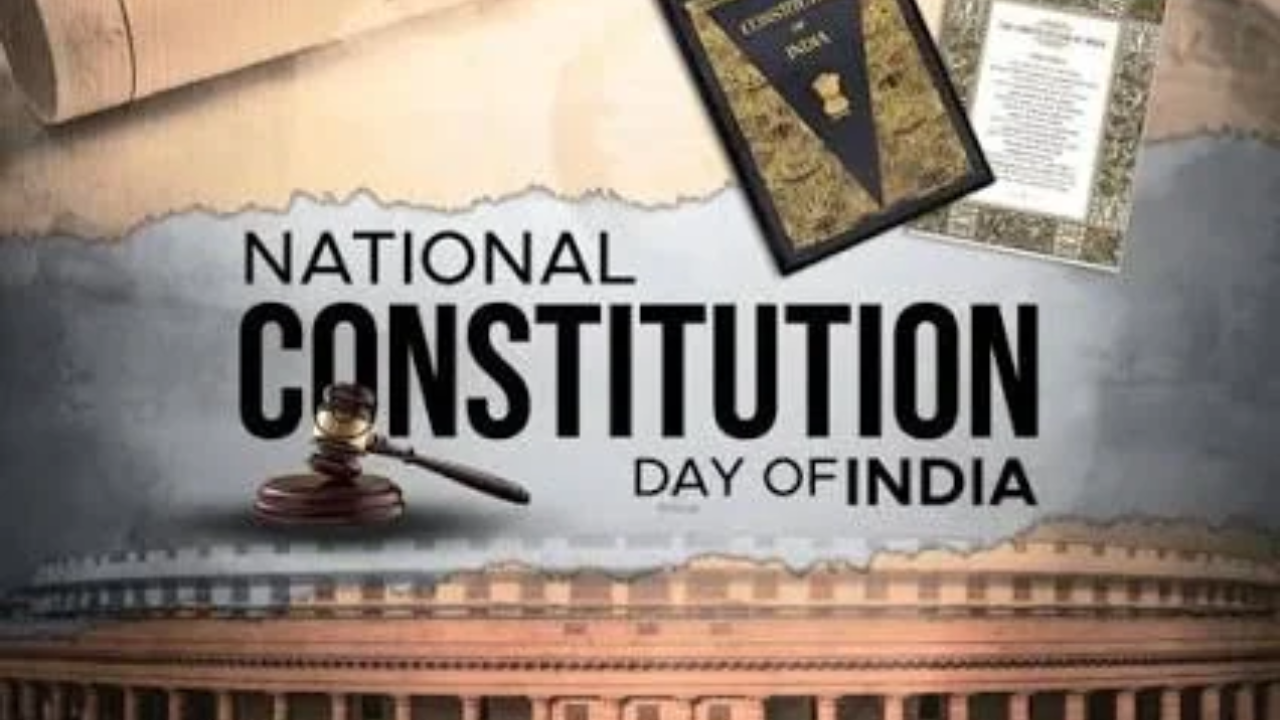
India observes Constitution Day (Samvidhan Diwas) 2026 today, 26 November 2026, marking 77 years since the Constituent Assembly adopted the Constitution of India on 26 November 19491. Leading competitive exam news today in current affairs November 26, 2026, the national observance features a 23-language online Preamble reading coordinated by the Ministry of Parliamentary Affairs, a flagship commemoration by the Dr. Ambedkar Foundation on the theme "The Constitution @76: Dr. B.R. Ambedkar's Constitutional Vision and the Future of Indian Democracy", and a Constitution Day address by Chief Justice of India (CJI) Surya Kant calling for judicial introspection on artificial intelligence, digital crimes, and affordable justice1.
For serious aspirants following UPSC current affairs and daily GK updates on Atharva Examwise Current Affairs, Samvidhan Diwas 2026 bridges high-frequency Prelims static polity (the Drafting Committee, split commencement under Article 394, and Preamble jurisprudence) with Mains GS Paper II analytical themes (constitutional morality, federalism under Article 200, and the judiciary's interpretation of the Constitution as a living document)4.
Constitution Day 2026: Official Theme, National Initiatives, and Key Facts
Across Union Ministries, State and Union Territory Governments, courts, and educational institutions, Constitution Day 2026 blends mass civic outreach with constitutional scholarship1. Aspirants should note a key calendar distinction: 26 November 2026 marks 77 years since adoption (26 November 1949)2, whereas the Dr. Ambedkar Foundation's 2026 programme uses the title “The Constitution @76”—corresponding to the 76 years completed since full commencement on 26 January 19502.
- Date and Occasion: Observed annually on 26 November to commemorate the adoption of the Constitution of India by the Constituent Assembly on 26 November 19491.
- Online Preamble Reading (23 Languages): Facilitated by the Ministry of Parliamentary Affairs via the MyGov portal (pledge.mygov.in/constitution-day-2026), allowing citizens, ministries, and academic institutions to read the Preamble online in 23 languages (all 22 Eighth Schedule languages plus English) and obtain participation certificates1.
- Constitution Day Quiz 2026: Conducted through the MyGov and MyBharat portals from 18 to 26 November 2026 to strengthen constitutional literacy among youth1.
- Viksit Bharat Yuva Samvad: Organised from 24 to 26 November 2026 across 786 districts in all 36 States and Union Territories to encourage youth engagement in constitutional values1.
- Dr. Ambedkar Foundation (DAF) National Programme: Organised under the Ministry of Social Justice & Empowerment at the Dr. Ambedkar International Centre (DAIC), New Delhi, on the theme “The Constitution @76: Dr. B.R. Ambedkar's Constitutional Vision and the Future of Indian Democracy”5. Union Minister Dr. Virendra Kumar attended as Chief Guest alongside Ministers of State Ramdas Athawale and B.L. Verma, while former Chief Justice of India Justice Uday Umesh Lalit led the Preamble reading and delivered the Constitution Day Lecture on “Constitutional Governance and the Legacy of Dr. B.R. Ambedkar”5.
- Fit India Tribute: Ahead of Samvidhan Diwas, the 99th edition of Fit India's Sundays on Cycle was held on 22 November 2026 across 26,000 locations—led by Union Sports Minister Dr. Mansukh Mandaviya and Gujarat Deputy Chief Minister Harsh Sanghavi at Dandi Kutir, Gandhinagar—dedicated to honouring the Constitution10.
- National Leadership Messages: Prime Minister Narendra Modi described the Constitution as a "priceless heritage of Indian democracy" guiding the resolve of a developed India (Viksit Bharat), while Vice President C.P. Radhakrishnan paid tribute to Dr. B.R. Ambedkar, Dr. Rajendra Prasad, and Constituent Assembly members11. Opposition leaders, including Rahul Gandhi and Mallikarjun Kharge, stressed safeguarding justice, liberty, equality, fraternity, secularism, and socialism, recalling Ambedkar's caution that political democracy cannot endure without social democracy at its foundation13.
Historical Evolution: From National Law Day (1979) to Samvidhan Diwas (2015)
Although 26 November has anchored India's constitutional calendar since 1949, its designation as Constitution Day is comparatively recent—a frequent trap in Prelims statement-based questions14. In 1979, acting on a proposal by eminent jurist Dr. L.M. Singhvi, the Supreme Court Bar Association (SCBA) initiated the annual observance of 26 November as National Law Day3. For more than three decades, Law Day functioned largely as a forum for the legal fraternity to review the administration of justice, judicial independence, and institutional credibility3.
The observance expanded into a nationwide civic commemoration in 2015, marking the 125th birth anniversary year of Dr. B.R. Ambedkar, Chairman of the Drafting Committee and independent India's first Law Minister15. Prime Minister Narendra Modi announced the redesignation on 11 October 2015 while laying the foundation stone of the Ambedkar memorial in Mumbai, and the Ministry of Social Justice and Empowerment formally notified 26 November as Constitution Day via a Gazette notification on 19 November 20159. Aspirants must keep the institutional division clear: the Ministry of Social Justice and Empowerment issued the 2015 notification, while the Ministry of Parliamentary Affairs coordinates nationwide online Preamble reading and youth outreach1.
As former Union Law Secretary P.K. Malhotra noted while reflecting on the 77th year since adoption, transitioning from Law Day to Constitution Day did not replace older concerns over accessible justice and institutional independence3. Instead, it widened constitutional stewardship—underscoring that constitutional values must be understood and upheld not only by courts and legislatures, but also by citizens whose rights and duties the document defines3. This public outreach continues the momentum of the year-long "Hamara Samvidhan, Hamara Swabhiman" campaign, which culminated on 26 November 2025 at the Central Hall of Samvidhan Sadan in the presence of President Droupadi Murmu15.
Making of the Constitution and Split Commencement Under Article 394
Understanding why India observes two distinct constitutional dates—Constitution Day (26 November) and Republic Day (26 January)—requires mastering the transitional architecture of Part XXII (Articles 393–395) alongside the structural evolution of the constitutional text over 77 years7.

Why did the framers mandate a staggered two-stage enforcement under Article 394 rather than bringing the entire Constitution into force on 26 November 1949? The rationale was administrative necessity amid Partition and democratic transition22. Preparing for independent India's first general elections required two legal foundations immediately: defining citizenship status amidst large-scale Partition displacement (Articles 5–9) and establishing the Election Commission of India (Article 324) to compile electoral rolls7. Alongside these, the oath of the President (Article 60), definitional clauses (Articles 366–367), and provisional transitional arrangements (Articles 379, 380, 388, 391–394) took effect at once to prevent an institutional vacuum7.
Crucially for Prelims elimination questions, Part III (Fundamental Rights) and Part IV (Directive Principles of State Policy) were not among the 16 immediate provisions; they entered into force two months later on 26 January 195016. The Constituent Assembly reserved 26 January as the official "date of commencement" to honour 26 January 1930, when the Indian National Congress proclaimed Purna Swaraj (complete independence) following its Lahore Session2.
Aspirants should also master the final articles of Part XXII alongside Article 394A and the Constitution's amendment tally, all of which are recurring Prelims favourites16:
- Article 393 (Short Title): Expressly stipulates that the document "may be called the Constitution of India"20.
- Article 394A (Authoritative Hindi Text): Inserted by the 58th Constitutional Amendment Act, 1987, empowering the President to publish an authoritative Hindi translation of the Constitution and subsequent amendments with equal legal standing16.
- Article 395 (Repeals): Explicitly repealed the Indian Independence Act, 1947 and the Government of India Act, 1935 (with its amending enactments), while deliberately exempting the Abolition of Privy Council Jurisdiction Act, 1949 from repeal16.
- Structural Evolution (1949 to 2026): Although formal numbering still ends at Article 395, inserted sub-articles (such as 21A, 51A, 300A, 323A–B), four added Parts (IVA, IXA, IXB, and XIVA, offset by the repeal of Part VII via the 7th Amendment, 1956), and four added Schedules (9th via 1st Amendment, 1951; 10th via 52nd Amendment, 1985; and 11th & 12th via 73rd & 74th Amendments, 1992) expanded the text to 25 Parts, 12 Schedules, and roughly 448 active Articles (reference portals report counts between 448 and 470 depending on how inserted and repealed clauses are tallied)24. As of August 2026, 106 Constitutional Amendments have been enacted, with the 106th Constitutional Amendment Act, 2023 (Nari Shakti Vandan Adhiniyam / Women's Reservation Act) remaining the latest enacted amendment26.
Drafting Committee and Major Constituent Assembly Committees (Prelims Ready-Reckoner)
The Constituent Assembly—which convened for the first time on 9 December 1946 under temporary President Dr. Sachchidananda Sinha before electing Dr. Rajendra Prasad as permanent President—functioned through 8 Major Committees and 13 Minor Committees21. Its deliberations were guided by Jawaharlal Nehru's Objectives Resolution (moved on 13 December 1946 and unanimously adopted on 22 January 1947) and an initial constitutional draft prepared by Constitutional Advisor Sir B.N. Rau31.
| Category | Committee / Role | Key Personnel & Exam-Critical Details |
| Drafting Committee (Set up 29 Aug 1947; 7 Members; 141 sittings) | Chairman & 6 Members | Dr. B.R. Ambedkar (Chairman), N. Gopalaswami Ayyangar, Alladi Krishnaswami Ayyar, Dr. K.M. Munshi, Syed Mohammad Saadullah, N. Madhava Rau (replaced B.L. Mitter, who resigned due to ill health), T.T. Krishnamachari (replaced D.P. Khaitan, who died in 1948)30 |
| Major Committees (Chaired by Jawaharlal Nehru — 3) | Union Powers; Union Constitution; States Committee | Handled Union-level constitutional framework and negotiations with Princely States30 |
| Major Committees (Chaired by Sardar Vallabhbhai Patel — 2) | Provincial Constitution; Advisory Committee on Fundamental Rights, Minorities & Tribal/Excluded Areas | Oversaw sub-committees chaired by J.B. Kripalani (Fundamental Rights), H.C. Mookerjee (Minorities), Gopinath Bardoloi (North-East Frontier Tribal Areas), and A.V. Thakkar (Excluded Areas)31 |
| Major Committees (Chaired by Dr. Rajendra Prasad — 2) | Rules of Procedure Committee; Steering Committee | Also chaired the Finance & Staff Committee and the Ad-hoc Committee on the National Flag31 |
| Key Secretariat & Assembly Officers | Drafting, Advice & Record | Sir B.N. Rau (Constitutional Advisor), S.N. Mukherjee (Chief Draftsman), H.V.R. Iyengar (Secretary), H.C. Mookerjee & V.T. Krishnamachari (Vice Presidents)30 |
- Assembly Composition and Signing: Originally 389 seats (reduced to 299 post-Partition), including 15 women members; 284 members signed the final handwritten English and Hindi copies on 24 January 195016.
- Calligraphy and Preservation: Calligraphed by Prem Behari Narain Raizada and illuminated by Nandalal Bose and Shantiniketan artists (including Beohar Rammanohar Sinha); published via photolithography at the Survey of India, Dehradun, and preserved in inert-gas cases in the Parliament Library16.
To build conceptual mastery over Indian Polity from NCERT fundamentals to advanced Prelims problem-solving, explore the NCERT Foundation Polity Path on Atharva Examwise and download structured mind maps and revision notes from our Study Material Hub.
The Constitution as a Living Document: CJI Surya Kant's 2026 Vision and Recent Constitutional Milestones
Marking Constitution Day 2026, Chief Justice of India Justice Surya Kant—India's 53rd CJI, who assumed office on 24 November 2025—addressed the central constitutional challenge of the digital era: how a 1949 charter adapts to rapid technological change while remaining faithful to its foundational principles4. Describing the Constitution as a "living document", CJI Kant stressed that constitutional provisions understood in one manner four decades ago may warrant wider interpretation today in response to evolving social, technological, and global realities, provided courts stay within the Constitution's framework4.

Speaking on the eve of and during Constitution Day 2026 ceremonies at the Supreme Court, CJI Surya Kant underscored four pillars directly relevant to GS Paper II (Polity & Governance) and GS Paper IV (Ethics)4:
- Judicial Introspection for the AI and Digital Age: Observing that both crimes and citizens' rights expectations have transformed over the past four decades, CJI Kant urged courts to equip themselves for disputes involving artificial intelligence, digital crimes, and borderless technological challenges4.
- Timely, Affordable Justice Beyond Tareekh-pe-Tareekh: Emphasising that the cost of legal remedies must never become prohibitive for ordinary citizens, the CJI highlighted institutional digital reforms aimed at curbing chronic delays—including the Supreme Court's e-Filing modules (SC-eFM 2.0 and SC-eFM 3.0), electronic service of notices (via email and messaging platforms), and virtual hearings allowing local lawyers to argue cases remotely4.
- Institutional Restraint and Constructive Dissent: Addressing the Supreme Court's Constitution Day function, CJI Kant remarked that disagreement is not a weakness of constitutional democracy, while cautioning against politically or personally motivated attacks on constitutional institutions38. He urged mutual institutional respect, called for dialogue to resolve Centre-State disputes, and argued that the Constitution must be judged by its tangible impact on ordinary people rather than merely its textual division of powers4.
- Interdependence of Preamble Ideals and Citizen Duties: Reaffirming that rights must go hand in hand with duties, CJI Kant highlighted that liberty cannot exist without equality and justice cannot take deep root without fraternity—echoing the constitutional vision explored at the Dr. Ambedkar Foundation's 2026 national lecture4.
Key 2025–2026 Constitutional Touchpoints for Mains Answer Enrichment
Aspirants writing UPSC Mains answers on India's living Constitution should combine landmark static doctrines—such as Preamble jurisprudence (Berubari Union 1960 overruled by Kesavananda Bharati 1973; the sole Preamble amendment via the 42nd Amendment Act, 1976 adding Socialist, Secular, and Integrity; and LIC of India 1995 reaffirming the Preamble as an integral yet independently non-justiciable part)39—with contemporary 2025–2026 constitutional developments:
- Federalism & Article 200 (2025 Presidential Reference): Following a two-judge bench judgment on 8 April 2025 (Tamil Nadu Governor case) that set fixed timelines for Governors and invoked Article 142 for "deemed assent", a five-judge Constitution Bench (including then-CJI B.R. Gavai and Justice Surya Kant) delivered a unanimous Article 143 advisory opinion on 20 November 20256. The Bench held that judicially prescribed rigid timelines and "deemed assent" under Article 142 run counter to the separation of powers, while clarifying that gubernatorial immunity under Article 361 does not bar limited judicial review or reasonable directions where a Governor delays action without justification6.
- Expanding Article 21 & Substantive Equality (2026 Verdicts): As compiled in 2026 UPSC legal analyses, recent Supreme Court rulings have further deepened Article 21 dignity and substantive equality—including permitting passive euthanasia under safeguards in Harish Rana v. Union of India (March 2026), placing adoptive mothers on par with biological mothers for maternity benefits, flagging gender bias in Armed Forces permanent commissions (March 2026), recognising a fundamental right to walk safely on footpaths, and establishing a compensatory category valuing homemakers' unpaid domestic labour (June 2026)44.
- Active Constitutional Debates in Parliament and Courts (2026): Electoral governance remains at the centre of constitutional debate, with the 41-member Joint Parliamentary Committee (JPC) chaired by P.P. Chaudhary receiving extensions through the 2026 Monsoon and Winter Sessions to scrutinise the Constitution (129th Amendment) Bill, 2024 (One Nation, One Election), alongside pending Constitution Bench proceedings on the 2023 Chief Election Commissioner (CEC) appointment law that replaced the selection panel prescribed in Anoop Baranwal (2023)45.
For regular exam-focused coverage of parliamentary legislation, judicial verdicts, and governance frameworks, visit the UPSC Polity & Current Affairs Portal or explore our related article on Multilateral Governance and Treaty Frameworks.
Official References and Related Atharva Examwise Resources
Credible Official & Institutional Sources
- Press Information Bureau (PIB) — Constitution Day 2026 Nationwide Observance (Ministry of Parliamentary Affairs)1
- PIB — Dr. Ambedkar Foundation's 'The Constitution @76' Programme (Ministry of Social Justice & Empowerment)5
- MyGov Portal — Online Preamble Reading in 23 Languages & Constitution Day Quiz 20261
- Legislative Department, Ministry of Law & Justice — Official Text of the Constitution of India50
- Supreme Court of India — Official Portal52
Related Preparation Links on Atharva Examwise
- Daily UPSC & Competitive Exam Current Affairs Updates
- UPSC CSE Structured Preparation & Polity Analysis
- MPPSC Prelims & Mains Target Preparation
- Free UPSC/MPPSC Study Material, PYQs & Revision Notes
Why this matters for your exam preparation
Indian Constitution Day is a perennial high-yield topic across UPSC CSE (Prelims, Mains, and Interview), State PCS (including MPPSC and UPPSC), CDS, CAPF, NDA, and SSC examinations because paper-setters regularly anchor conceptual polity questions to November 26 commemorations8.
- UPSC Prelims (Indian Polity & Governance): UPSC repeatedly tests fine distinctions on constitution-making, the Preamble, and commencement—including the legal status of the Preamble (UPSC Prelims 2020: part of the Constitution, with no legal effect independently of other parts), India's exact constitutional status on 26 January 1950 (UPSC Prelims 2021: Sovereign Democratic Republic), the chief purpose of a Constitution (UPSC Prelims 2023: defining and limiting government powers), and Parts/Schedules matching (UPSC Prelims 2025)32. For Prelims 2027, stay alert to statement traps around Article 394 (whether Fundamental Rights commenced on 26 November 1949), Article 395 (repeals), the 2015 notifying ministry (Social Justice & Empowerment), and the November 2025 Article 143 advisory opinion on Article 2006.
- UPSC Mains (GS Paper II, GS Paper IV & Essay): In UPSC Mains 2025 (GS-2, 15 marks), UPSC directly examined constitutional morality as a fulcrum balancing judicial independence and judicial accountability8. Integrating Dr. Ambedkar's vision of constitutional morality, CJI Surya Kant's 2026 call for judicial introspection on AI and affordable justice, and the 2025–2026 developments around Article 200 and Article 21 gives your GS-2 answers and essays crisp, contemporary depth4.
- State PCS, Defence (CDS/CAPF/NDA), and One-Day Exams: Objective papers routinely test the 2026 DAF theme ("The Constitution @76..."), the 23 languages of the MyGov Preamble reading, Dr. L.M. Singhvi's 1979 Law Day proposal, the 7 Drafting Committee members (especially the replacements of B.L. Mitter and D.P. Khaitan), and the 106th Constitutional Amendment Act1.
Practice Questions for Self-Assessment
1. Prelims Practice MCQ: With reference to the adoption and commencement of the Constitution of India, consider the following statements:
- Provisions relating to Citizenship (Articles 5–9), the Election Commission (Article 324), and Fundamental Rights (Part III) came into force immediately on 26 November 1949 under Article 394.
- The Government of India formally notified 26 November as Constitution Day in 2015 through the Ministry of Social Justice and Empowerment.
- Article 395 repealed both the Government of India Act, 1935 and the Abolition of Privy Council Jurisdiction Act, 1949.
Which of the statements given above is/are correct?
(a) 1 and 2 only
(b) 2 only
(c) 2 and 3 only
(d) 1, 2 and 3
Answer: (b) 2 only. Statement 1 is incorrect because Fundamental Rights (Part III) came into force on 26 January 1950, not 26 November 194916. Statement 3 is incorrect because Article 395 explicitly exempted the Abolition of Privy Council Jurisdiction Act, 1949 from repeal16.
2. Mains Practice Question (GS Paper II — 150 words / 10 Marks): "The Indian Constitution is a living document whose resilience depends as much on constitutional morality and institutional restraint as on textual provisions." Examine this statement in the context of recent constitutional developments and emerging digital-age challenges before the judiciary. (Hint: Structure your answer around Dr. Ambedkar's conception of constitutional morality, CJI Surya Kant's 2026 observations on AI, digital crimes, and institutional restraint, the November 2025 Article 143 opinion on separation of powers under Article 200, and the 2026 expansion of Article 21 substantive equality4.)