UPSC Current Affairs 20 November 2026: Komodo National Park's Volcanic Origins, Pink Beach Science & 2026 Conservation Cap | Daily GK Update
In today's Atharva Examwise current news and daily GK update for November 20, 2026, we examine Komodo National Park in Indonesia—a volcanic island sanctuary in the Lesser Sunda Archipelago famed for its translucent turquoise seas, pink coral-sand shorelines, coral reefs, and the endangered Komodo dragon (Varanus komodoensis). Sculpted over millions of years by tectonic uplift, volcanic lava, ocean currents, monsoonal rainfall, wind, and seismic tremors, the UNESCO World Heritage Site has returned to global environmental focus in 2026 after Indonesia's Ministry of Forestry enforced a strict cap of 1,000 daily visitors starting April 1, 2026, following a surge of roughly 432,000 visitors in 2025.
For aspirants tracking UPSC current affairs and competitive exam news today, Komodo National Park integrates multiple core syllabus pillars: Pacific Ring of Fire volcanism, Wallacea biogeography, Coral Triangle marine ecology, the physics of ocean color, IUCN Red List climate-risk modeling, and the governance trade-offs of carrying-capacity regulations in protected areas.
Key Facts at a Glance: Komodo National Park
Serious aspirants preparing for UPSC Prelims, MPPSC, and State PCS examinations should keep these verified facts ready for quick revision:
Geographical Location: East Nusa Tenggara (NTT) Province in south-central Indonesia, spanning the Sape Strait between Sumbawa and Flores (8°24'–8°50' S, 119°21'–119°49' E).
Island Composition: Encompasses 29 volcanic islands and surrounding seas, anchored by three main islands—Komodo, Rinca, and Padar—alongside smaller islets including Gili Motang and Nusa Kode (Gili Dasami).
Protected Area Coverage: The total UNESCO World Heritage property spans 219,322 hectares, centered on Komodo National Park (173,300 hectares, including 130,177 hectares of marine waters), alongside 31,000 hectares of Mbeliling/Ngorang Protection Forests and 3,000 hectares of Wae Wuul/Mburak Parks on Flores.
Biogeographical Regions: Situated inside Wallacea (the evolutionary transition belt between Asia's Sundaland and Australia's Sahul Shelf) and within the Coral Triangle, widely known as the "Amazon of the Seas".
UNESCO Designations: Recognized as a UNESCO Biosphere Reserve under the Man and the Biosphere (MAB) Programme in 1977 and inscribed on the UNESCO World Heritage List (Site N 609) in 1991 under Natural Criteria (vii) and (x).
Flagship Species Status: The Komodo dragon (Varanus komodoensis) is listed as Endangered on the IUCN Red List (upgraded from Vulnerable in September 2021 and maintained in IUCN Version 2026-1) and placed on CITES Appendix I.
2025–2026 Conservation Outlook: Rated "Significant Concern" in the 2025 IUCN World Heritage Outlook (finalized October 11, 2025) due to rapid tourism growth and climate risks, prompting Indonesia's 1,000 visitors/day cap effective April 1, 2026.
Volcanic Geology, Wallacea & Coral Triangle Biogeography
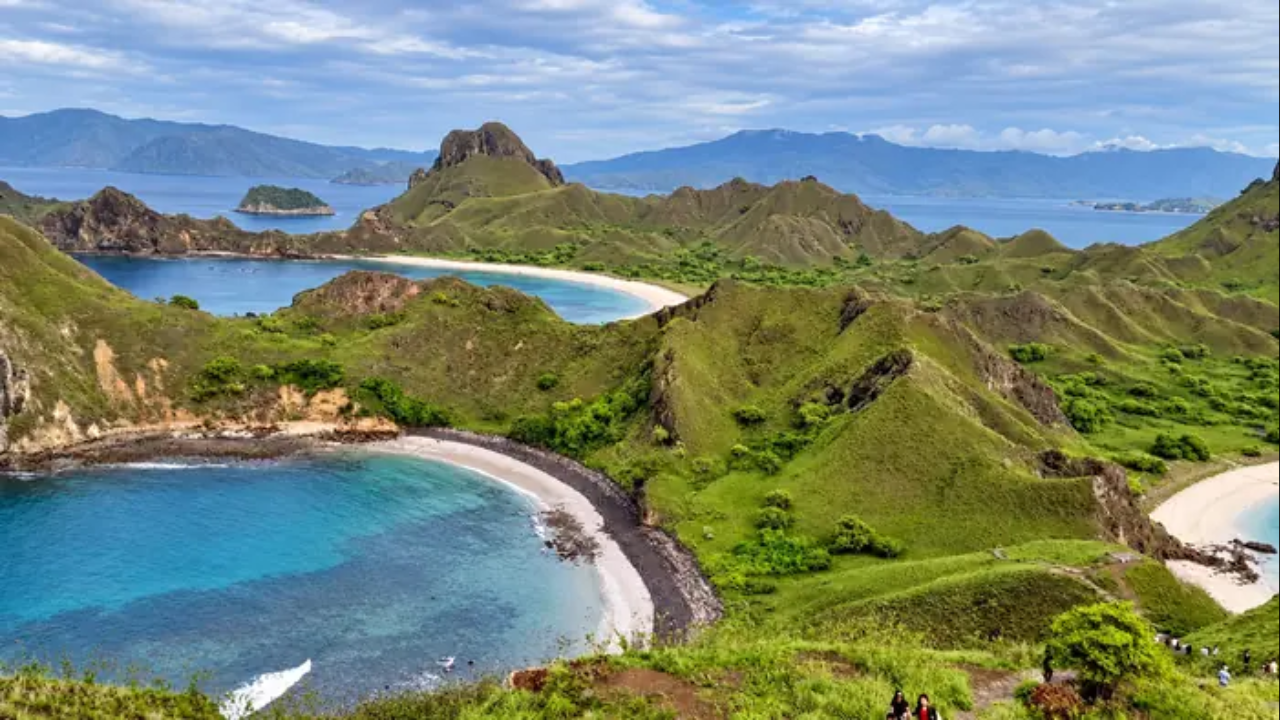
Komodo National Park owes its dramatic topography to the active plate tectonics of the Pacific Ring of Fire. Positioned along the Sunda Volcanic Arc, the Lesser Sunda Islands originated where the Indo-Australian Plate converges with and subducts beneath the Eurasian (Sunda) Plate. According to the UNEP-WCMC World Heritage datasheet, the islands were built largely through volcanic activity during the Eocene epoch, though the western flank of Komodo Island preserves older Jurassic rock formations. Solidified lava flows, resistant volcanic rocks, volcanic ash, conglomerates, and tectonically uplifted coral deposits were subsequently carved by ocean waves, wind, rainfall, and frequent earth tremors—although no active volcanoes remain inside the park today. The terrain rises steeply into north-south oriented rounded hills reaching 500–600 meters, peaking at Gunung Satalibo (735 m) on Komodo Island.
Biogeographically, the archipelago forms a living laboratory of evolutionary isolation. Terrestrially, it lies in Wallacea, a deep-water "shatter belt" separating the Asian Sunda Shelf from the Australian Sahul Shelf. Because these oceanic islands remained disconnected from the Asian mainland even during Pleistocene glacial lowstands, they developed a distinct fauna alongside arid ecosystems: dry open grass-woodland savannas blanket roughly 70% of the park, supporting relatively low plant diversity (~102 recorded species) due to shallow, rocky soils and dry conditions. Recorded terrestrial wildlife includes the endemic Komodo rat (Komodomys rintjanus), 72 bird species (including the critically rare yellow-crested cockatoo and Flores endemics), 14 land snake species, 9 skink species, 6 gecko species, and 2 frog species.
Beneath the waterline, volcanic drop-offs, underwater ridges, seamounts, and fierce tidal currents channeling between the Flores Sea and the Savu Sea fuel one of Earth's richest marine zones within the Coral Triangle. Surveys cited by WWF and the 2025 IUCN World Heritage Outlook document over 1,000 species of tropical reef fish, between 260 and 385 species of reef-building hard corals (reflecting different survey scopes), 19 mangrove species, 5 sea turtle species (including leatherback, hawksbill, and olive ridley), 14 to 16 cetacean species (including blue whales, sperm whales, and 10 dolphin species), dugongs, manta rays, and whale sharks.
The Science Behind Turquoise Waters and Pink Beach
Komodo National Park's signature visual contrasts—clear turquoise shallows alongside rose-tinted beaches—illustrate fundamental concepts in optical physics and marine sedimentology.
In clear shallow waters, water molecules selectively absorb longer wavelengths of visible sunlight (particularly red light) while allowing shorter wavelengths (blue light) to penetrate and scatter. Where coastal silt and suspended sediment remain minimal, sunlight travels unimpeded to the seabed and reflects off bright white carbonate sand and shallow coral reefs, creating an intense, luminous turquoise tint. Variations in water depth, seabed coral cover, and marine vegetation shift these hues across adjacent bays—deeper zones absorb more light and turn rich cobalt, whereas zones with higher marine flora or phytoplankton chlorophyll appear greener because chlorophyll absorbs red and blue light while reflecting green.
Equally remarkable is Komodo's famed Pink Beach (Pantai Merah). Its blush hue is not mineral dye but a biological mixture: fine white marine sand and eroded coral fragments blend continuously with the crimson calcium carbonate shells of microscopic, single-celled marine protists known as Foraminifera. Regional marine guides identify the encrusting foraminiferan Homotrema rubrum—which colonizes the undersides of living coral reefs—as the primary pigment contributor. When these organisms die, wave action detaches and pulverizes their hard red calcareous shells, washing them onto the shore where they mingle with white coral sand to color the beach pink.
Komodo Dragon Biology, Population Trends and IUCN Endangered Status
The park's flagship resident is the Komodo dragon (Varanus komodoensis), the largest living lizard on Earth (Order Squamata, Family Varanidae). Although popularly nicknamed a "living dinosaur," it is a monitor lizard whose Pleistocene fossil record on Flores dates back roughly 1.4 million years; evolutionary reconstructions cited in regional herpetological summaries suggest its ancestors dispersed from Australia around 4 million years ago across lower sea-level land bridges and evolved island gigantism in the absence of competing large mammalian predators.
Local communities on Komodo Island had lived beside the reptile—known locally as ora—for centuries before Western science took notice in 1910, when Dutch Lieutenant van Steyn van Hensbroek investigated fishermen's reports of giant "land crocodiles". In 1912, Pieter Ouwens, Director of the Zoological Museum in Bogor, Java, published the formal scientific description naming the species Varanus komodoensis, while American explorer W. Douglas Burden coined the English name "Komodo dragon" during his 1926 expedition.
Exam-Relevant Biological Adaptations
Size, Weight & Predatory Ecology: Adults typically grow 2 to 3 meters long (wild adult males averaging ~2.59 m and 70–91 kg; females ~2–2.5 m and 60–73 kg), and individuals can exceed 100 kg after a heavy meal—with an exceptional verified record reaching 3.13 meters and 166 kg. As apex ambush predators, they prey on Timor/Javan rusa deer (Rusa timorensis), wild boar, water buffalo, and carrion, sprinting at 18–20 km/h in short bursts and consuming up to 80% of their body weight in one sitting.
Chemoreception via Jacobson's Organ: Rather than relying primarily on nostrils, Komodo dragons flick a long, yellow, forked tongue to collect airborne odor particles and deliver them to the vomeronasal organ (Jacobson's organ) in the roof of the mouth, allowing them to locate carrion 4 to 5 kilometers downwind.
Venom Glands: Landmark research led by Bryan Fry et al. (2009) identified functional venom glands in the lower jaw that induce shock and inhibit blood clotting, overturning the earlier assumption that Komodo bites killed solely through toxic oral bacteria.
Osteoderm Armor & Arboreal Juveniles: Adult dragons develop interlocking bony plates called osteoderms beneath their scales that function like chain-mail armor during intraspecific combat; hatchlings lack these osteoderms and live in trees for their first several years to avoid predation by cannibalistic adults.
Parthenogenesis: Confirmed scientifically in 2006 (Nature), female Komodo dragons are capable of parthenogenesis—reproducing asexually without male fertilization—an unusual adaptive trait among large vertebrates.
Population Concentration and the Padar Island Ecological Lesson
In September 2021, the IUCN Red List upgraded Varanus komodoensis from Vulnerable to Endangered—not because of an abrupt single-year crash, but because of its tightly restricted insular range, human encroachment on Flores, and long-term climate-change projections threatening low-lying habitats.
Official Indonesian forestry monitoring data (KSDAE) show that while the National Park's population remained stable with a modest upward trajectory between 2018 and 2024—reaching an estimated 3,270 ± 371 individuals in 2024, compared with the IUCN Red List's global estimate of ~1,383 mature adults—spatial concentration remains extreme. Roughly 94.5% of the National Park's dragons inhabit just two islands: Komodo (1,619) and Rinca (1,472), with IUCN noting that these two strongholds account for approximately 68% of the species' broader global distribution.
Padar Island offers a cautionary ecological lesson. Despite receiving early reserve status in 1938, illegal poaching of Timor deer collapsed Padar's prey base, leading to the temporary local extirpation of its resident Komodo dragons in the 1980s. Sustained anti-poaching enforcement has allowed a slow recovery to an estimated 28 individuals by 2024, underscoring that apex-predator survival depends directly on safeguarding prey populations. Outside the national park on Flores Island (roughly 701 ± 131 individuals, restricted to elevations below 300 m above sea level), dragons lack full park protection and face acute threats from agricultural expansion, fire, deer hunting, feral dogs (whose presence correlates inversely with camera-trap detections of dragons), and retaliatory killings.
Conservation Timeline and UNESCO World Heritage Status
Komodo National Park's legal protection evolved over more than a century from species-specific colonial edicts to integrated terrestrial-marine conservation.
| Year | Conservation / Institutional Milestone | Exam Significance |
|---|---|---|
| 1910–1912 | Lt. van Steyn van Hensbroek documents "land crocodiles" (1910); Pieter Ouwens formally describes Varanus komodoensis (1912). | Marks scientific discovery of the world's largest living lizard. |
| 1915 | First formal legal protection enacted for the Komodo dragon under colonial regulation. | Early example of species-specific wildlife legislation in Southeast Asia. |
| 1938 | Padar Island and parts of Rinca Island designated as Nature Reserves. | Earliest territorial reserve protection in the archipelago. |
| 1965 | Komodo Island gazetted as a Nature Reserve / Wildlife Sanctuary under Ministerial Decree #66. | First national-level Indonesian protection for Komodo Island. |
| 1977 | Recognized as a UNESCO Biosphere Reserve under the Man and the Biosphere (MAB) Programme. | Integrates core ecosystem protection with sustainable coastal resource use. |
| 1980 | Komodo National Park formally established, unifying islands and surrounding marine waters. | Expands conservation mandate from a single species to full land-sea biodiversity. |
| 1991 | Inscribed on the UNESCO World Heritage List (Site N 609) under Natural Criteria (vii) and (x). | Recognizes Outstanding Universal Value (OUV) for scenic contrast and threatened habitats. |
| 2021 | IUCN Red List upgrades Varanus komodoensis from Vulnerable to Endangered. | Highlights climate change and sea-level rise as primary extinction drivers. |
| 2025–2026 | IUCN Outlook assigns "Significant Concern" (Oct 2025); Indonesia launches 2025–2035 Action Plan and enforces 1,000 daily visitor cap (April 1, 2026). | High-relevance current affairs case study on World Heritage governance and carrying capacity. |
Under the World Heritage Convention, Komodo National Park's Outstanding Universal Value rests on two natural criteria: Criterion (vii) celebrates its superlative natural beauty—starkly rugged dry savanna hillsides, sheer coastal cliffs, white and pink sandy beaches, and clear coral waters—while Criterion (x) recognizes its irreplaceable role in the in-situ conservation of globally threatened biodiversity, anchored by the world's primary wild populations of Varanus komodoensis. Domestically, legal protection is grounded in Indonesia's Law No. 5 of 1990 on the Conservation of Natural Resources and Ecosystems (amended by Law No. 32 of 2024) and Government Regulation No. 7 of 1999.
2025–2026 Governance Challenges: Overtourism, Visitor Caps and Climate Risk
Despite robust statutory protection, Komodo National Park sits at the center of a classic sustainable-development dilemma in 2025–2026, squeezed simultaneously by rapid tourism expansion and accelerating climate change.
UNESCO Scrutiny and the April 2026 Visitor Cap
International scrutiny intensified after 2020 following reports of mass-tourism infrastructure—including a high-profile "Jurassic Park"-style development on Rinca Island and a 2020 decree temporarily relaxing Environmental Impact Assessment (EIA) rules inside the park. A joint UNESCO/IUCN Reactive Monitoring mission inspected the site in March 2022, and the UNESCO World Heritage Committee maintained active State of Conservation oversight through its 47th Session in 2025 (document WHC/25/47.COM/7B.Add), emphasizing that no private tourism concessions or projects under the Labuan Bajo Flores Integrated Tourism Master Plan (ITMP) should compromise Outstanding Universal Value without a Strategic Environmental Assessment (SEA) and site-level EIAs. In October 2025, the IUCN World Heritage Outlook rated the park "Significant Concern", classifying both tourism and climate change as High Threats and noting the lack of a comprehensive long-term marine monitoring framework.
Real-world visitor growth quickly outpaced planning models. Whereas Indonesia's 2023 SEA projected unrestricted visitation reaching 283,686 by 2030, actual arrivals jumped to approximately 432,000 visitors in 2025 (reported at 432,217 by local tourism tracking)—nearly double the 2019 pre-pandemic peak of 221,703. Acting on carrying-capacity studies, Indonesia's Ministry of Forestry under Minister Raja Juli Antoni introduced a cap of 1,000 visitors per day (roughly 365,000 visitors per year) effective April 1, 2026, managed through a centralized digital booking platform covering Komodo, Rinca, Padar, and adjacent marine zones.
Implementation Realities and Long-Term Climate Vulnerability
Field reporting on the April 2026 visitor cap reveals structural governance bottlenecks that extend well beyond ticket quotas. Early software glitches on the centralized booking portal permitted daily numbers to slip past the 1,000-visitor ceiling, while clustered boat departures from the gateway town of Labuan Bajo still produced uneven congestion at high-demand trails like Padar Island. Equally important, land-based visitor limits have not stopped marine plastic debris—bottles, wrappers, and packaging carried by ocean currents or discarded from passing vessels—from washing onto Komodo and Rinca beaches, underscoring the limits of island-level regulation against transboundary marine pollution. Meanwhile, tighter marine protection zones and lower tourist turnout imposed immediate livelihood shocks on small-scale local fishers, guesthouses, dive operators, and dried-seafood vendors in Labuan Bajo, highlighting the friction between immediate economic costs and slower ecological recovery—a gap President Prabowo Subianto's administration aims to mitigate by reinvesting park revenues into conservation patrols and community development.
Overlaying these local governance challenges is an existential global threat. A peer-reviewed spatial demographic modeling study running over one million simulations across varied climate models and greenhouse gas pathways projects that warming and sea-level rise could shrink suitable Komodo dragon habitat by 8%–87% by 2050, driving 25%–97% declines in habitat patch occupancy and 27%–99% declines in range-wide abundance. Locally, the 2025 IUCN World Heritage Outlook projects temperature rises of up to 0.8°C by 2045, compounding heat stress, shifting savanna vegetation and shade availability, elevating wildfire risk, accelerating ocean deoxygenation and acidification, and intensifying coral bleaching—an acute concern following the 2024 global coral bleaching event.
Related Reading on Atharva Examwise & Credible External References
Strengthen your integrated notes across Environment, Geography, and Global Governance with these related modules on Atharva Examwise:
Global Conservation Governance: Master the IUCN Framework, Red List Criteria & Global Environmental Governance
Volcanism & UNESCO Heritage: UNESCO Adds Baratang, Andaman Volcanoes & Sirpur to India's Tentative List
Coastal Sustainability: Blue Flag Tag, Marina Beach & India's Eco-Friendly Coastal Management
Protected Areas & Conservation Movements: 52nd Anniversary of the Chipko Movement & Evolution of Conservation and World Wetland Day: National Parks & Ramsar Wetlands Update
Core Preparation Hubs: Explore our Daily Current Affairs Hub, NCERT Geography & Environment Foundation, and downloadable UPSC/MPPSC Study Material, PYQs & Mind Maps.
Credible External References:
UNESCO World Heritage Centre — Komodo National Park (Site N 609)
IUCN World Heritage Outlook — Komodo National Park 2025 Assessment
IUCN Red List of Threatened Species — Varanus komodoensis
UNEP-WCMC World Heritage Datasheet — Komodo National Park
WWF Coral Triangle — Protecting Komodo National Park
Why this matters for your exam preparation
Komodo National Park is a high-yield, multidisciplinary topic directly aligned with UPSC Civil Services Examination (CSE), MPPSC, and other State PCS question patterns:
UPSC Prelims (Geography, Map Work & Biodiversity): Expect map-based questions linking Southeast Asian geography—Lesser Sunda Islands, Sape Strait, Flores, Sumbawa, Wallacea, and the Coral Triangle—alongside species-level ecology such as the IUCN Endangered status and CITES Appendix I listing of Varanus komodoensis, parthenogenesis, Jacobson's organ, and the role of single-celled marine protists (Foraminifera) in forming pink coral beaches. Applied science questions also regularly test light absorption and scattering principles behind shallow-sea coloration.
UPSC Mains GS Paper I (Physical Geography): Offers a concrete contemporary illustration of convergent-boundary volcanism along the Sunda Arc (Indo-Australian and Eurasian plates), island biogeography in Wallacea, and marine-coastal geomorphology.
UPSC Mains GS Paper III (Conservation, EIA & Sustainable Tourism): Indonesia's April 2026 visitor cap (1,000/day), the 2025 IUCN "Significant Concern" rating, the tension between rapid tourism infrastructure and Strategic Environmental Assessments (SEA/EIA), and livelihood trade-offs in Labuan Bajo provide a crisp international benchmark for answers on India's own fragile ecosystems—including the Andaman & Nicobar Islands, Lakshadweep, Western Ghats, and Himalayan carrying-capacity debates.
Mains Practice Question (GS-III, 150 Words): "Using Indonesia's 2026 visitor cap in Komodo National Park as a case study, examine why carrying-capacity regulations alone are insufficient to safeguard insular UNESCO World Heritage ecosystems against climate change and transboundary marine pollution."
Stay ahead in your preparation by following Atharva Examwise for daily, verified, and exam-focused UPSC current affairs.