
UPSC Current Affairs 19 November 2026: Gandhi Sagar Cabinet Approves 4 Industrial Parks, ₹42,350 Crore Proposed Investment | Daily GK Update
Why Is This News Important?
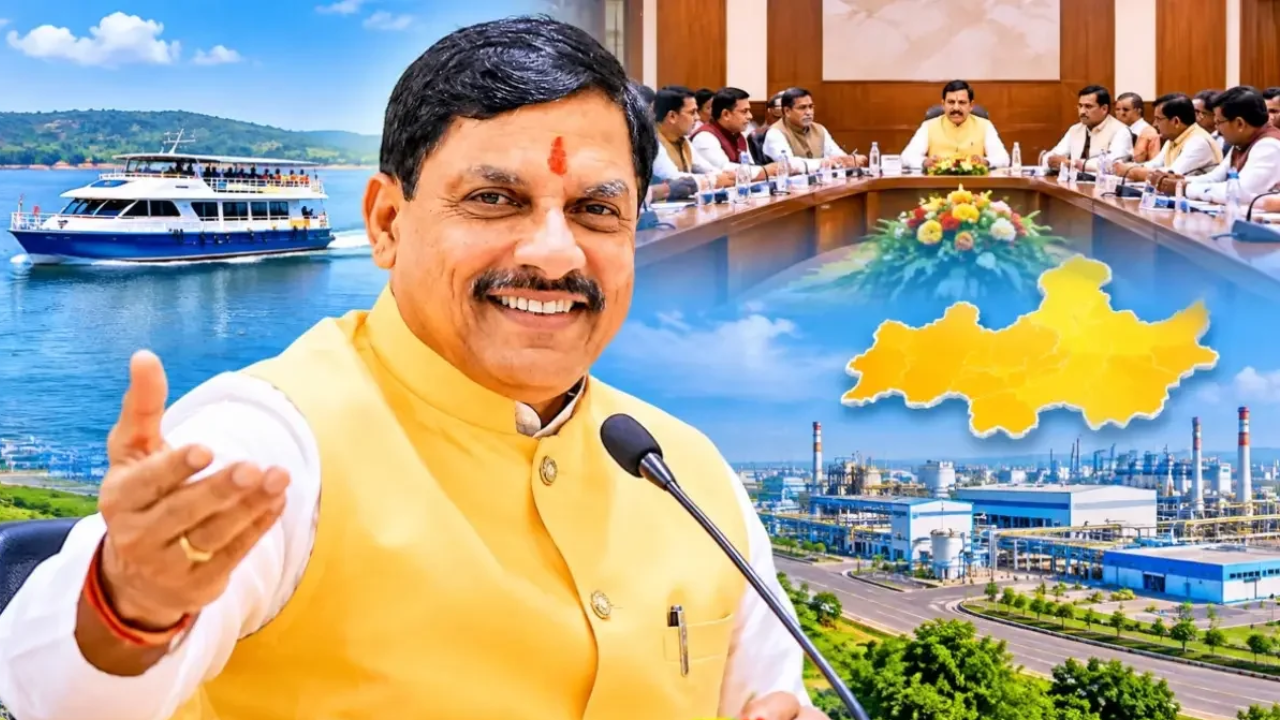
The ninth Destination Cabinet meeting of the Madhya Pradesh Council of Ministers was held on 18 November 2026 at the Gandhi Sagar Forest Retreat in Mandsaur district, under the chairmanship of Chief Minister Dr. Mohan Yadav.
Therefore, the Current Affairs Update Date of this article is 19 November 2026, while the actual Cabinet decisions were taken on 18 November 2026.
During the meeting, the Cabinet approved several proposals related to industrial development, Micro, Small and Medium Enterprises (MSMEs), research and innovation, renewable energy, civil aviation and judicial infrastructure.
Four major industrial parks associated with the Malwa-Nimar region were among the key proposals:
Mandsaur Agro Park
Mandsaur Chemical Park
Ratlam Bio-Pharma Park
Dhar Textile & Allied Industries Park
Together, these four industrial parks are expected to attract approximately ₹42,350 crore in investment and potentially create around 1.74 lakh (174,000) employment opportunities.
However, it is important to understand that these figures represent proposed investment and projected employment opportunities. They should not be interpreted as investment already realised or jobs already created.
For more examination-oriented updates, aspirants can visit the Current Affairs section of Atharva Examwise.
Four Industrial Parks: At a Glance
| Industrial Park | Location and Area | Proposed Units | Proposed Investment | Potential Employment | Major Sectors |
|---|---|---|---|---|---|
| Mandsaur Agro Park | Basai, 178.83 hectares | ~47 | ₹3,200 crore | 14,000+ | Food processing, AYUSH, herbal products, agricultural engineering |
| Mandsaur Chemical Park | Kurlasi, Garoth, 3,500+ acres | ~150 | ₹15,000 crore | ~100,000, direct and indirect | Chemical industries |
| Ratlam Bio-Pharma Park | Ratlam Investment Region, 1,121 acres | ~150 | ₹18,000 crore | ~25,000 | Biologics, vaccines, enzymes, pharmaceuticals |
| Dhar Textile & Allied Industries Park | Bhainsola, Badnawar, 842.88 acres | ~50 | ₹6,150 crore | ~35,000 direct jobs | Textiles, garments, allied industries |
The combined figures for these four projects amount to approximately ₹42,350 crore in proposed investment and 1.74 lakh potential employment opportunities.
Reports covering the Cabinet decisions describe these figures as proposed or projected. Therefore, they must not be presented as confirmed economic outcomes.
Mandsaur Agro Park
The Madhya Pradesh Cabinet approved the development of an Agro Park on 178.83 hectares of land in Basai village of Mandsaur district.
The park is intended to promote agricultural processing and value-added industries based on the region's agricultural resources.
Eligible industrial activities include:
Processing of garlic, onions, coriander, cumin, fenugreek and soybeans.
Manufacturing of spice oleoresins and essential oils.
Food dehydration and agricultural value addition.
Orange pulp and juice processing.
Cold-chain infrastructure and agricultural storage.
Nutraceuticals based on medicinal crops.
AYUSH-related processing industries.
Key examination-relevant facts:
Approximately 47 industrial units are proposed.
The park is expected to attract ₹3,200 crore in investment.
More than 14,000 employment opportunities are projected.
Investors will receive an additional 25% discount on the prevailing land premium.
Electricity tariff assistance equivalent to ₹2 per unit will be provided for seven years from the commencement of commercial production, with reimbursement by the Madhya Pradesh Industrial Development Corporation (MPIDC).
Water will be supplied at a fixed rate of ₹25 per kilolitre for five years.
Approximately ₹85 crore is expected to be spent on park development over three years.
This project is particularly relevant to agricultural value addition, food processing, rural industrialisation and employment generation.
Mandsaur Chemical Park
The Cabinet approved sending a proposal to the Central Government for the development of a dedicated Chemical Park covering more than 3,500 acres in Kurlasi village of Garoth tehsil, Mandsaur district.
The Madhya Pradesh Industrial Development Corporation (MPIDC) has been designated as the nodal and implementing agency.
The state government has granted in-principle approval for a minimum contribution of ₹500 crore towards common infrastructure and utilities.
An important distinction must be understood regarding Central Government assistance.
Financial support from the Central Government remains proposed or potential, rather than an already approved or received grant.
According to media reports, the relevant Central Government scheme provides for assistance of up to ₹1,000 crore per chemical park.
However, the principal decisions taken at the Gandhi Sagar Cabinet meeting concerned submitting the proposal to the Central Government and providing a minimum state contribution of ₹500 crore.
Therefore, it would be incorrect to describe the proposed ₹1,000 crore assistance as a grant already received from the Central Government.
Key projected figures:
Approximately 150 industrial units.
Proposed investment of ₹15,000 crore.
Around 100,000 potential direct and indirect employment opportunities.
The Chemical Park could contribute to the development of an integrated chemical manufacturing ecosystem by providing shared infrastructure, utilities and industrial facilities.
Ratlam Bio-Pharma Park
The Madhya Pradesh Government approved the establishment of a Bio-Pharma Park (Bioeconomy & Biomanufacturing Cluster) over approximately 1,121 acres in the Ratlam Investment Region.
MPIDC has been designated as the nodal agency for this project.
The park is expected to support industries involved in biotechnology, pharmaceuticals and advanced biological manufacturing.
Key activities include the production of vaccines, biologics, enzymes and pharmaceutical products.
Under the approved provisions:
Eligible industrial units will receive land at a premium of ₹1 per square metre.
An effective electricity tariff of ₹5 per unit will be provided for seven years from the commencement of commercial production.
Major project details:
Estimated development expenditure: ₹1,042 crore.
Proposed industrial units: 150.
Proposed private investment: ₹18,000 crore.
Potential employment generation: 25,000 jobs.
The proposed Bio-Pharma Park is significant from the perspective of India's bioeconomy, pharmaceutical manufacturing, biotechnology innovation and industrial diversification.
Dhar Textile & Allied Industries Park
A new Textile & Allied Industries Park will be developed over approximately 842.88 acres at Bhainsola in Badnawar tehsil of Dhar district.
The proposed industrial park will be located adjacent to the existing PM MITRA Park in Dhar, but it will function as a separate industrial park.
MPIDC will be responsible for its development, operation and maintenance.
The state government has provided for:
Land allotment at a token premium of ₹1 per square metre.
Utilities comparable to those available at the PM MITRA Park.
Major project details:
Approximately 50 industrial units are proposed.
Expected investment: ₹6,150 crore.
Projected direct employment: 35,000 jobs.
Estimated park development expenditure: ₹835.50 crore.
The industrial activities are expected to include spinning, weaving, garment manufacturing and other textile-related industries.
The project is particularly relevant to labour-intensive manufacturing, textile value chains, industrial clusters and regional employment generation.
Major Decisions Related to Industrial Policy, MSMEs and Deep-Tech
The Madhya Pradesh Cabinet approved amendments to the Madhya Pradesh Industrial Promotion Policy 2025.
The original policy aims to encourage industrial investment across sectors such as manufacturing, pharmaceuticals, biotechnology, textiles, renewable-energy equipment and high-value manufacturing.
The official Invest MP portal lists the Industrial Promotion Policy 2025 and MSME Development Policy 2025 among the state's policy resources.
Revised Eligibility Criteria for Mega Industrial Units
One of the most important examination-related aspects of the policy amendments concerns the revised eligibility criteria for Mega Industrial Units.
A crucial distinction is that the various investment thresholds should not be interpreted as conditions that must all be satisfied simultaneously.
The amendments establish different eligibility pathways and investment thresholds for different categories of industries.
According to the available details of the Cabinet decisions:
An industrial unit proposing or providing direct employment to 500 people and investing ₹300 crore in plant and machinery may qualify for Mega Unit status.
For general manufacturing, the plant and machinery investment threshold is ₹500 crore.
For eligible large industrial units in priority development blocks and high-potential sectors, the investment threshold is ₹250 crore.
In specified categories, such as agriculture, dairy and food processing, furniture, garments, footwear, toys and accessories, gems and jewellery, herbal and minor forest produce, and high-value-added manufacturing, an investment of ₹75 crore in plant and machinery may qualify a unit for Mega Unit status.
Therefore, stating that every industry can qualify as a Mega Unit with an investment of ₹75 crore would be incorrect.
The ₹75 crore threshold is category-specific and applies only to eligible industries covered under the relevant provisions.
The policy amendments also extend the scope of assistance to eligible:
Independent Research and Development (R&D) facilities.
Industrial testing and certification laboratories.
Recognised Centres of Excellence.
These changes are intended to encourage industrial research, quality infrastructure, technological innovation and high-value manufacturing.
Establishment of MP MSME Limited
The Cabinet approved the establishment of MP MSME Limited, a state-owned company under the Companies Act, 2013.
The company will have:
Initial paid-up capital of ₹10 crore.
An initial budgetary provision of ₹11 crore.
MP MSME Limited is expected to play a role in implementing policies and schemes related to MSMEs and startups.
Its major responsibilities will include:
Implementation of MSME development policies.
Implementation of startup-related policies.
Allotment of industrial land and buildings.
Implementation of Central and State Government schemes.
Investment facilitation and industrial development support.
Additionally, the Cabinet approved ₹1,507 crore for MSME infrastructure development over five financial years, from FY 2026-27 to FY 2030-31.
This initiative is relevant to industrial infrastructure, entrepreneurship, MSME growth and employment generation.
Ujjain Deep-Tech Research and Innovation Park
The Madhya Pradesh Government decided to develop a Deep-Tech Research and Innovation Park in Ujjain over approximately 100 acres of land.
The state government's proposed contribution towards the project is ₹237 crore.
The Indian Institute of Technology (IIT) Indore will serve as the principal academic and research partner.
A Special Purpose Vehicle (SPV) is proposed for the project, with the following ownership structure:
Madhya Pradesh Council of Science and Technology: 70% stake.
Madhya Pradesh Industrial Development Corporation (MPIDC): 30% stake.
The proposed park is expected to support research, technological innovation and collaboration between academic institutions and industry.
From the UPSC examination perspective, this initiative is related to General Studies Paper III, particularly Science and Technology, the innovation ecosystem, research and development, and industry-academia collaboration.
Major Decisions in Clean Energy, Aviation and the Justice Sector
Omkareshwar Floating Solar Project: Phase II
The Madhya Pradesh Cabinet approved the second phase of the Omkareshwar Floating Solar Project at the Omkareshwar Reservoir.
The approved expansion includes:
200 MW of additional floating solar power capacity.
A Battery Energy Storage System (BESS) with a minimum energy-storage capacity of 800 MWh.
The first phase has a capacity of 278 MW.
With the proposed addition of 200 MW under Phase II, the total floating solar capacity will reach 478 MW.
An important technical distinction for competitive examinations:
MW (Megawatt) measures power capacity.
MWh (Megawatt-hour) measures energy capacity, including the amount of energy a battery storage system can store or deliver.
Therefore, describing the proposed battery system as an "800 MW battery" would be technically inaccurate in this context.
The approved battery energy-storage capacity is 800 MWh.
This project is relevant to renewable energy integration, energy storage, grid stability and sustainable infrastructure development.
Extension of Viability Gap Funding Under the Civil Aviation Policy
The Cabinet approved amendments to the Madhya Pradesh Civil Aviation Policy 2025 to extend the duration of Viability Gap Funding (VGF) support for new aviation routes.
Under the revised provisions:
For new domestic air routes, VGF support has been extended from one year to four years.
For new international air routes, VGF support has been extended from one year to two years.
What is Viability Gap Funding (VGF)?
Viability Gap Funding is a financial support mechanism intended to improve the commercial viability of projects or services that may not initially generate sufficient revenue but are considered economically or socially important.
In the aviation sector, VGF can support new routes that may be commercially challenging during their initial years but are useful for improving regional connectivity.
The objective is to encourage airlines to operate such routes by providing financial assistance for a limited period.
The Madhya Pradesh Civil Aviation Policy 2025 is listed in the official Invest MP policy repository.
Six Special NDPS Courts Approved
The Madhya Pradesh Cabinet approved the establishment of six exclusive Special Courts for cases under the Narcotic Drugs and Psychotropic Substances (NDPS) Act.
These courts will be established in the following six districts:
Bhopal
Indore
Mandsaur
Neemuch
Singrauli
Rewa
The Cabinet approved a total of 72 posts for these courts, including six judges, six senior public prosecutors and other supporting staff.
The primary objective is to accelerate the hearing and disposal of cases registered under the NDPS Act.
This decision is relevant to judicial infrastructure, criminal justice administration and the implementation of narcotics-related laws.
Industrial Area to Replace the Proposed SEZ in Sausar
The Cabinet also decided to develop an industrial area in Sausar, Pandhurna district, in place of the previously proposed Special Economic Zone (SEZ).
This change formed part of the wider industrial infrastructure development package approved at the Gandhi Sagar Cabinet meeting.
The decision is relevant to regional industrial development and the distinction between Special Economic Zones and conventional industrial areas.
Important Facts for UPSC and MPPSC Examinations
The following facts from the Cabinet decisions may be useful for UPSC Prelims, MPPSC Prelims, State Public Service Commission examinations and Mains answer writing.
Gandhi Sagar Destination Cabinet Meeting: Held on 18 November 2026 in Mandsaur district.
Total Proposed Investment in Four Malwa-Nimar Industrial Parks: ₹42,350 crore.
Total Potential Employment in These Four Parks: Approximately 1.74 lakh (174,000).
Mandsaur Agro Park: Basai village, 178.83 hectares.
Mandsaur Chemical Park: Kurlasi village, Garoth tehsil, over 3,500 acres; MPIDC is the nodal agency.
Ratlam Bio-Pharma Park: Ratlam Investment Region, 1,121 acres.
Dhar Textile & Allied Industries Park: Bhainsola, Badnawar, 842.88 acres, near the PM MITRA Park.
MSME Infrastructure Allocation: ₹1,507 crore for FY 2026-27 to FY 2030-31.
MP MSME Limited: ₹10 crore initial paid-up capital and ₹11 crore budget provision.
Ujjain Deep-Tech Research and Innovation Park: Approximately 100 acres, ₹237 crore state contribution, IIT Indore as research partner.
Omkareshwar Floating Solar Phase II: 200 MW floating solar capacity and 800 MWh battery storage.
NDPS Special Courts: Six districts and 72 sanctioned posts.
Additional factual clarification:
Some news reports referred to five new industrial parks because they also included Gwalior Telecom Manufacturing Zone Phase II in the broader industrial expansion package.
However, the combined figures of ₹42,350 crore in proposed investment and 1.74 lakh potential employment opportunities discussed in this article relate specifically to the four designated Malwa-Nimar industrial parks located in Mandsaur, Ratlam and Dhar.
This distinction is important when comparing different reports and interpreting investment and employment data.
How to Use This Topic in UPSC GS-3 and MPPSC Mains
The Gandhi Sagar Cabinet decisions provide a useful case study for several interconnected topics covered under UPSC General Studies Paper III.
These include industrial policy, regional development, employment generation, MSMEs, infrastructure development, renewable energy and the technology ecosystem.
The proposed industrial parks can be discussed in the context of cluster-based industrial development.
Industrial clusters can potentially generate several economic benefits:
Development of common industrial infrastructure.
Concentration of suppliers and related industries.
Better integration of supply chains.
Development of sector-specific manufacturing ecosystems.
Improved access to specialised services.
Greater opportunities for employment and regional economic development.
However, the success of such industrial projects depends on several implementation-related factors.
These include land availability, reliable utilities, environmental clearances, skilled labour, transport and logistics infrastructure, and the conversion of proposed private investment into actual operational projects.
Therefore, it would be inappropriate to present proposed investment commitments as already achieved outcomes.
The actual implementation progress and economic results of these projects will need to be assessed and verified over time.
Relevance for MPPSC Mains
This topic is particularly important for MPPSC aspirants because it connects several geographical locations in Madhya Pradesh with the state's industrial, MSME, aviation and energy policies.
Important locations include Mandsaur, Ratlam, Dhar, Ujjain, Omkareshwar, Pandhurna, Bhopal, Indore, Neemuch, Singrauli and Rewa.
Students should understand the geographical distribution of these projects and their relationship with the state's broader economic development strategy.
The decisions may also be used as examples while discussing regional industrialisation, employment generation, entrepreneurship, industrial infrastructure and sustainable development in Madhya Pradesh.
Why this matters for your exam preparation
This current affairs topic is not merely about the approval of four industrial parks.
For both UPSC and MPPSC examinations, it can serve as an integrated case study covering:
GS-3 Economy + Industry + Infrastructure + Employment + MSMEs + Science and Technology + Clean Energy
In Preliminary examinations, questions may focus on factual distinctions such as industrial park locations, matching parks with their respective sectors, investment thresholds, the role of MPIDC, Viability Gap Funding and the difference between MW and MWh.
In Mains examinations, the topic can support analytical answers on balanced regional industrialisation, labour-intensive manufacturing, cluster-based development and the effectiveness of state government incentives.
It can also help aspirants understand how industrial policies attempt to attract investment, develop infrastructure, encourage innovation and generate employment.
However, students must distinguish between government approvals, investment proposals, projected employment opportunities and actual economic outcomes.
The most important factual precaution is that the proposed investment of ₹42,350 crore and approximately 1.74 lakh employment opportunities are projections, not realised outcomes.
Similarly, the potential Central Government assistance of up to ₹1,000 crore for the Mandsaur Chemical Park should not be treated as an amount already sanctioned or received by the state.
According to the available information, the Cabinet approved the submission of a proposal to the Central Government and an in-principle minimum state contribution of ₹500 crore.
Understanding these distinctions will help UPSC and MPPSC aspirants develop a more accurate, analytical and evidence-based approach to current affairs preparation.