
UPSC Current Affairs November 16, 2026: SpaceX Starship Flight 15 Historic Tower Catch & Reusable Launch Technology | Atharva Examwise Current News, Daily GK Update & Competitive Exam News Today
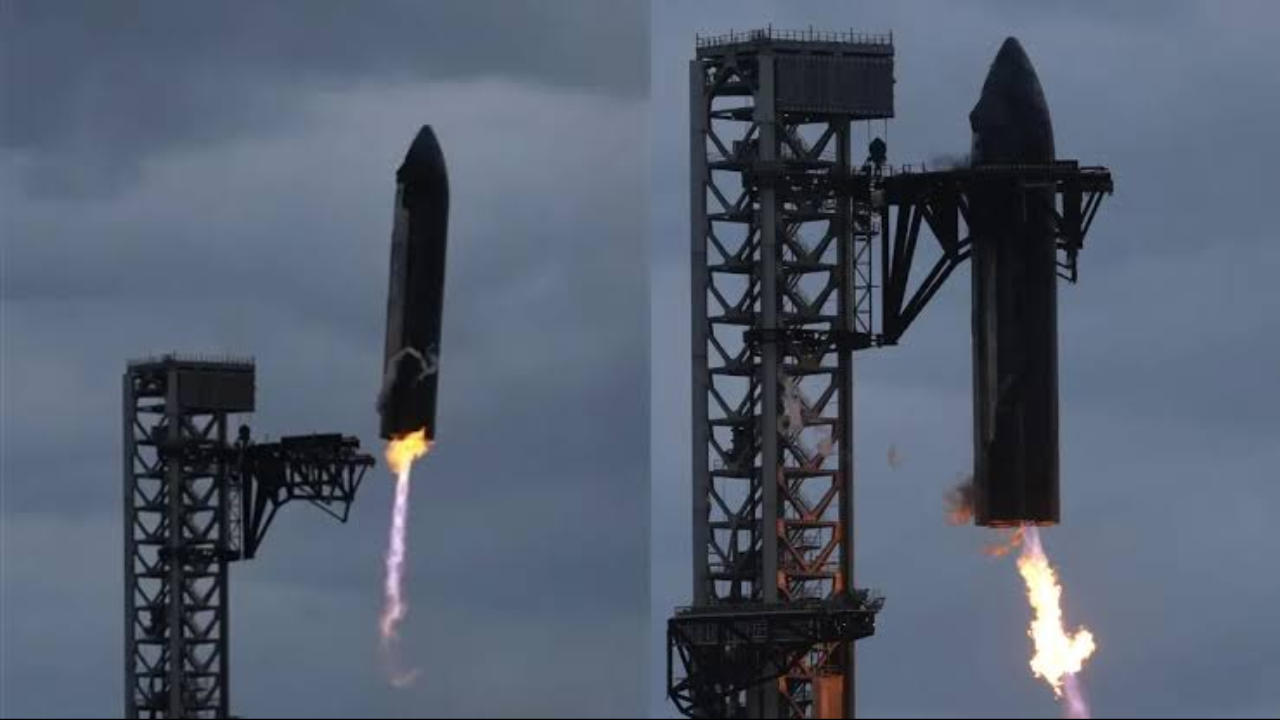
In a landmark aerospace engineering milestone dominating current affairs November 16, 2026, private American space manufacturer SpaceX executed the world's first mid-air launch tower capture of an orbital-class spacecraft upper stage returning from space. On November 14, 2026, at 21:20:03 UTC (3:20:03 p.m. CST), the 52-meter Starship upper stage—designated Ship 42—completed a 22-hour, 32-minute, and 32-second orbital mission (approximately 22.5 hours) and 14 revolutions around Earth before settling onto the mechanical "chopstick" arms of the "Mechazilla" launch tower at Orbital Launch Pad 2 (OLP-2) in Starbase, South Texas. For civil services aspirants tracking our daily GK update and UPSC current affairs, this 15th integrated test flight (Starship Flight 15) advances orbital rocketry from partial first-stage recovery toward full two-stage reusability, carrying major implications for Low Earth Orbit (LEO) satellite deployment economics, NASA's restructured Artemis III (2027) and Artemis IV (2028) lunar missions, and long-term human expeditions to Mars.
While the upper-stage capture succeeded on its first attempt, the mission's planned "double catch" was only partially achieved because the first-stage booster (Super Heavy Booster 22) suffered engine underperformance and low propellant reserves during its descent, triggering an automated offshore divert and self-destruction over the Gulf of Mexico at 6 minutes and 35 seconds after liftoff. Furthermore, although SpaceX demonstrated intact orbital upper-stage recovery, the company has yet to demonstrate rapid refurbishment and reflight of a recovered Starship or Super Heavy stage, nor has it tested in-orbit cryogenic propellant transfer—two essential technical prerequisites required before Starship can execute deep-space lunar landings. In this Atharva Examwise current news analysis and competitive exam news today briefing, we examine the flight telemetry of Flight 15, the mechanics of legless tower-catch mass optimization, NASA's updated lunar roadmap, and a comparative evaluation of India's indigenous Reusable Launch Vehicle (RLV) programs (Pushpak and NGLV Project Soorya) for UPSC Prelims and Mains (GS Paper III).
Key Facts and Exam-Relevant Data: SpaceX Starship Flight 15
For aspirants revising UPSC current affairs and State PCS science and technology modules, the core operational facts and exam-relevant parameters of the Starship Flight 15 mission are itemized below:
Mission Name & Vehicle Architecture: Starship Flight 15 (carrying payload mission Starlink Group 31-2) utilized the upgraded Block 3 (Version 3) vehicle architecture, pairing the 71-meter Super Heavy Booster 22 (B22) first stage with the 52-meter Ship 42 (S42) upper stage for a combined stacked height of 124 meters (407 feet)—the largest and most powerful rocket ever built. Ship 42 carried the hull inscription "Don't Panic", a reference to Douglas Adams's The Hitchhiker's Guide to the Galaxy.
Launch & Recovery Window: Lifted off on November 13, 2026, at 22:47:36 UTC (4:47:36 p.m. CST) from Orbital Launch Pad 2 (OLP-2) at Starbase, Texas, and concluded with the mid-air tower capture of Ship 42 on November 14, 2026, at 21:20:03 UTC (3:20:03 p.m. CST), establishing a record Starship mission duration of 22 hours, 32 minutes, and 32 seconds (~22.5 hours).
Orbital Altitude & Revolutions Completed: Ship 42 completed 14 full orbits around Earth. While general news reports cited an approximate flight altitude of 265 km (165 miles) and pre-launch planning projected ~275 km, post-flight geocentric Low Earth Orbit (LEO) telemetry recorded a perigee of 276 km (171 miles), an apogee of 278 km (173 miles), and an orbital inclination of 30.5°. Flight 15 marked only the second time a Starship reached Earth orbit, following Flight 14 on September 28, 2026, which completed one to two orbits before an ocean splashdown.
Payload & In-Orbit Heat Shield Inspection: Between T+00:35:01 and T+01:17:40, Ship 42 deployed 26 third-generation Starlink V3 satellites. According to SpaceX, each V3 satellite adds 1 terabit per second (Tbps) of network capacity, making this single payload deployment equivalent to roughly ten Falcon 9 Starlink launches. Notably, 3 of the 26 satellites carried specialized imaging cameras to inspect and photograph Ship 42's thermal protection heat shield tiles while in orbit.
Divergent Stage Recovery Outcomes: Super Heavy Booster 22 separated via hot-staging at T+00:02:21, but after 32 of its 33 Raptor engines relit for the boostback burn, engine underperformance and low propellant reserves caused automated guidance computers to abort the tower return at T+00:06:35, diverting the booster into the Gulf of Mexico where its Flight Termination System (FTS) destroyed it. Conversely, Ship 42 cleared three orbital health checkpoints over Hawaii and Chile, withstood atmospheric reentry, and achieved the first intact upright tower capture of an orbital upper stage.
NASA Artemis & Deep-Space Linkages: NASA has committed approximately $3.2 billion since 2021 toward Starship's Human Landing System (HLS) development alongside at least $15 billion in internal SpaceX investment. Under NASA's revised lunar architecture, a Starship Version 3 test article will conduct an in-orbit docking demonstration with the crewed Orion spacecraft in Low Earth Orbit during Artemis III (2027), laying the operational foundation for the Artemis IV (2028) crewed lunar surface landing and future human missions to Mars.
Technical Analysis: How the "Mechazilla" Tower Catch Works and Why Booster 22 Aborted
Understanding the engineering distinction between recovering a suborbital first-stage booster and recovering an orbital upper stage is essential for tackling analytical questions in UPSC current affairs. Prior to Flight 15, SpaceX had already validated the tower-catch technique by capturing the Super Heavy first-stage booster on three earlier test flights. However, capturing the Starship upper stage (Ship 42) presented a far more demanding aerodynamic and thermal challenge because the upper stage flies higher, farther, and at full orbital speed, requiring it to dissipate extreme kinetic energy as heat before executing a precision vertical landing.
1. The Multi-Checkpoint Orbital Return and Belly-Flop Maneuver
Because Ship 42's reentry trajectory required overflying land corridors across northern Mexico and South Texas—approved via a Federal Aviation Administration (FAA) launch license modification on November 13, 2026—SpaceX embedded three mandatory contingency checkpoints into the 22.5-hour flight timeline to verify vehicle health before committing to a return over land. The first check (Early Hawaii Return Check at T+01:27:46) occurred roughly 10 minutes after Starlink payload deployment concluded, allowing engineers to command an early Pacific Ocean splashdown near Hawaii if payload doors or thrusters malfunctioned. The second check (Mid Chile Return Check at T+07:15:35) and the third check (Final Hawaii Return Check at T+20:41:55) verified avionics, propellant tank pressures, and orbital camera imagery of the ceramic heat shield tiles before final descent.
After clearing all three checkpoints across 14 orbits, Ship 42 reignited a single sea-level Raptor engine at T+21:35:57 for a 10-second deorbit burn. Entering Earth's atmosphere over the Pacific Ocean at T+22:10:46, the spacecraft descended belly-first behind its tile heat shield, steering with four aerodynamic flaps through banking turns over northern Mexico and South Texas while decelerating through transonic (T+22:29:34) and subsonic (T+22:30:13) regimes. SpaceX also maintained a contingency splashdown zone in the Gulf of Mexico in case tower or vehicle sensors flagged an anomaly on final approach. With all parameters nominal, Ship 42 ignited three sea-level Raptor engines at T+22:32:16, executed a rapid vertical landing flip maneuver at T+22:32:18, throttled down from three engines to two (T+22:32:21) and then to a single engine (T+22:32:27) as it neared a hover, and rested two load-bearing catch fittings located just below its forward flaps onto the closing mechanical arms of the Pad 2 launch tower at T+22:32:28.
2. Why Super Heavy Booster 22 Failed Its Catch Attempt
Flight 15 marked the debut of the third-generation (Block 3 / V3) Super Heavy booster, whose three enlarged grid fins carry the structural catch points, operating at Orbital Launch Pad 2 (OLP-2), whose mechanical arms are shorter and electrically driven to track the returning vehicle faster. While Booster 22 performed a nominal ascent and hot-staging separation at T+00:02:21, only 32 of its 33 Raptor engines relit for the boostback burn at T+00:02:26. According to post-flight analysis by SpaceX and CEO Elon Musk, engine underperformance during descent left the booster with low propellant reserves, violating automated tower-catch safety criteria. At T+00:06:35, the guidance system automatically aborted the pad catch and diverted Booster 22 offshore into the Gulf of Mexico, where its Flight Termination System (FTS) was activated to destroy the booster. To prevent a similar shortfall on future flights, Musk noted that SpaceX will upgrade to Raptor V3.2 engines and advance main engine cutoff (MECO) by approximately one second during ascent to preserve sufficient landing propellant.
Economic and Engineering Benefits of Full Reusability and Legless Recovery
In conventional expendable launch vehicles—such as India's operational PSLV and LVM3—over 90% of a rocket's liftoff mass consists of propellant and fuel tanks, leaving less than 4% for usable payload, while expensive engines and avionics accounting for 60–70% of total vehicle cost are discarded into the ocean after a single launch. Starship Flight 15 advances three interconnected breakthroughs in launch vehicle engineering and economics.
First, capturing both stages with the 146-meter (480-foot) Mechazilla launch tower eliminates the need for onboard landing legs. Traditional vertical-landing rockets such as Falcon 9 carry heavy deployable legs that concentrate touchdown forces onto base attachment points, requiring substantial structural reinforcement. According to aerospace industry analysis by SpaceNexus, eliminating landing legs on a 71-meter booster and 52-meter ship saves potentially tens of thousands of kilograms of structural mass by transferring landing hardware to ground infrastructure and absorbing loads at existing structural hard points near the grid fins and forward flaps. Under the Tsiolkovsky rocket equation, every kilogram of structural landing gear removed from an orbital rocket translates directly into an extra kilogram of payload capacity or propellant margin—yielding vital mass savings for deep-space variants such as the Starship Human Landing System (HLS) and orbital propellant depots.
Second, tower capture enables ultra-fast turnaround and launch cadence. Recovering a rocket stage on an ocean drone ship requires days of maritime transit and crane recovery before the vehicle returns to its launch complex. Catching the vehicle directly over the launch mount eliminates off-site recovery transport, theoretically allowing engineers to inspect, restack, refuel, and relaunch the rocket within hours rather than weeks, similar to commercial airliners. Elon Musk has projected that Starship could reach a weekly launch cadence by the first half of 2027, supported by a new Florida launchpad at Kennedy Space Center expected to begin operations within the next few months.
Third, full two-stage reusability substantially reduces the cost per kilogram to orbit. While community and industry estimates place partially reusable Falcon 9 launch costs at roughly $3,000 per kg to LEO and project that Starship could lower near-term costs to ~$250 per kg (with theoretical long-term models targeting under $100 per kg), independent analysts emphasize that future cost-per-kilogram figures remain engineering targets rather than commercial prices until SpaceX proves rapid refurbishment and reflight.
(For a deeper look at how SpaceX's satellite deployments impact Indian telecommunications and security, read our related analysis: UPSC Current Affairs October 26, 2026: Starlink in India, LEO Satellite Internet & National Security Challenges.)
Impact on NASA's Restructured Lunar Roadmap (Artemis III & IV) and Mars Exploration
A crucial dimension for aspirants following UPSC current affairs is how Starship's orbital recovery connects to NASA's restructured Artemis lunar exploration architecture, unveiled in 2026 under NASA Administrator Jared Isaacman. Building on NASA's Ignition initiative announced in March 2026—and alongside the cancellation of the Lunar Gateway station in March 2026—NASA revised its mission sequence to reduce operational risk and accelerate a US crewed return to the Moon ahead of international competitors, notably China.
1. 2027: Artemis III Redesignated as a Low Earth Orbit Docking Demonstration
Prior to February 2026, Artemis III was slated to be the first crewed lunar landing of the program. Under NASA's updated architecture, Artemis III (targeted for 2027) will instead operate as a 14-day crewed demonstration mission in Low Earth Orbit (LEO)—comparable to Apollo 9 in 1969—coordinating three separate heavy-lift launches to test commercial lunar landers before attempting a Moon landing. NASA astronauts Randy Bresnik (Commander), Frank Rubio, and Andre Douglas, together with European Space Agency (ESA) astronaut Luca Parmitano (Pilot), will launch aboard the Orion (CM-004) spacecraft atop NASA's Space Launch System (SLS) rocket from Kennedy Space Center.
During Phase 1 of Artemis III, Jeff Bezos's Blue Origin will first launch an uncrewed test version of its Blue Moon Mark 2 lander into a ~237-nautical-mile (273-mile) circular LEO. After Orion launches and circularizes its orbit, the crew will rendezvous and dock with Blue Moon for approximately two days, opening the hatch to enter the lander cabin and evaluate its life-support systems, controls, and cabin pressure. During Phase 2, SpaceX will launch a Starship Version 3 lander test article from Florida into a 206-nautical-mile LEO equipped with a forward-mounted nose docking system. Orion will undock from Blue Moon, reposition, and conduct a two-hour docking demonstration with Starship to validate multi-vehicle controllability, communications, and integrated docking software (astronauts will not enter the Starship cabin during this test). In Phase 3, the crew will spend up to five additional days in LEO testing Orion survival suits, autonomous crew health assessments, cellular biology experiments, and lunar sample-return contamination protocols before splashing down in the Pacific Ocean off the California coast.
2. 2028: Artemis IV Targeted for First Crewed Lunar Landing Since 1972
Following the 2027 LEO docking trials, Artemis IV (targeted for early 2028) will serve as the first crewed lunar surface landing since Apollo 17 in 1972, targeting the Lunar South Pole. NASA is pursuing parallel development with both SpaceX (Starship HLS) and Blue Origin (Blue Moon Mark 2), determining the lander assignment based on Artemis III test outcomes and contractor readiness. Under SpaceX's redesigned mission profile, Starship HLS will first perform orbital refueling in Earth orbit via tanker Starships, then rendezvous with Orion and transport the spacecraft toward the Moon before descending to the lunar surface. To accelerate readiness for 2028, NASA reduced Artemis III hardware processing timelines by roughly 50%,explored a stretched United Launch Alliance (ULA) Centaur V upper stage as a second option alongside the SLS Interim Cryogenic Propulsion Stage (ICPS), and partnered with Axiom Space to build a lighter "Sortie" spacesuit weighing roughly half as much as the primary lunar suit for early moonwalks.
3. Foundation for Permanent Lunar Infrastructure and Human Mars Missions
NASA's revised roadmap aims to increase lunar landing frequency to roughly once every six months, establishing permanent surface infrastructure near the Moon's South Pole. Mastering high-cadence reusable launches, orbital refueling, and precision atmospheric reentry with Starship directly provides the heavy-lift transportation architecture needed for NASA's and SpaceX's ultimate objective: sending humans to Mars.
Comparative Analysis for UPSC GS Paper III: SpaceX Starship vs. ISRO's Reusable Launch Vehicles (Pushpak & Project Soorya)
In UPSC Prelims and Mains, international space milestones are regularly examined alongside India's domestic technological initiatives under the Indian Space Policy 2023 and the Debris-Free Space Missions (DFSM) 2030 goal. While SpaceX has developed a fully reusable, all-vertical super-heavy rocket, the Indian Space Research Organisation (ISRO) is advancing a complementary two-track reusability roadmap designed to cut launch costs by 80–90% (targeting roughly $2,000 per kg to LEO) as the global space economy approaches a projected $1 trillion by 2030.
As synthesized in the comparative matrix above, aspirants should focus on three analytical themes linking Starship's achievement to India's space program:
First, ISRO is pursuing both Vertical Takeoff, Vertical Landing (VTVL) and Vertical Takeoff, Horizontal Landing (VTHL) recovery methods. While SpaceX relies exclusively on VTVL retro-propulsion, ISRO is developing VTVL capability through its ADMIRE testbed and the Next Generation Launch Vehicle (NGLV — Project Soorya), which received Union Cabinet approval in September 2024 (with an outlay reported at ₹8,240 crore) to replace the PSLV and expendable LVM3. Simultaneously, ISRO's Pushpak (RLV-TD)—a 6.5-meter winged technology demonstrator named after the self-propelled Pushpaka Vimana from the Ramayana—uses a VTHL spaceplane profile, gliding unpowered onto a runway at speeds above 320–350 km/h using NavIC navigation, honeycomb fins, and drogue parachutes. Having completed its Hypersonic Flight Experiment (HEX-01 in 2016) and all three Landing Experiments (LEX-01 in April 2023, LEX-02 in March 2024, and LEX-03 in June 2024) at Chitradurga, Pushpak is advancing in 2026 toward the Orbital Re-entry Experiment (ORE / OREX), where it will be launched into orbit atop a GSLV/LVM3 rocket to test indigenous ceramic-matrix composite heat shields at reentry temperatures exceeding 1,200°C, followed later by the Scramjet Propulsion Experiment (SPEX).
Second, reusable launch systems are driving a global propulsion transition toward Liquid Oxygen (LOX) and Liquid Methane (Methalox) as well as semi-cryogenic architectures. SpaceX's Raptor engines burn LOX and liquid methane, while civil services study analyses note that ISRO's NGLV Project Soorya is being designed around clean-burning semi-cryogenic (5× SCE-200 engines with a CE-20 cryogenic upper stage) and LOX–Methane propulsion options. Compared to conventional kerosene or solid fuels, LOX–Methane provides higher combustion efficiency, easier long-term storage, and substantially reduced carbon soot deposition inside engine components—a critical advantage for minimizing refurbishment turnaround time between flights.
Third, heavy-lift reusability underpins India's long-term human spaceflight milestones. With a payload capacity of approximately 30 tonnes to LEO in expendable configuration and ~15 tonnes in reusable configuration (targeted for operational readiness around 2032), NGLV Project Soorya is vital for launching the heavy modules of the Bharatiya Antariksh Station (2035), achieving India's crewed lunar landing target (2040), and preventing discarded rocket stages from adding to orbital space debris (Kessler Syndrome).
(Explore more science, defense, and environment updates on our Atharva Examwise Current Affairs Portal, including India Installs First Glacial Flood Warning System at Ghepan Lake and Flex Fuel Technology (E85 & E100) vs E20 Petrol.)
Authoritative External References for Further Reading
For aspirants wishing to consult primary mission documentation and official space agency briefings:
SpaceX Official Mission Overview: Starship's Fifteenth Flight Test (SpaceX)
NASA Official Artemis Architecture Update: NASA Shares Plans to Accelerate Artemis, Return to Moon in 2028 (NASA.gov)
NASA Artemis III LEO Docking Mission Details: NASA's Artemis III Mission to Test Future Moon Lander Operations (NASA.gov)
Why this matters for your exam preparation
Why this matters for your exam preparation: Space launch technology, orbital mechanics, and international lunar exploration programs are high-yield recurring topics across UPSC Civil Services (Prelims & Mains), State PCS (MPPSC, UPPSC, BPSC), and NDA/CDS examinations. In UPSC Prelims 2024, for example, a direct question examined the naming and autonomous glide characteristics of ISRO's Pushpak RLV-TD, while UPSC Mains GS Paper III regularly tests the economic and strategic implications of reusable launch vehicles under the Indian Space Policy 2023.
In UPSC Prelims (General Science & International Current Events), questions frequently test comparative orbital regimes (such as Ship 42's 276 × 278 km Low Earth Orbit versus Geostationary orbits), rocket staging and propulsion chemistry (LOX–Methane, Cryogenic, and Semi-Cryogenic engines), and the updated mission profiles of Artemis III (2027 LEO docking test) versus Artemis IV (2028 crewed lunar landing). In UPSC Mains GS Paper III (Science & Technology), this topic maps directly to "Awareness in the fields of Space" and "Indigenization of technology and developing new technology". Aspirants can cite Starship Flight 15's legless Mechazilla tower capture as a benchmark in structural mass optimization and contrast it with ISRO's dual-track reusability strategy in Pushpak (OREX) and NGLV (Project Soorya). For State PCS examinations (including MPPSC Pre + Mains), factual specifics such as the 14 orbits, 22.5-hour duration, 265–278 km altitude, and 15th test flight number are prime candidates for objective one-liner questions. (Strengthen your foundational concepts with our Atharva Examwise Study Material & NCERT Foundation Courses and our dedicated MPPSC Live Batch (Pre + Mains).)
Practice Prelims MCQ for Self-Assessment
Q. With reference to recent developments in space launch technology and lunar exploration (November 2026), consider the following statements:
SpaceX's Starship Flight 15 marked the first-ever mid-air launch tower recovery of an orbital upper stage after completing 14 orbits around Earth, while its Super Heavy booster was also successfully caught on the same flight.
Under NASA's revised Artemis roadmap, the Artemis III mission in 2027 is designed as a Low Earth Orbit (LEO) docking demonstration involving both SpaceX's Starship and Blue Origin's Blue Moon landers, prior to a crewed lunar surface landing on Artemis IV in 2028.
Unlike SpaceX's Starship, which uses vertical landing via a launch tower catch, ISRO's Pushpak RLV-TD is a winged technology demonstrator designed for autonomous horizontal runway landing.
Which of the statements given above are correct? (a) 1 and 2 only
(b) 2 and 3 only
(c) 1 and 3 only
(d) 1, 2 and 3
Correct Answer: (b) 2 and 3 only
Explanation: Statement 1 is incorrect because while the upper stage (Ship 42) was successfully caught by the launch tower arms after 14 orbits (~22.5 hours), the first-stage booster (Super Heavy Booster 22) aborted its catch attempt due to engine underperformance and low propellant, diverting into the Gulf of Mexico where it was destroyed. Statements 2 and 3 are correct.
Practice UPSC Mains Question (GS Paper III — 250 Words)
"The successful orbital recovery of SpaceX's Starship upper stage signals a paradigm shift from expendable rocketry to full, rapid reusability. Examine the engineering and economic advantages of fully reusable launch vehicles, and evaluate how India's indigenous RLV-TD (Pushpak) and NGLV (Project Soorya) programs align with the objectives of the Indian Space Policy 2023."