
UPSC Current Affairs November 13, 2026: India Re-Elected ISA President for 2026–28 | Atharva Examwise Current News, Daily GK Update & Competitive Exam News Today
Executive Summary: Competitive Exam News Today and Daily GK Update
In a defining multilateral development for global clean energy governance and South-South climate diplomacy, the Republic of India has been re-elected as the President of the International Solar Alliance (ISA) for the 2026–2028 term. Announced on November 3, 2026, by Union Minister for New and Renewable Energy Shri Pralhad Joshi during the 9th Session of the ISA Assembly—held alongside the Bharat Renewable Energy (BRE) Summit & Expo 2026 in New Delhi—this mandate marks India's third consecutive term at the helm of the intergovernmental organization. Simultaneously, the Republic of France, represented by Minister Delegate for Ecological Transition Mathieu Lefèvre, secured re-election as Co-President for the two-year term after prevailing over Burkina Faso in the Co-Presidency ballot.
For civil services candidates tracking UPSC current affairs, this development represents a critical convergence of institutional leadership, renewable energy finance, and geopolitical strategy. As recorded on the Atharva Examwise Daily Current Affairs Portal, the 9th ISA Assembly reflects a fundamental paradigm shift within the alliance, moving beyond foundational treaty-building toward accelerated capital mobilization, decentralized agricultural solarization, and energy sovereignty for the Global South. With total alliance representation reaching 130 signatory and member nations by November 2026, India and France are leveraging their foundational partnership—originally forged at the Paris COP21 summit in November 2015—to bridge structural disparities in global clean energy deployment.
High-Yield Prelims Facts and Exam-Relevant Data
Presidency Mandate (2026–2028): India has been re-elected as the President of the International Solar Alliance for a third consecutive term (two-year tenure from 2026 to 2028), represented by Union Minister for New and Renewable Energy Shri Pralhad Joshi.
Co-Presidency Mandate (2026–2028): France has been re-elected as the Co-President of the ISA for the 2026–2028 term, defeating Burkina Faso in the Co-Presidency election during the 9th Assembly in New Delhi. While certain wire dispatches referenced the operational cycle as 2027–2029, official diplomatic communiqués from the Embassy of France in India Official Statement on the 2026–2028 ISA Co-Presidency and the Ministry of New and Renewable Energy confirm the 2026–2028 term.
Announcement Forum: The leadership renewal was formally announced on November 3, 2026, at the 9th Session of the ISA Assembly during the Bharat Renewable Energy (BRE) Summit & Expo 2026 in New Delhi.
Preceding Tenure Context (2024–2026): During the 7th Session of the ISA Assembly held at Bharat Mandapam, New Delhi (November 3–6, 2024), India stood as the sole contender for President and France defeated Grenada for Co-President for the 2024–2026 cycle.
Executive Leadership (Director General): Ashish Khanna of India serves as the 3rd Director General of the ISA, having been elected at the 7th Assembly to succeed the 2nd Director General, Dr. Ajay Mathur, upon the conclusion of the latter's term in March 2025.
Alliance Membership Reach: As of November 3, 2026, the ISA encompasses 130 signatory and member countries, up from 120 signatory states (and 100 ratified full members) recorded in November 2024.
Founding and Legal Status: Co-founded by Prime Minister Narendra Modi and then-French President François Hollande on November 30, 2015, at UNFCCC COP21 in Paris; opened for signature on November 15, 2016, at COP22 in Marrakech, Morocco; and entered into force on December 6, 2017, as the first treaty-based international intergovernmental organization headquartered in India.
Headquarters and Secretariat: Hosted at the National Institute of Solar Energy (NISE) campus in Gurugram, Haryana, India.
Core Vision and Targets: "One Sun One World One Grid" (OSOWOG), supported by the "Towards 1000" strategy targeting USD 1,000 billion ($1 trillion) in solar investments, 1,000 GW of installed solar capacity, clean energy access for 1,000 million people, and annual mitigation of 1,000 million tonnes of $\text{CO}_2$ emissions by 2030.
Institutional Architecture and Evolution of the International Solar Alliance
Understanding the structural evolution of the International Solar Alliance is essential for aspirants utilizing Atharva Examwise Exam-Ready Study Material, NCERT Notes, Mind Maps & PYQs to master international organizations for Preliminary and Mains examinations. Conceived in November 2015 as a coalition of solar-resource-rich nations—colloquially termed "sunshine countries"—located fully or partially between the Tropic of Cancer ($23.5^\circ\text{N}$) and the Tropic of Capricorn ($23.5^\circ\text{S}$), the alliance was designed to address the distinct energy transition bottlenecks of tropical developing economies. While solar insolation is available year-round in abundance across the inter-tropical belt, high capital costs, sovereign risk perceptions, and fragmented technological ecosystems historically impeded large-scale photovoltaic (PV) deployment in these regions. Following an amendment to the ISA Framework Agreement, membership eligibility was expanded beyond the inter-tropical zone to include all member states of the United Nations, transforming the alliance into a universal multilateral platform for solar cooperation.
| Institutional Parameter | Key Exam-Relevant Data & Historical Milestones |
|---|---|
| Organizational Nature | Action-oriented, treaty-based international intergovernmental organization. |
| Founding Launch | November 30, 2015, in Paris on the sidelines of UNFCCC COP21 by Indian PM Narendra Modi and French President François Hollande. |
| Framework Agreement Signing | Opened for signature on November 15, 2016, at UNFCCC COP22 in Marrakech, Morocco. |
| Treaty Entry into Force | December 6, 2017, following ratification by 15 countries. |
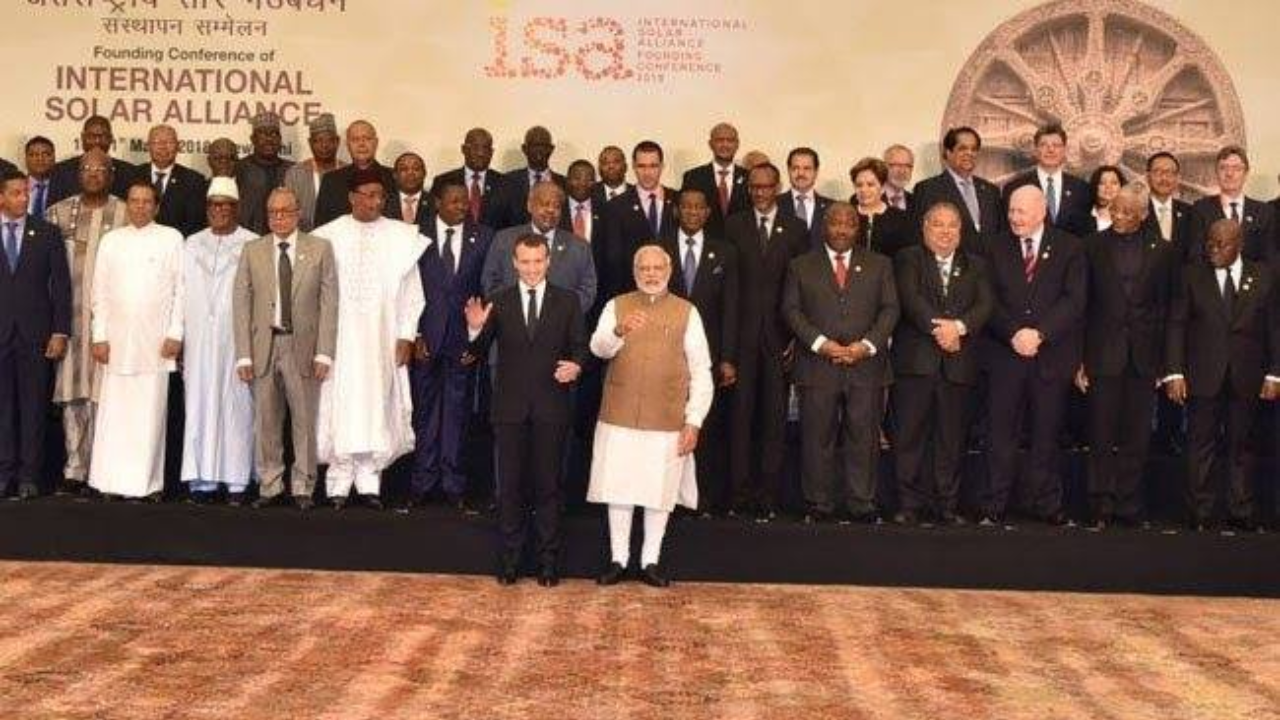
| Founding Conference | March 11, 2018, co-hosted by Indian PM Narendra Modi and French President Emmanuel Macron. |
| Permanent Secretariat | Gurugram, Haryana, India (National Institute of Solar Energy campus). |
| Apex Decision-Making Body | The ISA Assembly, comprising ministerial delegates from all Member and Signatory Countries. |
| Current Presidency (2026–2028) | President: Republic of India (3rd consecutive term; represented by Union MNRE Minister Shri Pralhad Joshi).
Co-President: Republic of France (represented by Minister Delegate Mathieu Lefèvre). |
| Secretariat Head (Director General) | Ashish Khanna (3rd DG; assumed office in March 2025 following Dr. Ajay Mathur). |
| Regional Governance Structure | Four Geographical Regions: (1) Africa; (2) Asia and the Pacific; (3) Europe and Others; (4) Latin America and the Caribbean. |
The governance architecture of the ISA Assembly places strong institutional emphasis on equitable geographical representation across four designated regional groups: Africa, Asia and the Pacific, Europe and Others, and Latin America and the Caribbean. Under the regional Vice-Presidency framework established by the Assembly, leadership responsibilities are distributed across continents—represented by Ghana and Seychelles for Africa; Australia and Sri Lanka for Asia and the Pacific; Germany and Italy for Europe and Others; and Grenada and Suriname for Latin America and the Caribbean. This multipolar representation was prominently demonstrated during the November 2026 BRE Summit & Expo and 9th ISA Assembly in New Delhi, as documented in the Press Information Bureau (PIB) Official Release on the 9th ISA Assembly & BRE Summit 2026, which featured high-level ministerial participation from Mr. David Abiamofo (Minister of Natural Resources, Suriname), H.E. Ms. Geralda Desaubin (Minister of Industry and Enterprise, Seychelles), and H.E. Mr. Muhammadu Arkam Ilyas (Deputy Minister of Energy, Sri Lanka).
Furthermore, the transition in executive leadership at the Gurugram Secretariat reinforces the shift toward project bankability and private-capital mobilization. The election of Ashish Khanna as the 3rd Director General—succeeding Dr. Ajay Mathur in March 2025—brought over 26 years of energy sector development experience across more than 15 developing nations in South Asia, West Asia, North Africa, and Sub-Saharan Africa, alongside specialized expertise as a former Lead Energy Specialist at the World Bank. Operating in tandem with India's Presidency and France's Co-Presidency, the Secretariat's institutional mandate is to partner with Multilateral Development Banks (MDBs), Development Financial Institutions (DFIs), and private enterprises to de-risk solar investments in Least Developed Countries (LDCs) and Small Island Developing States (SIDS).
Strategic Priorities of India's 2026–2028 ISA Presidency
During the 9th ISA Assembly on November 3, 2026, Union Minister Shri Pralhad Joshi articulated a four-pillar operational roadmap for India's 2026–2028 Presidency, designed to convert shared climate commitments into measurable ground-level outcomes across the 130 signatory and member states. Rather than treating solar energy solely as a utility-scale grid addition, the new Presidency agenda integrates decentralized finance, rural livelihood enhancement, island grid resilience, and artificial intelligence-driven institutional capacity.
Catalyzing Solar Finance for the Global South
The foremost barrier to the clean energy transition in developing nations is not technological viability, but rather the prohibitive cost of capital across emerging markets. To unlock private investment in high-risk jurisdictions, India's Presidency prioritizes structured risk-mitigation instruments that crowd-in institutional capital. Central to this effort is the USD 200 million Africa Solar Facility, an investment vehicle designed to finance the continent's distributed renewable energy (DRE) industry, toward which the Government of India has pledged approximately INR 225 crore (USD 25 million) as catalytic anchor capital. Complementing this continental mechanism is the USD 300 million Nigeria Distributed Renewable Energy (DRE) Fund, which was highlighted during the 9th Assembly as a dedicated national financing framework to accelerate off-grid and mini-grid solar electrification across Nigeria.
Solar for Farmers and the Global Export of Agrivoltaics
A cornerstone of India's renewable energy diplomacy is the internationalization of its domestic developmental schemes. Union Minister Pralhad Joshi emphasized that India has empowered 3 million farmers domestically through decentralized solar energy and Agrivoltaics (Agri-PV)—an integrated land-use system that combines solar photovoltaic power generation with active agricultural cultivation on the same parcel of land. Under the 2026–2028 Presidency, the ISA is actively exporting the policy blueprint of India's PM-KUSUM (Pradhan Mantri Kisan Urja Suraksha evam Utthaan Mahabhiyan) scheme to fellow developing nations. This technology-sharing initiative enables agrarian economies across Africa, Asia, and Latin America to replace diesel irrigation pumps with solar-powered alternatives, significantly lowering input costs for smallholder farmers while generating surplus clean electricity. Aspirants connecting rural economy schemes with environmental sustainability through the Atharva Examwise Complete NCERT Foundation & UPSC/State PCS Courses will recognize this initiative as a premier illustration of Indian domestic welfare architecture shaping global developmental norms.
Tailored Solar and Storage Solutions for Small Island Developing States
Small Island Developing States (SIDS) confront a severe structural vulnerability, as they bear the immediate impacts of climate hazards while remaining heavily reliant on imported fossil fuels for basic power generation. Under India's leadership, the ISA has expanded targeted project assistance to island nations including Fiji, Madagascar, Comoros, and Seychelles. Within these island economies, ISA-supported solar deployments are directed toward four vital human-development applications: electrifying primary healthcare facilities and educational institutions, powering clean drinking water systems, enabling solar-powered farming, and strengthening overall community climate resilience. Furthermore, to overcome the intermittency of solar generation on isolated island grids, the alliance is rolling out integrated hybrid solar and battery energy storage solutions tailored specifically for SIDS, initiating this next-generation deployment model in Mauritius.
Technology Capacity Building, AI Integration, and the Circular Economy
To prevent developing nations from remaining passive importers of clean technology without indigenous maintenance or manufacturing ecosystems, the fourth priority pillar focuses on institutional knowledge transfer and circular lifecycle management. The alliance is currently developing 17 Solar Technology Application Resource Centres (STAR-C) to serve as regional hubs for technical training, quality assurance, and equipment standardization across member states. Alongside the STAR-C network, the Presidency is establishing the SHINE (Strategic Hub for Innovation and Execution) Global Capability Centre and launching an AI-enabled ISA Academy to deliver artificial intelligence-driven energy learning, regulatory training, and technical capacity building. Recognizing that rapid photovoltaic expansion will eventually generate substantial end-of-life panel waste, the ISA also operates the Sunrise Recycling Network to promote circular solar economies and sustainable photovoltaic waste management protocols.
Global Solar Macroeconomics: Empirical Findings from the World Solar Report Series
A rigorous evaluation of the ISA's 2026–2028 agenda requires situating India's Presidency within the broader empirical trends documented by the ISA's flagship World Solar Report series, which was first introduced in 2022, expanded in its 3rd edition at the 7th Assembly, and supplemented by specialized publications on global solar trends, green hydrogen, and e-mobility at the 9th Assembly. The macroeconomic data reveals an extraordinary technological revolution alongside a persistent geographic concentration of capital and employment.
The Technological Triumph vs. The Geographic Asymmetry Paradox
A deeper examination of the empirical findings from the World Solar Report series uncovers a critical structural contradiction in the global energy transition. On the supply side, between 2000 and 2023, global installed solar capacity expanded at an extraordinary 40% annual growth rate, surging more than a thousandfold from 1.22 GW to 1,418.97 GW, with 345.83 GW commissioned in 2023 alone. Over the same timeframe, global solar electricity generation rose from 1.03 Terawatt-hours (TWh) to 1,628.27 TWh. This rapid deployment was propelled by a 90% reduction in the global weighted average Levelized Cost of Electricity (LCOE) for utility-scale solar PV, which fell from USD 0.460/kWh in 2010 to USD 0.044/kWh in 2023, representing country-level declines ranging between 76% and 93%.
Simultaneously, global energy investments expanded from USD 2.4 trillion in 2018 to an estimated USD 3.1 trillion in 2024, with clean energy investments reaching twice the volume of fossil fuel allocations by rising from USD 1.2 trillion in 2018 to USD 2.0 trillion by 2024. However, regional capital absorption and workforce distribution remain highly uneven: Europe, the Middle East, and Africa (EMEA) recorded modest solar investment growth at USD 91 billion in 2023, followed by the Americas (North, Central, and South America) at USD 78 billion, while 86% of all global solar jobs remain concentrated in just ten countries.
This empirical disparity explains why India's third consecutive term as ISA President is geopolitically consequential. Although solar PV is now the most cost-competitive source of bulk electricity on a technological basis, capital-market imperfections prevent Least Developed Countries in Sub-Saharan Africa, Latin America, and island states from capturing these cost reductions. As noted in the PIB Curtain Raiser and Official Documentation on the 7th Session of the ISA Assembly, global solar deployment faces three interconnected hurdles: investments, infrastructure, and indigenisation. By deploying blended-finance vehicles like the Africa Solar Facility and establishing 17 STAR-C centres for local workforce training, the ISA directly targets the 86% employment concentration bottleneck and diversifies global solar supply chains.
From Climate Action to Energy Sovereignty and Green Hydrogen
A major conceptual evolution highlighted at the 9th ISA Assembly by Director General Ashish Khanna is that member nations increasingly view solar generation coupled with battery storage not merely as an environmental obligation under the Paris Agreement, but as an essential pillar of energy sovereignty. For fuel-importing developing countries vulnerable to geopolitical supply disruptions, domestic solar-plus-storage architecture insulates national economies from external energy shocks.
Furthermore, the ISA has expanded its analytical and policy scope into green hydrogen and e-mobility. Produced via renewable-powered electrolysis, green hydrogen is positioned by the alliance as a vital decarbonization pathway for hard-to-abate heavy industries—specifically steel and fertilizer production—enabling African and Asian economies to transition away from coal, oil, and gas while building indigenous green industrial bases. Just as India has strengthened its domestic environmental monitoring and coastal sustainability through initiatives analyzed in Atharva Examwise's coverage of India Installs First Glacial Flood Warning System at Ghepan Lake (UPSC Current Affairs) and Blue Flag Tag, Marina Beach & India's Eco-Certification Initiatives, its international leadership through the ISA cements New Delhi's position as the primary architect of Global South climate resilience.
Why this matters for your exam preparation
For serious aspirants preparing through Learn Concept-First Geography, Polity & Current Affairs with Dr. Ajay Bhamoliya and state civil services programs such as the MPPSC Live Batch (Pre + Mains) & State Civil Services Coaching, India's re-election as ISA President for 2026–2028 is a high-probability topic across multiple tiers of competitive examinations.
Direct Syllabus Mapping for UPSC CSE and State PCS
| Examination Stage & Paper | Specific Syllabus Theme | Analytical & Exam-Focused Linkage |
|---|---|---|
| UPSC Prelims (GS Paper I) | Current events of national and international importance; General issues on Environmental Ecology & Climate Change. | Statement-based questions testing the exact tenure (2026–2028, 3rd consecutive term), Co-Presidency election (France defeating Burkina Faso), membership count (130 countries), treaty evolution (COP21 Paris 2015 vs. COP22 Marrakech 2016 vs. 2017 entry into force), and specific initiatives (STAR-C, SHINE, Sunrise Recycling Network, Towards 1000). |
| UPSC Mains (GS Paper II) | Bilateral, regional and global groupings and agreements involving India and/or affecting India's interests; Important International institutions, agencies and fora—their structure, mandate. | Evaluating the ISA as a pillar of Indo-French strategic convergence and Global South leadership. Analyzing how India uses treaty-based multilateralism headquartered on Indian soil (Gurugram) to project soft power, counter supply-chain monopolies, and assist SIDS and African nations. |
| UPSC Mains (GS Paper III) | Infrastructure: Energy, Ports, Roads, Airports, Railways; Conservation, environmental pollution and degradation. | Utilizing empirical statistics from the World Solar Report (90% LCOE drop to USD 0.044/kWh, 1,418.97 GW capacity, 86% job concentration in 10 countries) to substantiate answers on renewable energy financing, Agrivoltaics (Agri-PV), PM-KUSUM, One Sun One World One Grid (OSOWOG), and Green Hydrogen decarbonization. |
| MPPSC, State PCS, RBI Grade B & NABARD Grade A | International Organizations, Agricultural Economics, and Renewable Energy Targets. | Direct objective questions on the 9th ISA Assembly venue (New Delhi), Union MNRE Minister (Shri Pralhad Joshi), 3rd Director General (Ashish Khanna), India's financial pledge to the Africa Solar Facility (INR 225 crore / USD 25 million), and agricultural solarization (3 million farmers empowered via solar/Agri-PV). |
Strategic Synthesis for Mains Answer Writing
In UPSC Mains General Studies Paper II and Paper III, high-scoring responses must contextualize the ISA within three broader structural shifts in global governance. First, the alliance marks India's transition from a climate norm-taker to a global institution-builder; whereas developing nations historically participated in environmental regimes designed in Western capitals, the ISA stands as the first treaty-based intergovernmental organization headquartered in India, giving the Global South direct agenda-setting power. Second, the integration of India's PM-KUSUM and Agrivoltaics experience into the ISA's 2026–2028 priority framework demonstrates how successful domestic developmental models are being scaled as global public goods for agrarian and island economies. Third, candidates should cite the USD 200 million Africa Solar Facility—backed by India's USD 25 million anchor pledge—and the USD 300 million Nigeria DRE Fund as concrete mechanisms of South-South climate finance that address the structural failure of traditional financial markets to deliver affordable capital to developing nations.
Practice Evaluation for Prelims and Mains
Prelims Practice Question: Consider the following statements regarding the International Solar Alliance (ISA) and its 9th Assembly held in November 2026: (1) India was re-elected as the President of the ISA for a third consecutive term (2026–2028), while France was re-elected as Co-President after defeating Burkina Faso; (2) The ISA Framework Agreement was opened for signature at COP21 in Paris in 2015 and restricts full membership strictly to countries located between the Tropic of Cancer and the Tropic of Capricorn; (3) The Sunrise Recycling Network and the SHINE Global Capability Centre are institutional initiatives associated with the International Solar Alliance. Which of the statements given above are correct? Options: (a) 1 and 2 only, (b) 1 and 3 only, (c) 2 and 3 only, (d) 1, 2 and 3.
Answer and Explanation: The correct option is (b) 1 and 3 only. Statement 2 is incorrect because while the ISA was launched at COP21 in Paris on November 30, 2015, its Framework Agreement was opened for signature at COP22 in Marrakech on November 15, 2016, and its membership was subsequently expanded beyond tropical sunshine countries to include all member states of the United Nations.
Mains Practice Question (GS Paper II / GS Paper III — 15 Marks, 250 Words): "As the International Solar Alliance (ISA) enters India's third consecutive Presidential term (2026–2028), its strategic focus has evolved from treaty expansion to addressing capital asymmetry and advancing energy sovereignty across the Global South." Discuss in light of the outcomes of the 9th ISA Assembly and the empirical findings of the World Solar Report series.