
Daily GK Update: UPSC Current Affairs October 24, 2026 | Atharva Examwise Current News on Badr and Mecca Pacts
Geopolitical Overview: The Emergence of Interconnected Defense Coalitions
The regional security architecture connecting West Asia, South Asia, and Southeast Asia is witnessing a realignment driven by middle-power diplomacy, defense indigenization, and multi-vector alignments. In late October 2026, two diplomatic and military milestones unfolded: the formal conclusion of the quadripartite Badr Memorandum of Understanding (MoU) in Doha, Qatar, and the signing of 20 bilateral agreements encompassing maritime defense and capacity-building between Pakistan and the Maldives in Islamabad.
These pacts follow the Mecca Joint Defence Agreement signed in August 2026 by Pakistan, Saudi Arabia, and Turkey. Rather than operating as isolated bilateral exchanges, these initiatives collectively reflect an evolving network of defense-industrial partnerships that connect Gulf capital, Turkish defense technology, Pakistani military capacity, and Southeast Asian industrial participation. For candidates following competitive exam news today, these developments provide vital case studies on shifting defense architectures, regional deterrence doctrines, and the security of the Indian Ocean Region (IOR). Aspirants can explore daily strategic coverage through the Atharva Examwise Daily Current Affairs Series.
The Badr Memorandum of Understanding: Defense Industrial Integration
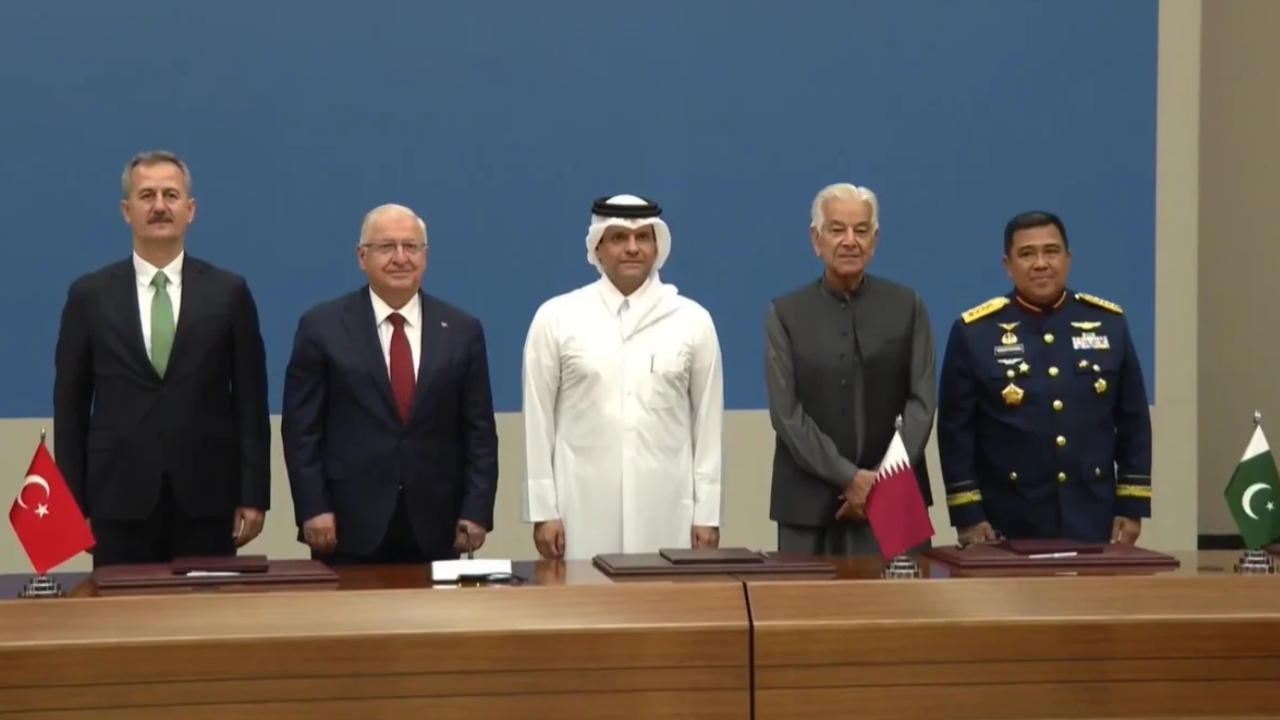
On October 21, 2026, senior defense representatives from Pakistan, Turkey (Türkiye), Qatar, and Indonesia gathered in Doha to sign the multilateral Badr Memorandum of Understanding (MoU). The agreement is structured around defense-industrial collaboration, technology transfer, joint research and development (R&D), and interoperability training rather than a formal military alliance.
The agreement was formalized by the following delegations:
Pakistan: Defence Minister Khawaja Muhammad Asif
Turkey: Minister of National Defence Yaşar Güler
Qatar: Deputy Prime Minister and Minister of State for Defence Affairs Sheikh Saud bin Abdulrahman Al Thani
Indonesia: Deputy Defence Minister Muhammad Yusuf Jauhari
Functional Architecture and Institutional Workflow
The Badr MoU establishes an institutional mechanism designed to systematically transition collaborative concepts into joint production lines. The operational workflow proceeds through three distinct phases:
First, each participating nation compiles an inventory of its immediate national security requirements, identifying technological gaps and critical equipment shortfalls.
Second, these defense requirement profiles are submitted to an Executive Board of Technical and R&D Experts. This board assesses industrial feasibility, drafts standardized engineering specifications, and prepares detailed plans for co-development and joint production.
Third, actionable proposals advance to a Strategic Board composed of ministerial representatives. This body exercises executive authority over budget allocations, resource sharing, and the distribution of production sites, with primary weapons assembly centers concentrated within Turkey's advanced industrial complexes. The pact also contains open-accession provisions permitting friendly third-party states to participate in specific project lines.
Historical and Symbolic Nomenclature
The agreement derives its name from the Battle of Badr (624 CE), fought 1,402 years ago near Medina in modern-day Saudi Arabia. In Islamic history, the battle marks the foundational military victory of the early Muslim community led by Prophet Muhammad against the Quraysh. The word Badr also translates to "full moon" in Arabic. Participating defense officials cited this linguistic root to characterize the pact as an integrative arrangement, wherein the distinct financial, technological, and manufacturing endowments of the four states combine to complete a comprehensive security framework.
Comparative Resource Endowments and Industrial Capabilities
The Badr partnership relies on an asymmetric division of industrial labor that leverages each state's comparative advantage.
| Member State | Core Resource Contribution | Primary Defense Industrial Role | Existing Collaborative Baseline |
|---|---|---|---|
| Turkey | NATO-standard engineering, unmanned combat aerial vehicles (UCAVs), naval design, sensors | Industrial anchor; primary host of manufacturing plants and technical research hubs | Defense and aerospace exports exceeded $10 billion in 2025; builder of the MILGEM corvette platform |
| Qatar | High-volume capital, defense investment funds, energy diplomacy | Financial underwriter of capital-intensive R&D and low-cost air defense initiatives | Bilateral defense industry memorandum concluded with Turkey in October 2025 |
| Pakistan | Conventional military manpower, ordnance facilities, assembly labor, operational combat testing | Component manufacturing, licensed assembly, naval outfitting | Co-production of four Babur-class (PN-MILGEM) corvettes (two in Istanbul, two at Karachi Shipyard) |
| Indonesia | Industrial manufacturing capacity, Southeast Asian logistical reach, critical raw materials | Armored vehicle production, tropicalized field testing, regional maintenance support | Joint development of the Harimau / Kaplan MT medium-weight tank with Turkey’s FNSS |
Strategic Catalysts in West Asia
The formalization of the Badr MoU reflects structural security pressures in the Middle East and the Persian Gulf. Sustained hostilities involving Iran, coupled with persistent missile and drone strikes against critical energy infrastructure, have highlighted severe vulnerabilities in Gulf air defense. Disruption along maritime chokepoints—principally the Strait of Hormuz and Bab-el-Mandeb—has accelerated demand for cost-effective, high-volume counter-unmanned aerial systems (C-UAS) and short-to-medium-range surface-to-air missile batteries.
At the same time, regional powers perceive a shift in traditional American security guarantees. Statements by United States officials in Doha urging regional partners to assume greater responsibility for collective defense, combined with strained Western weapons supply chains, have driven Gulf and Middle Eastern middle powers to pursue autonomous defense-industrial options. Aspirants can analyze these shifts in regional alignments through the Atharva Examwise West Asia Geopolitics Module.
The Mecca Joint Defence Agreement: Collective Security and Operational Clauses
The Badr MoU operates alongside the Mecca Joint Defence Agreement (MJDA), signed on August 7, 2026, by Saudi Arabia, Turkey, and Pakistan. While the Badr pact focuses strictly on industrial co-development, the Mecca Pact establishes a mutual defense arrangement. The complete terms of the Mecca agreement were submitted to the Grand National Assembly of Turkey for constitutional ratification, revealing a 16-article collective defense architecture.
Core Statutory Provisions
The Mecca Joint Defence Agreement introduces mutual assistance obligations among its signatories:
Territorial Integrity Guarantee (Article 1): Obligates all signatories to employ all necessary mechanisms, diplomatic and military, to safeguard one another's sovereignty, independence, and internationally recognized frontiers.
Collective Self-Defense Principle (Article 2): Codifies a mutual defense clause modeled after Article 5 of the North Atlantic Treaty. An external armed attack against one signatory is defined as an armed aggression against all three, invoking the collective self-defense provisions recognized under Article 51 of the United Nations Charter.
Comprehensive Logistics and Supply (Articles 6 & 7): Commits the signatories to supply weapons, ammunition, petroleum reserves, replacement parts, and military hardware during both peacetime and active hostilities, alongside joint technology transfer and R&D.
Institutional Intelligence Sharing: Formalizes channels for the exchange of classified strategic intelligence, surveillance data, and unified threat assessments.
Command Structure and Governance: The alliance establishes a permanent Secretariat in Riyadh, Saudi Arabia, with its inaugural Secretary-General designated from Pakistan. The treaty holds an indefinite term, reinforced by a mandatory 10-year non-withdrawal clause.
The Nuclear Deterrence Question
The text of Article 2 requires member states to provide mutual assistance utilizing all available means, military assets, and sovereign capabilities. Strategic defense analysts have noted that this unrestricted wording could encompass Pakistan’s nuclear deterrent.
Although Pakistani diplomatic officials have downplayed the automatic extension of a nuclear umbrella to non-nuclear allies, the intentional ambiguity creates an additional tier of regional deterrence against external adversaries.
Comparative Assessment: Contemporary Multilateral Defense Frameworks
The functional, institutional, and legal boundaries of these regional treaties differ significantly from traditional mutual assistance pacts:
| Feature / Metric | Badr Memorandum of Understanding (2026) | Mecca Joint Defence Agreement (2026) | GCC Peninsula Shield Force (1984) | NATO Alliance (1949) |
|---|---|---|---|---|
| Signatories | Turkey, Qatar, Pakistan, Indonesia | Saudi Arabia, Turkey, Pakistan | Saudi Arabia, UAE, Bahrain, Oman, Qatar, Kuwait | 32 North American and European Nations |
| Structural Mandate | Defense-industrial co-production, R&D, and technology transfer | Collective security, deterrence, and mutual wartime support | Sub-regional rapid intervention and monarchical regime stability | Collective defense, political consultation, and military alliance |
| Collective Defense Clause | Absent. Strictly industrial and technical | Present (Article 2). External aggression triggers collective defense | Limited to internal stability and localized Gulf threats | Present (Article 5). Armed attack on one triggers mutual military response |
| Permanent Headquarters | Project-specific boards (Turkey/Qatar hubs) | Permanent Secretariat in Riyadh (Led by Pakistani SG) | Joint Force Command at King Khalid Military City (Hafar al-Batin) | NATO Headquarters in Brussels, Belgium (SHAPE Command) |
| Accession Provisions | Open to third-party states | Open to prospective allies (e.g., discussions surrounding Bangladesh) | Restricted solely to sovereign member states of the GCC | Open to European states under Article 10 consensus |
| Duration & Exit Clauses | Flexible MoU protocols | Indefinite duration; mandatory 10-year lock-in period | Indefinite regional treaty regime | Indefinite duration; 1-year denunciation notice (Article 13) |
Pakistan-Maldives Strategic Convergence: Maritime Footprints
Simultaneous with the conclusion of the Badr MoU, Maldivian President Mohamed Muizzu undertook an official three-day state visit to Islamabad in late October 2026. This marked the first state visit by a Maldivian head of state to Pakistan since President Abdulla Yameen's trip in 2015, highlighting a renewed diplomatic engagement between the two South Asian nations. Aspirants tracking developments in island diplomacy and maritime affairs can consult the Atharva Examwise India-Maldives Relations Dossier.
The bilateral summit culminated in the execution of 20 Memorandums of Understanding (MoUs) covering security, economic, and technological cooperation:
| Cooperation Sector | Key Agreed Deliverables | Strategic Significance for Bilateral Ties |
|---|---|---|
| Military & Police Training | Pakistan Armed Forces to provide training modules for the Maldives National Defence Force (MNDF) and police personnel | Deepens institutional defense-to-defense linkages between Islamabad and Malé |
| Maritime Domain Awareness | Coordinated maritime patrols, intelligence sharing on narcotics trafficking, and joint surveillance | Establishes Maldivian operational security links outside traditional regional partnerships |
| Technology & Cyber Defense | Agreements on artificial intelligence, cybersecurity frameworks, and data center engineering | Modernizes Maldivian digital infrastructure with Pakistani technical assistance |
| Bilateral Trade Expansion | Plan to increase merchandise trade from $13.9 million to $200 million within two years | Diversifies the Maldivian economy through new commercial agreements |
| Regional Diplomacy | High-level discussions with Field Marshal Asim Munir; Maldivian call to revive the SAARC summit | Highlights Malé's diplomatic efforts to re-engage with broader regional platforms |
President Muizzu's call for the revitalization of the South Asian Association for Regional Cooperation (SAARC) summit process aligns with similar proposals voiced by Bangladesh's interim administration.
However, India’s Ministry of External Affairs maintains that regional cooperation requires an atmosphere free of cross-border terrorism, emphasizing that the burden of creating those conditions rests with Pakistan.
Strategic Implications for India and Regional Stability
The simultaneous signing of the Badr MoU, the operationalization of the Mecca Pact, and the expansion of Pakistan-Maldives defense cooperation present complex foreign policy and national security considerations for New Delhi.
Conventional Balance and Pakistan's Defense Modernization
For decades, Pakistan's defense procurement has faced budget constraints and declining access to Western military hardware, increasing its reliance on Chinese platforms. The Badr and Mecca agreements provide Islamabad with alternative pathways to diversify its weapons inventory. Access to advanced Turkish aerospace systems, electronic warfare suites, and sensor integration—financed through Gulf investments—could narrow India's conventional military edge along its western border.
The completed PN-MILGEM (Babur-class) project shows how Turkish design transfer has improved the shipbuilding capabilities of the Karachi Shipyard and Engineering Works (KSEW). New Delhi is responding by accelerating domestic defense capital acquisition under Aatmanirbhar Bharat, a policy examined in the Atharva Examwise Defence Technology & Indigenisation Analysis.
Indonesian Engagement and Defense Export Safeguards
Indonesia’s involvement in the Badr framework introduces a delicate dynamic into India-Indonesia ties. Jakarta and New Delhi maintain a Comprehensive Strategic Partnership focused on maritime security along the Malacca Strait, regular bilateral drills (Samudra Shakti), and ongoing negotiations regarding the export of India's BrahMos supersonic cruise missiles and Astra beyond-visual-range missiles.
Strategic observers raised questions about whether Indonesia's participation in an industrial pact alongside Pakistan could expose sensitive technical parameters of Indian-origin weapons systems.
Technical defense analysts and former leadership from the Defence Research and Development Organisation (DRDO) and BrahMos Aerospace have pointed out that Indian defense export frameworks feature strict protective safeguards:
Technology transfer (ToT) is legally and operationally separate from export sales; importing states receive user-level maintenance manuals rather than underlying software source code or manufacturing blueprints.
Original Equipment Manufacturer (OEM) controls ensure that maintenance, life-extension overhauls, and guidance software updates remain managed by India.
Indonesia's non-aligned foreign policy (bebas-aktif) seeks to diversify partnerships without establishing exclusive defense alliances targeting third countries.
Maritime Security Architecture and the SAGAR Doctrine
The Maldives occupies a strategic location in the Indian Ocean, overlooking Sea Lines of Communication (SLOCs) through the Eight Degree and One and a Half Degree Channels. Pakistan’s expanded role in training Maldivian defense and police personnel touches on India's position as the traditional First Responder in the region.
India's policy response combines infrastructure assistance, financial diplomacy, and naval positioning under the SAGAR (Security and Growth for All in the Region) framework:
Economic Support: India rolled over a ₹3,000-crore currency swap facility to support Malé's fiscal stability, while continuing work on projects such as the Greater Malé Connectivity Project (GMCP).
Gulf Partnerships: India maintains defense and trade partnerships with Riyadh and Abu Dhabi through the India-Saudi Strategic Partnership Council, ensuring that Gulf-Pakistan defense initiatives do not undermine broader India-Gulf counterterrorism cooperation.
| Strategic Challenge | Nature of Regional Pressure | India's Strategic and Diplomatic Counterweight |
|---|---|---|
| Pakistani Arsenal Diversification | Access to Turkish UCAV designs and advanced sensors funded by Gulf capital | Indigenization through the Positive Indigenisation Lists; deployment of S-400 and Project Kusha air defenses |
| Indian Ocean Encirclement | Pakistani training missions and maritime agreements with the Maldives | Bilateral financial support to Malé; infrastructure delivery; Indian Navy patrols under SAGAR |
| Diplomatic SAARC Revival Push | Coordinated diplomatic calls by Malé and Islamabad to restart SAARC summits | Bilateral sub-regional frameworks (BIMSTEC, BBIN); conditionality linking regional summits to counterterrorism |
| Defense Technology Protection | Concerns over technology leakage via Indonesian partnerships | Strict OEM controls, black-box export agreements, and absence of design-level technology transfer |
Why this matters for your exam preparation
For candidates preparing for the Union Public Service Commission (UPSC) Civil Services Examination and State PSCs, these developments link multiple themes across General Studies Paper 2 (International Relations) and General Studies Paper 3 (Internal & External Security).
Syllabus Mapping and Conceptual Linkages
In General Studies Paper 2, these agreements highlight the transition from traditional, broad-based multilateral bodies toward flexible minilateral groupings. The Mecca Pact and the Badr MoU demonstrate how middle powers form issue-based coalitions to secure capital and technology without entering into formal Western alliances. In India's neighborhood, the Pakistan-Maldives agreements illustrate how regional states navigate competing partnerships, testing New Delhi's "Neighborhood First" policy and maritime security strategy.
In General Studies Paper 3, these events relate directly to defense modernization, indigenization, and regional deterrence. The pooling of Turkish industrial capacity and Gulf funding highlights the importance of joint defense manufacturing models. Furthermore, the nuclear ambiguity in the Mecca Pact raises conceptual questions regarding extended deterrence doctrines and conventional-nuclear thresholds.
Key Facts for Competitive Exam Revision
Badr MoU Signatories: Turkey, Qatar, Pakistan, and Indonesia; concluded October 21, 2026, in Doha, Qatar.
Battle of Badr: Historical military engagement fought in 624 CE; Prophet Muhammad’s early military victory.
Mecca Joint Defence Agreement: Signed August 7, 2026, by Saudi Arabia, Turkey, and Pakistan; establishes collective defense commitments under Article 51 of the UN Charter.
PN-MILGEM Class: Four Babur-class heavy corvettes co-manufactured by Turkey and Pakistan; two built in Istanbul and two at Karachi Shipyard.
Harimau / Kaplan MT: Medium-weight tank jointly developed by Turkey’s FNSS and Indonesia’s PT Pindad.
Pakistan-Maldives Accords: 20 agreements signed during President Mohamed Muizzu’s state visit to Islamabad in October 2026, focusing on military training and maritime domain awareness.
Model Analytical Practice Question
Mains Question:
"The proliferation of minilateral defense agreements in West Asia and the Indian Ocean Region reflects a structural shift in regional security architectures. Critically examine the implications of the Mecca Defence Agreement and the Badr MoU for India's national security, and suggest diplomatic measures to protect India's maritime and regional interests." (GS Paper 2 & 3, 250 Words, 15 Marks)
Structured Answer Framework:
Introduction: Define minilateral security cooperation; introduce the Mecca Joint Defence Agreement (mutual collective defense) and the Badr MoU (defense industrial co-production) as examples of issue-based security alignments.
Drivers of Alignment: Explain the underlying catalysts, including shifting US security guarantees in the Gulf, recent regional conflicts involving Iran, and middle-power efforts to achieve defense technology self-sufficiency.
Strategic Implications for India:
Conventional Parity: Pakistan’s access to Turkish aerospace, drone, and naval technology supported by Gulf capital.
Maritime Position: Pakistan’s training and capacity-building footprint in the Maldives, affecting security dynamics in the central Indian Ocean.
Defense Export Safeguards: The need to protect Indian-origin intellectual property regarding weapons systems exported to partners like Indonesia.
Recommended Measures: Highlight the expansion of the India-Saudi Strategic Partnership Council, continued support for Maldivian infrastructure and economic stability, development of domestic defense ecosystems under Aatmanirbhar Bharat, and regional engagement through BIMSTEC and the SAGAR framework.
Conclusion: Emphasize that India's policy should focus on strategic autonomy, institutional diplomacy, and maritime domain awareness to maintain stability across the broader Indian Ocean region.