
UPSC Current Affairs October 19, 2026: Tesla Unveils Flying Roadster with Cold-Gas Thrusters | Atharva Examwise Current News & Daily GK Update
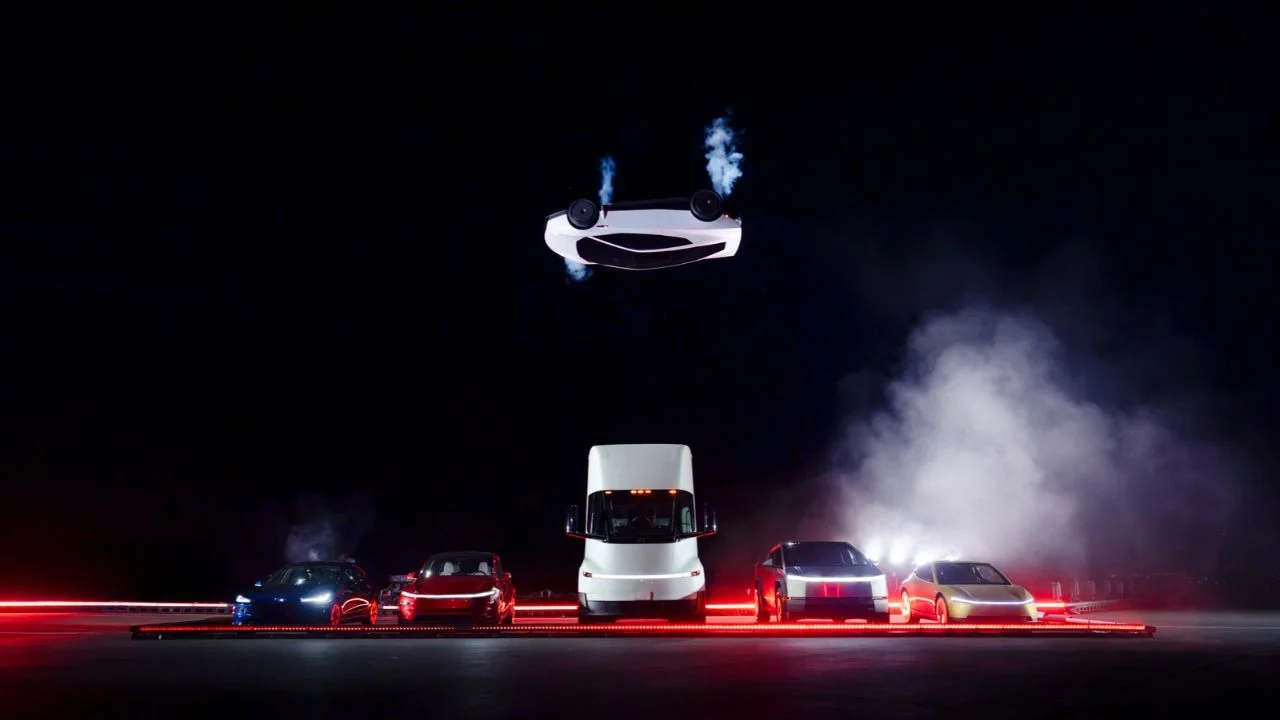
The boundary between terrestrial automotive engineering and aerospace propulsion blurred when Tesla unveiled a functional demonstration of its second-generation Roadster at a SpaceX testing complex in McGregor, Texas. The public demonstration revealed maneuvers previously unseen in consumer automotive design: ascending a curved vertical loop, remaining stationary while inverted, launching into free flight, completing an aerial roll, and executing a controlled, cushioned touchdown.
Rather than relying on aerodynamic wings or traditional internal combustion, the vehicle integrates cold-gas reaction thrusters derived from orbital spacecraft control mechanisms, coupled with underbody ground-effect suction fans. For competitive examination candidates following UPSC Current Affairs, this event serves as an instructive study in applied Newtonian mechanics, fluid dynamics, reaction control systems, and the emerging challenges of multi-regime transportation governance.
Technical Overview and Core Specifications
The demonstrated platform diverges from standard electric vehicles by converting its internal rear cabin space into a high-pressure pneumatic storage array designed to discharge propellant through supersonic nozzles. This architecture provides short, high-force reaction impulses capable of overcoming tire-friction limitations and supporting transient airborne levitation.
| Parameter / Engineering Metric | Stated Specification | Technical Operational Context |
|---|---|---|
| 0 to 97 km/h (0–60 mph) Acceleration | 0.81 seconds | Bypasses tire-road coefficient of friction limits through horizontal thrust assist. |
| Maximum Velocity | Exceeding 370 km/h (230 mph) | Aerodynamic stabilization provided by variable-pitch dynamic wings. |
| All-Electric Driving Range | 480 km (over 300 miles) | Powered by high-discharge 4680 structural lithium-ion cells. |
| Target Production Timeline | 2028 | Commercial production target communicated by the manufacturer. |
| Pneumatic Propellant Capacity | 250 kg air within 600-liter storage | Carbon-Fiber-Overwrapped Pressure Vessels (COPVs) pressurized to $\approx 5,500\,\text{psi}$. |
| Reaction Thruster Array | 10 Cold-Gas Nozzles | Electrically actuated high-speed valves enabling rapid pulse adjustments. |
| Artificial Downforce System | Internal Powered Suction Fans | Generates up to $2\,\text{g}$ ground adhesion independent of forward velocity. |
Key Facts and Exam-Relevant Data
Pneumatic Energy Storage: The vehicle replaces secondary passenger seating with dual carbon-fiber-overwrapped pressure vessels holding 250 kilograms of compressed atmospheric air at an internal operating pressure of approximately 379 bar ($5,500\,\text{psi}$).
Reaction Propulsion Core: High-speed electric actuators modulate 10 cold-gas thrusters located along the perimeter, firing directional air pulses within milliseconds to deliver rapid acceleration and attitude correction.
Active Ground Adhesion: High-capacity undercarriage suction fans exhaust air from beneath the sealed chassis, lowering pressure below the car to create a pressure differential that yields up to $2\,\text{g}$ of artificial downforce, allowing the car to adhere to inverted surfaces even at zero speed.
Ballistic Air Time vs. Aerodynamic Lift: The platform does not generate continuous aerodynamic flight; its lift relies entirely on pure vertical impulse, where a full tank provides a few seconds of airborne hover before requiring repressurization by onboard compressors.
Acceleration Dynamics: Accelerating from 0 to 97 km/h in 0.81 seconds requires an average acceleration exceeding $3.3\,\text{g}$, a threshold unattainable through rubber-tire traction alone, which typically peaks around $1.26\,\text{g}$ on standard asphalt.
Scientific Principles Deconstructed
The demonstration highlights five interconnected physical mechanisms spanning classical mechanics, thermodynamics, and aerospace attitude dynamics.
1. Cold-Gas Thruster Reaction Propulsion
Unlike chemical rocket propulsion systems that rely on exothermic combustion between liquid or solid propellants, cold-gas thrusters operate mechanically without flame or thermal reactions. Dry atmospheric air is compressed into carbon-fiber pressure vessels and released through converging-diverging de Laval nozzles.
As the gas transitions through the narrow nozzle throat, it reaches sonic velocity ($\text{Mach } 1$) and expands in the flared divergent section, accelerating to supersonic exhaust speeds while temperature and pressure drop. The momentum carried away by the exiting mass generates reaction thrust cleanly, eliminating combustion emissions while enabling precise pulsed operation.
2. Application of Newton's Third Law of Motion
The propulsion mechanism directly illustrates Newton’s Third Law of Motion, which dictates that every action produces an equal and opposite reaction. The governing thrust equation in an atmospheric environment is expressed mathematically as:
$$F = \dot{m} v_e + (p_e - p_a) A_e$$
Where $\dot{m}$ denotes the mass flow rate of the escaping air ($\text{kg/s}$), $v_e$ represents the effective exit velocity, $p_e$ is the nozzle exit pressure, $p_a$ is ambient atmospheric pressure, and $A_e$ represents the nozzle exit plane area. By exhausting high-mass air streams downward at high velocity, an opposing vertical thrust vector is imparted to the vehicle. When this reaction force exceeds the gravitational force acting on the total mass ($F > mg$), the vehicle lifts into the air without aerodynamic wings.
3. Underbody Suction and Inverted Ramp Adhesion
Passive automotive downforce relies on external wings, splitters, and diffusers, with generated downforce scaling quadratically with forward velocity according to dynamic pressure:
$$q = \frac{1}{2} \rho v^2$$
Consequently, passive aerodynamic grip approaches zero at low speeds.
To enable the vehicle to traverse and stop along an inverted vertical ramp, the engineering design incorporates active motorized suction fans. These fans rapidly draw air from beneath a skirted underbody, lowering the local fluid pressure beneath the floor relative to the surrounding atmosphere ($P_{\text{under}} < P_{\text{ambient}}$).
This creates a pronounced Bernoulli pressure differential across the chassis, holding the vehicle firmly against track surfaces regardless of speed.
4. Multiaxial Attitude Control Systems (ACS)
In spaceflight, satellites and spacecraft use Reaction Control Systems (RCS) to adjust orientation in a vacuum. The Roadster adapts this aerospace approach for low-altitude atmospheric maneuvers.
An array of peripheral cold-gas thrusters connects to a central inertial measurement unit (IMU) that continuously tracks the vehicle's angular position across the three fundamental spatial axes:
Pitch: Rotation about the transverse axis (tilting the nose upward or downward).
Roll: Rotation about the longitudinal axis (executing mid-air barrel rolls or stabilizing flips).
Yaw: Rotation about the vertical axis (adjusting directional heading in flight).
When the vehicle launches into the air, the flight computer fires opposing thruster nozzles in millisecond pulses. These targeted bursts produce corrective rotational moments, countering aerodynamic disturbances and orienting the chassis for a wheels-down, cushioned descent.
5. Impulse-Momentum Flight vs. Aerodynamic Lift
A critical physical distinction separates transient reaction impulse from continuous aerodynamic flight. Airplanes and electric Vertical Take-Off and Landing (eVTOL) systems generate sustained lift through fluid flow across airfoils, balancing gravity efficiently over long flights.
In contrast, the Roadster relies solely on impulse momentum ($\Delta p = \int F \, dt$). Because cold-gas systems offer a modest specific impulse ($I_{sp} \approx 60\text{ to }70\text{ seconds}$), hovering a $1,500\text{ kg}$ chassis consumes propellant at roughly $25\text{ kilograms per second}$.
The onboard 250-kilogram air reserve is exhausted in seconds during high-thrust maneuvers, confirming that the system provides brief ballistic jumps and obstacle clearance rather than sustained cross-country flight.
Comparative Technology Matrix
Aspirants must evaluate the differences between impulse-thruster hybrid vehicles, dedicated urban air mobility aircraft, and conventional high-performance electric vehicles.
| Dimension | Cold-Gas Hybrid Platform | Urban Air Mobility (eVTOL) | Conventional High-Performance EV |
|---|---|---|---|
| Primary Lift Mechanism | Pneumatic Reaction Thrust (Newton's 3rd Law) | Distributed Rotary Aerofoils / Fixed Wings | None; relies exclusively on road friction |
| Propulsive Efficiency ($I_{sp}$) | Low ($60\text{--}70\text{ s}$); high propellant mass penalty | High efficiency; continuous aerodynamic lift | Maximum rolling efficiency via wheel torque |
| Operating Envelope | Seconds (transient ballistic jumps) | $30\text{--}60\text{ minutes}$ continuous flight | Continuous terrestrial road operation |
| Regulatory Authority | Unclassified; dual-regime legal void | Civil Aviation Regulators (DGCA / FAA) | Surface Transport Ministries (MoRTH / DOT) |
| Acoustic & Urban Impact | Supersonic air blast, high noise, debris displacement | Low-noise electric rotors built for vertiports | Complies with urban vehicle noise limits |
Technical Bottlenecks, Safety Hazards, and Regulatory Hurdles
Integrating rocket propulsion into passenger cars introduces significant engineering, public safety, and regulatory challenges.
From a thermodynamic perspective, cold gas provides lower specific energy than chemical reactions, requiring large pressure vessels that take up interior space and add deadweight once emptied. While onboard compressors can recharge the tanks during standard driving, pressurizing air to $5,500\,\text{psi}$ requires significant electrical energy from the battery pack and careful thermal management to shed heat generated during rapid compression.
Public safety poses an equally complex problem. Discharging high-pressure air near ground level creates supersonic surface blasts that can throw loose gravel, asphalt debris, and roadway particles, posing risks to pedestrians, nearby motorists, and roadside infrastructure.
Furthermore, existing legal frameworks maintain a strict division between ground vehicles and aircraft. In India, road vehicles are governed by the Ministry of Road Transport and Highways (MoRTH) under the Motor Vehicles Act, 1988, while aircraft fall under the Directorate General of Civil Aviation (DGCA) and the Aircraft Act.
Because dual-use thruster vehicles lack formal safety classifications or crash-test certifications, transport authorities have withheld road approval for full-flight trim packages, limiting them to private tracks and controlled demonstrations.
Cross-Disciplinary Synergies with Defense and Space Systems
The pneumatic and attitude systems shown in this automotive test reflect principles used across aerospace and military defense architectures:
Satellite Station-Keeping and RCS: Reaction control systems that rely on pulsed nozzles mirror the cold-gas thruster systems used in small satellites and upper-stage rocket guidance. Aspirants should review related analyses, including the IAF Air Combat Shield with GSAT-7C Satellite and naval inductions like INS Mangrol Warship Integration.
Autonomous Actuator Systems: Deploying high-speed electronic valves alongside vehicle computers introduces complex cybersecurity and firmware considerations. Candidates can examine related military electronics concepts in our review of the Indian Army AASHVAST Military Drone Security Labs.
Core Physics and Foundation Modules: Candidates building their basic science foundations can consult topic-wise guides in the Atharva Examwise Study Material Repository.
For deeper technical study on nozzle physics and reaction dynamics, candidates can consult research from the NASA Glenn Research Center and track domestic aviation policy updates via the Directorate General of Civil Aviation (DGCA).
Why this matters for your exam preparation
For candidates preparing for the civil services and state competitive examinations, technological developments of this scale must be evaluated beyond product marketing. They provide clear, concrete examples for both preliminary and main examination questions across multiple disciplines.
1. Direct Syllabus Alignment
UPSC General Studies Paper 3 (Science & Technology): Covers developments and applications in everyday life, indigenization of aerospace technologies, alternative clean propulsion, thermodynamics, and energy storage tradeoffs.
UPSC General Studies Paper 3 (Infrastructure & Urban Mobility): Informs questions on future transport paradigms, Advanced Air Mobility (AAM), electric Vertical Take-Off and Landing (eVTOL) integration, traffic congestion mitigation, and electric vehicle battery life cycles.
UPSC General Studies Paper 2 (Governance & Public Policy): Highlights regulatory hurdles in governing multi-regime transportation systems, legislative coordination gaps between civil aviation regulators (DGCA) and surface transport authorities (MoRTH), and setting safety standards for emerging consumer technologies.
General Studies Prelims (General Science): Tests core principles of classical mechanics (Newton's laws of motion, conservation of linear and angular momentum), fluid mechanics (Bernoulli’s principle, pressure differentials, supersonic nozzle dynamics), and the differences between chemical combustion and pneumatic expansion.
2. High-Yield Prelims Exam Pointers
Cold-Gas Thruster Mechanisms: Operates without chemical combustion or hot exhaust, relying strictly on the mechanical expansion of compressed gas through a converging-diverging nozzle to generate reaction thrust.
Dynamic vs. Static Downforce: Conventional wings require forward speed to generate downforce ($q = \frac{1}{2}\rho v^2$), whereas active fan-driven suction systems create artificial downforce at zero speed via pressure differentials.
Specific Impulse Tradeoffs: Cold gas provides a low specific impulse ($I_{sp} \approx 60\text{--}70\text{ s}$), making it effective for short, high-force reaction bursts, but inefficient for sustained hover compared to winged aerodynamic flight.
3. Model Practice Question for UPSC Aspirants
UPSC Mains GS Paper 3 Practice Question
"The convergence of aerospace reaction propulsion with consumer automotive engineering highlights both technological innovation and regulatory gaps. Examine the physical principles underlying hybrid reaction-propulsion ground vehicles and discuss the policy challenges India's transport authorities would face in regulating multi-regime mobility platforms." (250 Words, 15 Marks)
Model Answer Structuring Framework
Introduction: Define the convergence of rocketry-derived reaction thrusters (such as cold-gas systems) and active suction technologies with electric vehicles.
Body Paragraph 1 (Scientific Mechanics): Detail the operation of Newton's Third Law of Motion, de Laval nozzle gas expansion, and active fan-assisted Bernoulli downforce. Contrast short-duration impulse maneuvers with continuous aerodynamic lift.
Body Paragraph 2 (Regulatory & Infrastructure Challenges in India): Highlight the institutional division between MoRTH (Motor Vehicles Act) and DGCA (Aircraft Act). Address urban safety risks, including supersonic debris dispersion, noise thresholds, vehicle airworthiness certification, and urban traffic coordination.
Conclusion & Way Forward: Emphasize the need for unified regulatory frameworks covering Advanced Air Mobility (AAM), proactive standards formulation by bodies like the Automotive Research Association of India (ARAI) and DGCA, and prioritizing energy-efficient public transit over individual high-risk mobility concepts.