
UPSC Current Affairs 13 October 2026: Robert Hall and Michael Woodford Win Nobel Economics Prize | Atharva Examwise Current News & Daily GK Update
Overview of the 2026 Nobel Prize in Economic Sciences
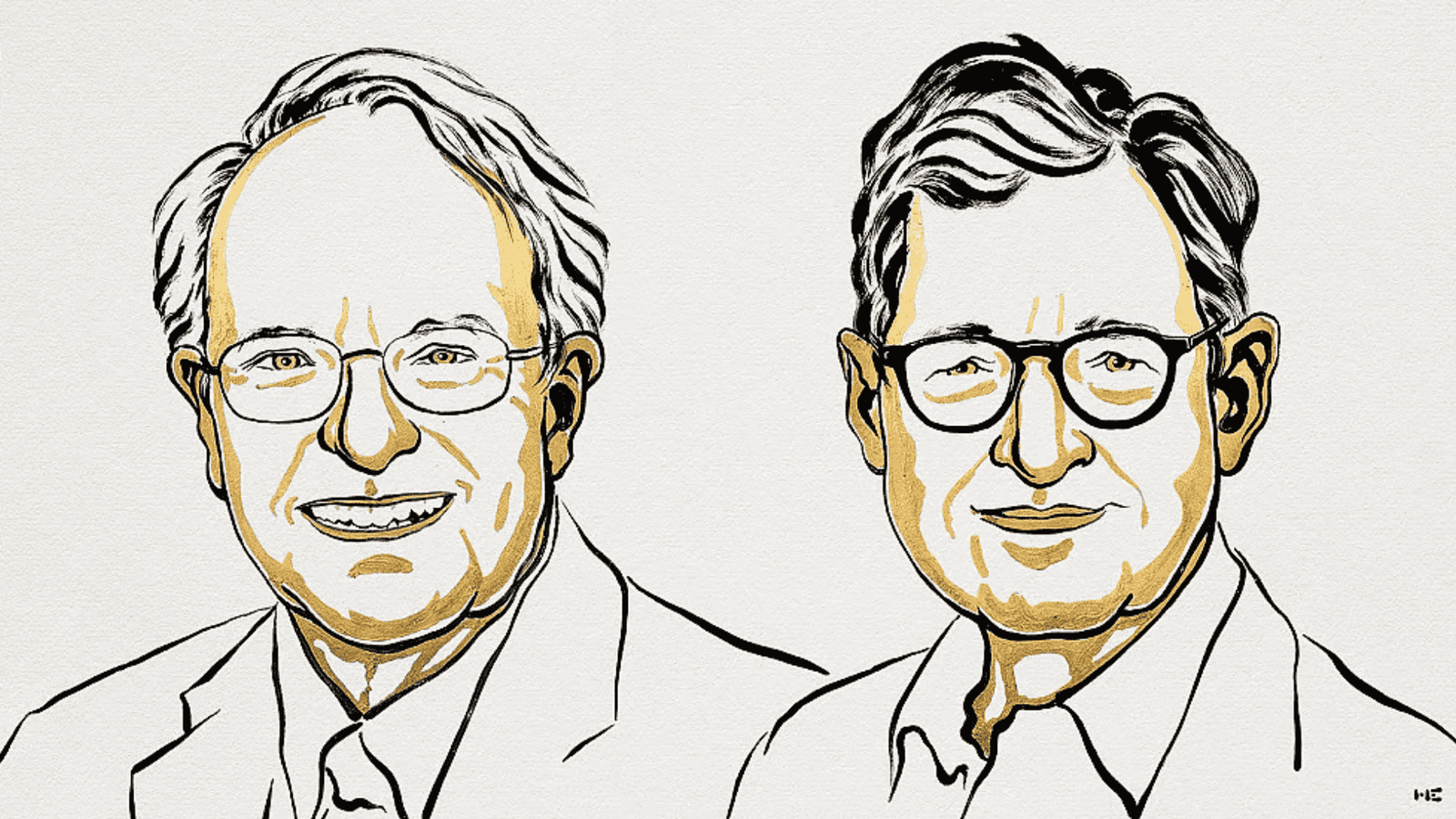
The Royal Swedish Academy of Sciences awarded the 2026 Sveriges Riksbank Prize in Economic Sciences in Memory of Alfred Nobel to American economists Robert E. Hall and Michael Woodford. The official citation recognizes the laureates "for microeconomic foundations of macroeconomic stabilisation". Their theoretical breakthroughs resolved long-standing weaknesses in post-war macroeconomic management by demonstrating how the microeconomic optimization decisions of individual households and commercial firms dictate economy-wide fluctuations.
The prize carries a cash award of 12 million Swedish kronor (SEK), shared equally between the two laureates. The dynamic frameworks developed by Hall and Woodford now provide the primary operational architecture used by central banks and finance ministries worldwide to determine when to stimulate aggregate demand during economic contractions and when to tighten policy to rein in inflationary spirals.
| Parameter | Key Detail |
|---|---|
| Official Prize Name | Sveriges Riksbank Prize in Economic Sciences in Memory of Alfred Nobel 2026 |
| Awarding Body | Royal Swedish Academy of Sciences, Stockholm |
| Official Citation | "For microeconomic foundations of macroeconomic stabilisation" |
| Laureates | Robert E. Hall (Stanford University) & Michael Woodford (Columbia University) |
| Prize Amount | 12 million Swedish kronor (SEK), shared equally |
| Primary Contribution | Grounding aggregate demand management and monetary policy in microeconomic foundations |
| Contemporary Impact | Foundation for New Keynesian Dynamic Stochastic General Equilibrium (DSGE) models and forward guidance |
Historically, the economics award was not among the original five prizes instituted in Alfred Nobel’s 1895 will. It was established by Sveriges Riksbank in 1968 to commemorate its tercentenary and was first conferred in 1969. The 2026 award follows the 2025 prize awarded to Joel Mokyr, Philippe Aghion, and Peter Howitt for their research on innovation-driven growth and creative destruction, and the 2024 prize conferred on Daron Acemoglu, Simon Johnson, and James A. Robinson for their institutional analyses of global prosperity.
Aspirants tracking macroeconomics for competitive exam news today can access comprehensive daily analyses through the Atharva Examwise Current Affairs Repository. Technical background documentation is maintained directly by the Nobel Prize Outreach Portal.
The Historical Breakdown of Traditional Keynesian Macroeconomics
Macroeconomic stabilization policy in the decades following John Maynard Keynes’s foundational work operated under the assumption that aggregate economic variables shared stable, mechanical relationships. Conventional stabilization tools, such as the IS-LM framework and the classical Phillips Curve, treated aggregate consumption, output, and inflation as empirical correlations observed in historical time-series data.
When aggregate demand collapsed during cyclical downturns, traditional policy dictated that central banks cut interest rates and governments expand budget deficits to close the demand deficit. Conversely, during periods of economic overheating, authorities were advised to restrict credit and curtail public spending.
This paradigm collapsed during the global supply-side oil disruptions of the 1970s. Advanced economies experienced simultaneous high inflation, elevated unemployment, and stagnating output—a phenomenon known as stagflation. Attempting to counter surging unemployment through conventional demand-side stimulus did not restore real production; instead, it entrenched double-digit inflation.
The crisis highlighted two structural weaknesses in post-war macroeconomic theory:
The Lucas Critique: Advanced by Robert E. Lucas Jr., this critique demonstrated that statistical correlations among aggregate macroeconomic variables shift whenever policy changes. Because rational economic agents alter their behavior in response to changes in policy rules, historical aggregate correlations cannot predict the real-world effects of new economic measures.
Absence of Microeconomic Foundations: Traditional models failed to explain how individual optimizing economic agents—households seeking to maximize lifetime utility and firms seeking to maximize profits under market constraints—respond to economic policy shifts.
Rehabilitating macroeconomic stabilization required models built from the ground up on microeconomic foundations, a transformation achieved through the combined insights of Robert E. Hall and Michael Woodford.
Robert E. Hall: Rational Expectations and Household Consumption Dynamics
Private consumption represents the largest single component of aggregate demand across both advanced and developing economies. Early Keynesian models assumed that current household expenditure was determined almost entirely by current disposable income. Robert E. Hall altered this paradigm by evaluating household consumption through the lens of rational expectations and dynamic optimization.
The Random Walk Hypothesis of Consumption (1978)
In a 1978 paper, Hall synthesized Milton Friedman’s Permanent Income Hypothesis with the rational expectations framework. Hall demonstrated that forward-looking households do not decide how much to consume based solely on current earnings. Instead, they smooth their consumption across their lifetimes based on their expectations of future income, asset wealth, and long-term economic security.
A representative household optimizes its intertemporal expected utility subject to lifetime budget constraints:
$$\max_{\{c_{t+\tau}, a_{t+\tau+1}\}_{\tau=0}^T} \mathbb{E}_t \left[ \sum_{\tau=0}^T \beta^\tau u(c_{t+\tau}) \right]$$
Subject to the intertemporal budget constraint:
$$a_{t+\tau+1} = (1 + r)(a_{t+\tau} - c_{t+\tau} + w_{t+\tau})$$
Where $\beta \in (0, 1)$ represents the subjective discount factor, $r$ is the real interest rate, $u(\cdot)$ is a strictly concave period utility function, $w_{t+\tau}$ is stochastic labor earnings, and $a_t$ denotes accumulated financial assets. Under rational expectations, the household's first-order Euler condition requires that the expected marginal utility of consumption remains equal across consecutive periods:
$$\mathbb{E}_t [u'(c_{t+1})] = \frac{1}{\beta(1 + r)} u'(c_t)$$
From this formulation, Hall derived the Random Walk Hypothesis of consumption. Because current consumption already incorporates all available information regarding past, present, and anticipated future earnings, changes in consumption ($\Delta c_{t+1}$) cannot be predicted using past macroeconomic trends or expected policy changes. Household consumption shifts only in response to unpredictable, unexpected economic news.
For example, if a family anticipates an economic slowdown or job insecurity, it will curtail major discretionary spending immediately, even if current household income remains intact. Consequently, simply increasing household disposable income through broad-based fiscal measures will not stimulate demand unless policymakers also address underlying expectations regarding future economic stability.
Empirical Household Microdata and Hand-to-Mouth Consumers
Recognizing that real-world financial market imperfections restrict access to credit, Robert Hall and Frederic Mishkin (1982) examined microeconomic household survey data to measure how closely actual behavior aligned with the theoretical model. Their empirical work revealed an important structural split in household consumption:
Forward-Looking Optimizers (~80%): Approximately four-fifths of households make consumption decisions aligned with the permanent-income framework, smoothing spending over business cycles in response to unexpected lifetime wealth shocks.
Liquidity-Constrained or "Hand-to-Mouth" Consumers (~20%): A significant minority faces binding credit constraints, lacks collateral, or possesses minimal financial savings. These households consume virtually all disposable income as it is received.
This empirical split provided policymakers with a framework for designing targeted fiscal transfers, proving that stimulus checks or social safety nets produce their largest multipliers when directed specifically toward liquidity-constrained groups.
Michael Woodford: The New Keynesian Synthesis and Price Stickiness
While Robert Hall illuminated forward-looking household demand, Michael Woodford integrated dynamic consumer choices with the pricing behavior of firms operating under imperfect competition. Woodford synthesized these microfoundations in his 2003 treatise, Interest and Prices: Foundations of a Theory of Monetary Policy, establishing the theoretical architecture of the modern New Keynesian framework.
Microfoundations of Price Frictions
In frictionless classical models with perfect competition and flexible pricing, changes in nominal monetary variables cannot influence real economic activity. Woodford demonstrated that in real-world economies, markets are characterized by monopolistic competition and nominal rigidities, known as price stickiness.
Firms face administrative expenses, menu costs, and strategic concerns about competitor responses, preventing them from adjusting output prices continuously. When firms do adjust prices, they look forward to anticipated future operating costs, nominal wage pressures, and aggregate market demand. Because prices adjust with a lag, monetary policy interventions generate substantial real effects on output, capacity utilization, and employment in the short-to-medium term.
The Canonical 3-Equation New Keynesian Framework
Woodford formalized these interactions into a three-equation structural model that now serves as the standard analytical tool for central bank policymaking:
The Forward-Looking Dynamic IS Curve: Derived from the intertemporal Euler equation governing household consumption:
$$\tilde{y}_t = \mathbb{E}_t [\tilde{y}_{t+1}] - \frac{1}{\sigma} (i_t - \mathbb{E}_t [\pi_{t+1}] - r_t^n)$$
Where $\tilde{y}_t$ is the output gap (actual output minus natural output), $i_t$ is the nominal policy interest rate, $\mathbb{E}_t [\pi_{t+1}]$ is expected future inflation, and $r_t^n$ is the natural or neutral rate of interest. Aggregate demand is driven not merely by current interest rates, but by expected future output and real borrowing costs relative to the natural rate.
The New Keynesian Phillips Curve: Derived from dynamic price-setting under nominal frictions:
$$\pi_t = \beta \mathbb{E}_t [\pi_{t+1}] + \kappa \tilde{y}_t$$
Where $\pi_t$ represents current inflation, $\beta$ is the discount factor, and $\kappa$ measures the sensitivity of inflation to output gap movements. This relationship establishes that current inflation depends primarily on expectations of future inflation rather than backward-looking historical inflation trends.
The Systematic Monetary Policy Rule: Specifies how the central bank adjusts policy rates in response to inflation and output gaps:
$$i_t = r_t^n + \phi_\pi \pi_t + \phi_y \tilde{y}_t$$
Where coefficients $\phi_\pi > 1$ (the Taylor Principle) and $\phi_y > 0$ dictate systematic adjustments. Woodford established that modern central banks manage economies by steering interest rates and shaping public expectations, rather than by targeting quantitative money supply aggregates.
Forward Guidance and Central Bank Communication
A core policy takeaway from Woodford’s research is that central bank communication is an active policy instrument. Because households and businesses make investments based on expectations of future interest rates, a credible public commitment regarding the future path of monetary policy—known as forward guidance—can lower long-term yields and stimulate spending without requiring immediate adjustments to current policy rates.
Comparative Analysis of Macroeconomic Paradigms
The shift from post-war macroeconomics to the Hall-Woodford New Keynesian paradigm represents an evolution in macroeconomic stabilization theory.
| Dimension | Traditional Keynesian Model (Pre-1970s) | Hall-Woodford New Keynesian Paradigm (2026 Nobel Focus) |
|---|---|---|
| Microeconomic Foundation | Absent; based on aggregate empirical correlations | Explicit; grounded in dynamic optimization by households and firms |
| Expectation Formation | Static or backward-looking (adaptive expectations) | Dynamic, forward-looking rational expectations |
| Consumption Function | Deterministic function of current income ($C = c_0 + c_1 Y_d$) | Intertemporal optimization; consumption follows a random walk |
| Price Adjustment | Ad hoc assumptions of nominal rigidity | Micro-founded nominal stickiness driven by menu costs and market frictions |
| Inflation Mechanism | Static trade-off via historical Phillips Curve | Forward-looking New Keynesian Phillips Curve driven by expectations |
| Primary Policy Instrument | Discretionary fiscal deficits and quantitative credit controls | Systematic policy interest rates and forward guidance |
| Response to Supply Shocks | Vulnerable to stagflation due to indiscriminate demand stimulus | Counter-cyclical policy calibrated against shifts in natural output |
Policy Application: Addressing Inflation, Supply Shocks, and Energy Crises
The Hall-Woodford framework explains why conventional policies failed during historical energy crises and provides guidance for responding to modern supply disruptions.
The Output Gap and Natural Output Dynamics
In Woodford's framework, stabilization policy does not aim to expand output indefinitely. Instead, it seeks to minimize the output gap ($\tilde{y}_t = y_t - y_t^n$), which measures the difference between actual output ($y_t$) and "natural output" ($y_t^n$)—the production level achieved if all nominal prices were flexible.
When an external supply shock occurs, such as a sharp spike in crude oil prices or geopolitical trade disruptions, an economy's productive capacity contracts, causing natural output ($y_t^n$) to fall. If policymakers misinterpret the slowdown in output as a shortfall in demand and deploy fiscal or monetary stimulus, they widen the positive output gap, fueling cost-push inflation and entrenched stagflation.
Under the Hall-Woodford approach, central banks recognize that natural output has fallen. Monetary policy must tighten or maintain a restrictive stance to anchor inflation expectations, preventing temporary energy or commodity price spikes from turning into generalized second-round wage-price spirals.
According to John Hassler, Chair of the Committee for the Prize in Economic Sciences, these micro-founded models explain why recent global shocks—including the COVID-19 pandemic and the 2022 international energy crises—did not result in the prolonged stagflation seen in the 1970s.
Implications for Central Banking and the Reserve Bank of India
For emerging economies like India, the theoretical contributions of Hall and Woodford have direct applications to domestic monetary and fiscal management.
1. Flexible Inflation Targeting (FIT) Architecture
India formalized Flexible Inflation Targeting through the 2016 amendments to the Reserve Bank of India (RBI) Act, 1934, establishing the statutory Monetary Policy Committee (MPC). The mandate to target Consumer Price Index (CPI) inflation at 4% with a tolerance band of $\pm 2\%$ is rooted in Woodford’s principle that nominal price stability is a prerequisite for sustained economic growth.
2. Central Bank Credibility During Food and Fuel Shocks
The Reserve Bank of India routinely encounters supply-side shocks driven by monsoon volatility and imported energy costs. If household and business inflation expectations become unanchored during these shocks, transient spikes in food and fuel can bleed into headline and core inflation.
Woodford’s New Keynesian Phillips Curve demonstrates that when a central bank maintains credibility, forward-looking price-setters do not raise core prices during temporary supply shocks, enabling the economy to absorb disruptions without prolonged stagflation.
3. Calibrating Fiscal Transfers to Hand-to-Mouth Households
Robert Hall’s findings on liquidity-constrained consumers are particularly relevant for India, where a larger share of the population operates without substantial savings buffers or formal credit access compared to advanced economies.
Because these households have a marginal propensity to consume (MPC) near unity, targeted fiscal measures—such as Direct Benefit Transfers (DBT), PM-KISAN, and MGNREGA allocations—deliver rapid, high-multiplier support during downturns, directly sustaining basic consumption without leaking into precautionary savings.
Aspirants studying Indian economic policies can access structured notes through the Atharva Examwise Study Material Portal and review foundational economic concepts via the Atharva Examwise NCERT Foundation Course.
Key Facts and Exam-Relevant Data
2026 Laureates: Robert E. Hall (Stanford University) and Michael Woodford (Columbia University).
Prize Citation: "For microeconomic foundations of macroeconomic stabilisation".
Administering Institution: Royal Swedish Academy of Sciences, Stockholm.
Prize Value: 12 million Swedish kronor, shared equally.
Historical Origin: Established in 1968 by Sveriges Riksbank; first awarded in 1969.
Robert Hall’s 1978 Contribution: Random Walk Hypothesis of Consumption, demonstrating that forward-looking consumers smooth spending over time and adjust consumption only in response to unpredictable news.
Hall & Mishkin’s 1982 Findings: Microdata revealed that ~80% of households behave as forward-looking optimizers, while ~20% operate as liquidity-constrained, hand-to-mouth consumers.
Michael Woodford’s 2003 Contribution: Interest and Prices, synthesizing sticky prices, dynamic IS curves, and policy interest rate rules into the modern New Keynesian model.
Policy Influence: Underpins inflation-targeting regimes, forward guidance, and Dynamic Stochastic General Equilibrium (DSGE) models used by central banks worldwide.
Why this matters for your exam preparation
For candidates preparing for the UPSC Civil Services Examination (CSE) and State PCS exams, the 2026 Nobel Prize in Economics connects foundational macroeconomic theory with ongoing policy debates.
UPSC Preliminary Examination (General Studies Paper I):
Direct questions on current events of international importance, including the 2026 Nobel laureates, the awarding institution, prize history, and citations.
Conceptual questions on macroeconomic terms: the Phillips Curve, supply-side shocks, the natural rate of interest, inflation targeting, and monetary policy transmission channels.
UPSC Mains Examination (General Studies Paper III - Indian Economy):
Monetary Policy and Inflation: Woodford's New Keynesian framework provides an analytical model for answers evaluating the Reserve Bank of India’s Monetary Policy Committee, Flexible Inflation Targeting (4% $\pm$ 2%), and the balance between controlling inflation and supporting growth.
Supply-Side Disruptions: Candidates can use the distinction between actual output and natural output to analyze policy responses to global crude oil shocks, food price volatility, and geopolitical supply chain bottlenecks.
Fiscal Policy and Welfare Interventions: Hall's findings on hand-to-mouth households offer an empirical justification for targeted social programs (such as DBT and rural employment guarantees) over broad-based corporate concessions during economic downturns.
State PCS Examinations (MPPSC, UPPSC, BPSC, RAS):
Direct questions regarding the 2026 Nobel Prize winners, their institutional affiliations, and the primary economic theories behind the award.
Essay and analytical questions on inflation management, central bank credibility, and stabilization policies in developing economies.
Practice Questions for Aspirants
Prelims Practice Question (MCQ)
Q. Consider the following statements regarding the New Keynesian macroeconomic framework developed by recent Nobel laureates:
New Keynesian models incorporate microeconomic foundations based on the optimizing behavior of households and firms.
According to Robert Hall’s consumption hypothesis, predictable future changes in income cause large, immediate fluctuations in consumer spending.
The framework demonstrates that central banks influence economic activity primarily by managing policy interest rate paths and public expectations rather than targeting monetary aggregate volumes.
Which of the statements given above are correct?
(a) 1 and 2 only
(b) 2 and 3 only
(c) 1 and 3 only
(d) 1, 2, and 3
Answer: (c) 1 and 3 only.
Explanation: Statement 1 is correct; the 2026 Nobel Prize honors the integration of microeconomic foundations into macroeconomic stabilization. Statement 2 is incorrect; Hall’s Random Walk Hypothesis shows that forward-looking consumers factor known future income changes into current plans, meaning consumption shifts only in response to unpredictable new information. Statement 3 is correct; Michael Woodford proved that modern monetary policy stabilizes economies through policy interest rates, forward guidance, and credibility management rather than money supply targeting.
Mains Practice Question
Q. "Effective monetary policy is rooted as much in managing forward-looking market expectations as it is in altering current policy interest rates." In light of the contributions of the 2026 Nobel laureates in Economic Sciences, evaluate how this paradigm informs the Reserve Bank of India’s inflation-targeting framework during global supply-side shocks. (250 words / 15 Marks)
Key Evaluation Pointers for Structuring the Answer:
Introduction: Highlight the 2026 Nobel Prize in Economic Sciences awarded to Robert E. Hall and Michael Woodford for microeconomic foundations of macroeconomic stabilization.
Theoretical Context: Explain Woodford’s New Keynesian Phillips Curve ($\pi_t = \beta \mathbb{E}_t[\pi_{t+1}] + \kappa \tilde{y}_t$), highlighting how expected future inflation drives current pricing decisions under nominal rigidities. Connect Hall's permanent income insights to household expectations.
Application to the RBI: Analyze how the RBI's Monetary Policy Committee utilizes forward guidance, repo rate adjustments, and transparent communication to anchor medium-term inflation expectations near 4%.
Navigating Supply Shocks: Contrast traditional demand stimulus with Woodford's framework during supply disruptions (e.g., imported crude oil or food spikes), showing how central bank credibility prevents temporary price increases from turning into persistent second-round inflation.
Conclusion: Emphasize that institutional transparency and policy credibility serve as primary stabilizers for emerging market economies like India.