
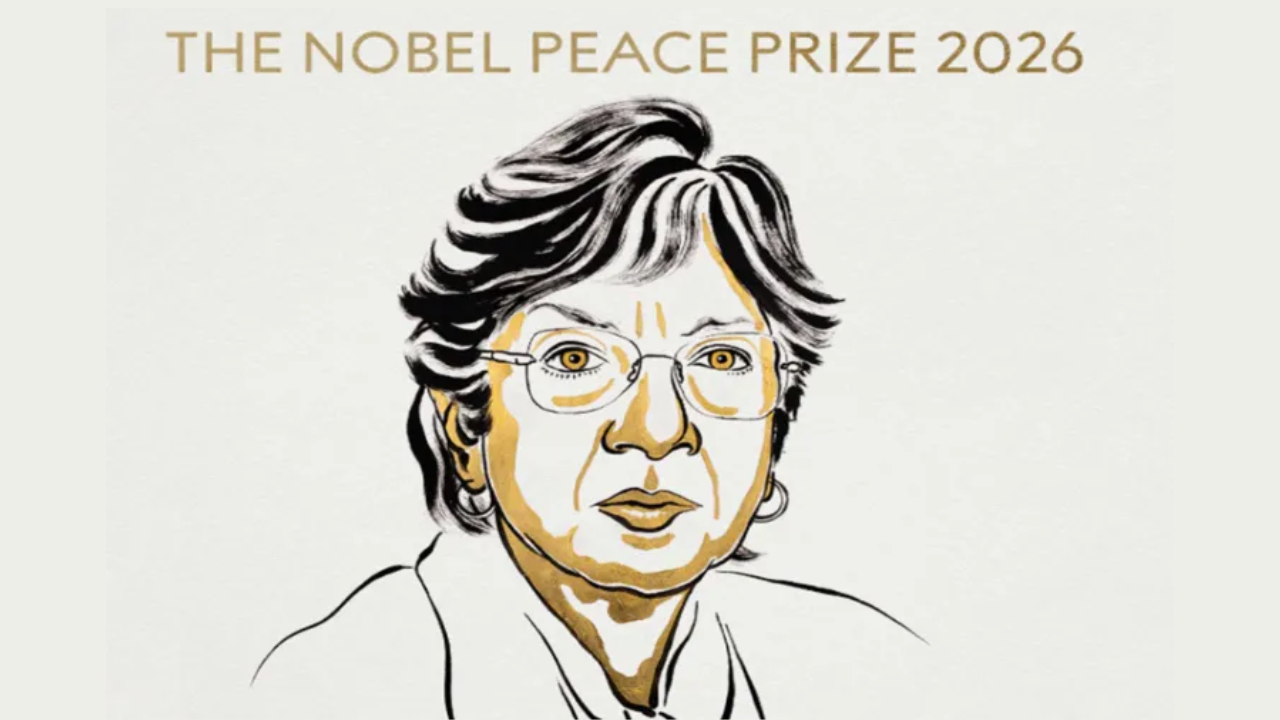
UPSC Current Affairs October 10, 2026: Navi Pillay Wins Nobel Peace Prize | Atharva Examwise Current News, Daily GK Update, and Competitive Exam News Today
The Norwegian Nobel Committee announced the conferral of the 2026 Nobel Peace Prize upon Navanethem "Navi" Pillay, a South African jurist of Indian Tamil descent. Awarded "for her efforts to promote peace and international law," the honor coincides with the 125th anniversary of the Nobel Prize's inception. Announced by Norwegian Nobel Committee Chairman Jørgen Watne Frydnes, the citation emphasizes that the rule of law—both domestic and international—underpins the global system designed to ensure peace and resolve disputes nonviolently, affirming that lasting peace fundamentally requires justice.
The decision arrives amidst heightened geopolitical friction, marked by growing challenges to multilateral oversight, unilateral state conduct, and diplomatic debates over international legal institutions. Pillay received the news while attending a legal symposium in Nuremberg, Germany—the historic seat of the post-World War II trials that established modern international criminal law. There, she cautioned that political attempts to weaken international accountability threaten to dismantle decades of legal progress, returning global affairs to an environment where power rather than law determines human rights protections.
Key facts for competitive exams
Laureate Profile: Navanethem "Navi" Pillay, born September 23, 1941, in Durban, South Africa, to Indian Tamil parents.
Prize Mandate: Awarded "for her efforts to promote peace and international law" at a historical juncture when international legal bodies face acute political and operational strain.
Anniversary Context: Conferred on the 125th anniversary of the Nobel Peace Prize, directly aligning with Alfred Nobel's vision of fostering fraternity between nations and advancing international legal tribunals.
Apartheid-Era Human Rights Defense: Began legal practice in 1967 as the first woman to open an attorney's office in South Africa's Natal province, providing defense counsel for political detainees and securing access to legal representation for prisoners on Robben Island in 1973.
Domestic Judicial Milestone: Elevated to the bench in 1995 as the first non-white woman judge on South Africa's High Court following the end of apartheid.
Landmark Jurisprudence at the ICTR: Served as judge (1995–2003) and President (1999–2003) of the International Criminal Tribunal for Rwanda, co-authoring the Jean-Paul Akayesu ruling (1998) that codified sexual violence and rape as acts of genocide, alongside precedents penalizing media hate propaganda as incitement to genocide.
Supranational Leadership: Appointed judge of the International Criminal Court (ICC, 2003–2008) and United Nations High Commissioner for Human Rights (OHCHR, 2008–2014).
Contemporary Mandates: Chaired the UN Independent International Commission of Inquiry on the Occupied Palestinian Territory and Israel (2021–2025) and currently serves as an ad hoc judge at the International Court of Justice (ICJ) in the genocide proceedings concerning Myanmar.
Exam-relevant data on international courts and commissions
Aspirants must distinguish the jurisdictions, foundational charters, and enforcement mechanisms of the primary bodies of international dispute resolution.
| Institution / Instrument | Legal Basis & Establishment | Primary Jurisdiction | Key Structural Characteristics |
|---|---|---|---|
| International Court of Justice (ICJ) | Chapter XIV of UN Charter (1945); Statute of the ICJ | Contentious disputes between sovereign States; advisory opinions | Principal judicial organ of the UN; judgments are binding, enforced via the UN Security Council. |
| International Criminal Court (ICC) | Rome Statute (adopted 1998, entry into force 2002) | Individual criminal liability for genocide, crimes against humanity, war crimes, and aggression | Independent treaty body; complementary to national courts; lacks independent enforcement constabulary. |
| International Criminal Tribunal for Rwanda (ICTR) | UN Security Council Resolution 955 (1994, Chapter VII) | Individual prosecution for serious violations of international humanitarian law in Rwanda | Ad hoc ad-judication; established key international jurisprudence defining systemic rape as genocide. |
| UN Commissions of Inquiry (COI) | UN Human Rights Council (UNHRC) Resolutions | Fact-finding, monitoring, and documenting international law violations | Quasi-judicial investigative mechanisms; submit findings to the UN General Assembly and international tribunals. |
Further analytical breakdowns of international treaties and United Nations organs can be reviewed on the Atharva Examwise Foundation Portal and tracked through Atharva Examwise Current Affairs.
Biographical evolution and legal milestones
Growing up in Durban under systemic apartheid, Pillay navigated institutional exclusion before earning law degrees from the University of Natal, followed by a Master of Laws (LLM) in 1982 and a Doctor of Juridical Science (SJD) in 1988 from Harvard Law School. Her domestic practice focused on defending anti-apartheid leaders, trade unionists, and political detainees. In 1992, she co-founded Equality Now, an international organization dedicated to protecting the legal rights of women and girls globally. Following South Africa's democratic transition, she contributed to the Women's National Coalition, advocating for the inclusion of equality guarantees covering race, gender, religion, and sexual orientation in the post-apartheid constitution.
| Chronology | Office / Forum | Historic Contribution & Precedent |
|---|---|---|
| 1967–1995 | Advocate, Supreme Court of South Africa | Defended anti-apartheid activists; secured Robben Island detainee access to lawyers and basic rights (1973). |
| 1992 | Co-Founder, Equality Now | Created an international institutional platform to litigate and reform gender-discriminatory statutes. |
| 1995–2003 | Judge & President, ICTR | Co-formulated rulings in Akayesu (rape as genocide) and Nahimana (media propaganda as genocidal incitement). |
| 2003–2008 | Judge, International Criminal Court | Established early procedural and appellate jurisprudence for the newly operational Rome Statute. |
| 2008–2014 | UN High Commissioner for Human Rights | Expanded field presences, prioritized whistleblower protections, and integrated gender identity protections. |
| 2021–2025 | Chair, UN Commission of Inquiry on OPT & Israel | Investigated armed hostilities, finding evidence of genocidal acts in Gaza and war crimes committed on October 7, 2023. |
| Ongoing | Ad Hoc Judge, International Court of Justice | Adjudicates state liability under the 1948 Genocide Convention in The Gambia v. Myanmar. |
Judicial jurisprudence and international criminal law
Pillay's judicial career has produced landmark precedents within international humanitarian law, particularly in expanding legal protections for vulnerable populations and standardizing accountability for mass atrocities.
The ICTR and the codification of gender-based genocide
Prior to the ICTR’s 1998 Jean-Paul Akayesu judgment, wartime sexual assault was frequently treated as an incidental consequence of armed conflict rather than a prosecutable atrocity under international criminal statutes. Pillay and her fellow judges ruled that sexual violence constitutes genocide under Article II of the 1948 Genocide Convention when committed with the intent to destroy, in whole or in part, a protected national, ethnic, racial, or religious group.
The tribunal also adjudicated the role of mass communication in atrocity crimes in the 2003 Media Case (Nahimana et al.). The bench affirmed that civilian broadcast executives and journalists who disseminated hate speech directing the extermination of the Tutsi population incurred individual criminal responsibility for direct and public incitement to commit genocide, creating a core precedent for evaluating modern propaganda and digital hate speech under international law.
Fact-finding in the Middle East and diplomatic friction
In 2021, the UN Human Rights Council mandated Pillay to chair the Independent International Commission of Inquiry on the Occupied Palestinian Territory, including East Jerusalem, and Israel. In late 2025, the Commission released a formal report concluding that Israeli military actions in Gaza constituted genocide, citing systematic destruction of civic and medical infrastructure, siege conditions resulting in mass starvation, and statements of intent made by high-ranking political and military figures.
The Commission's mandate also examined the October 7, 2023 attacks by Hamas, concluding that the killing and abduction of civilians constituted war crimes and grave violations of international humanitarian law. The panel's findings faced sharp diplomatic opposition, with United States and Israeli political leadership denouncing the commission's conclusions and the United States subsequently implementing sanctions against personnel affiliated with international tribunals.
Detailed summaries of international institutional inquiries are regularly archived on Atharva Examwise Study Material. Official source texts and announcements can be examined via the Official Nobel Prize Press Release and the United Nations News.
Geopolitical implications and structural challenges to multilateralism
The award highlights structural tensions between national sovereignty and the enforcement of international legal norms. The post-World War II international architecture was established on the principle that state behavior must remain bounded by supranational legal thresholds. However, contemporary geopolitical dynamics illustrate the operational vulnerabilities of this framework:
Enforcement Deficits and Sovereign Non-Compliance: While bodies like the ICJ issue binding rulings, they rely on voluntary state compliance or enforcement via the UN Security Council, where the veto power of permanent members (P5) can insulate states and allies from adverse judgments.
Politicization of Judicial Mandates: When international tribunals investigate actions involving global powers or their regional partners, those institutions frequently face reciprocal political pressure, budget restrictions, or bilateral sanctions, as observed in recent measures against international court officers.
The Nuremberg Legacy in a Fragmenting Global Order: Pillay's remarks in Nuremberg underscored that treating international humanitarian law as discretionary undermines legal protections for civilians worldwide. The Nobel Committee's recognition functions as an endorsement of judicial independence in the face of geopolitical resistance.
Why this matters for your exam preparation
For candidates preparing for the UPSC Civil Services Examination (CSE) and State Public Service Commissions, this development spans multiple syllabus areas across General Studies papers.
+--------------------------------------------------------------------------------------------------+ | UPSC EXAMINATION RELEVANCE MATRIX: 2026 NOBEL PEACE PRIZE | +--------------------------------------------------------------------------------------------------+ | UPSC Prelims | • 125th Nobel Peace Prize anniversary and historical context| | | • Legal distinctions: ICJ (UN organ) vs. ICC (Rome Statute) | | | • Landmark ICTR precedents: Akayesu (1998) & Media trial | +------------------------------------+-------------------------------------------------------------+ | UPSC Mains GS Paper II | • Bilateral and multilateral institutions and agreements | | (Polity, Governance, IR) | • Sovereign immunity vs. Universal Jurisdiction | | | • Structural enforcement limits of ICJ rulings & UNSC veto | +------------------------------------+-------------------------------------------------------------+ | UPSC Mains GS Paper IV | • Judicial independence, fortitude, and ethical objectivity | | (Ethics, Integrity, and Aptitude) | • Nuremberg principles and the moral limits of state power | +--------------------------------------------------------------------------------------------------+
Direct syllabus linkages
1. UPSC CSE Prelims (Current Events of National and International Importance)
Candidates must understand the distinction between statutory treaty bodies and charter organs. Objective questions often test the foundational years, institutional headquarters, and subject-matter jurisdiction of bodies like the ICJ, the ICC, and ad hoc tribunals like the ICTR. Key historical milestones—such as the 125th anniversary of the Nobel Peace Prize and landmark human rights conventions—remain common examination topics.
2. UPSC CSE Mains General Studies Paper II (International Relations & Global Governance)
This development connects directly to topics concerning "Important International Institutions, agencies and fora—their structure, mandate." Mains questions evaluate the structural limitations of international humanitarian law enforcement, the friction between supranational legal mandates and state sovereignty, and how geopolitical realpolitik influences compliance with international rulings.
3. UPSC CSE Mains General Studies Paper IV (Ethics, Integrity, and Aptitude)
Pillay’s judicial career offers practical case material for discussions on foundational values of public service, professional integrity, and moral fortitude. Her handling of sensitive inquiries despite external political opposition illustrates the application of non-partisanship and objectivity in judicial decision-making.
Practice corner for aspirants
Model Prelims Multiple-Choice Question
Q. With reference to international judicial institutions, consider the following statements:
The International Court of Justice (ICJ) is a principal organ of the United Nations whose contentious jurisdiction is open exclusively to sovereign States.
The International Criminal Court (ICC) was established directly by the UN Charter of 1945 to adjudicate interstate territorial disputes.
The International Criminal Tribunal for Rwanda (ICTR) established legal precedent by classifying systematic sexual violence and rape as acts of genocide.
Which of the statements given above are correct?
(a) 1 and 2 only
(b) 2 and 3 only
(c) 1 and 3 only
(d) 1, 2, and 3
Correct Answer: (c) 1 and 3 only
Explanation: Statement 1 is correct; the ICJ is the principal judicial organ of the UN, established under Chapter XIV of the UN Charter, and its contentious jurisdiction applies strictly to sovereign States. Statement 2 is incorrect; the ICC is an independent treaty-based body governed by the 1998 Rome Statute (which entered into force in 2002) and prosecutes individuals for atrocity crimes rather than resolving interstate territorial disputes. Statement 3 is correct; the ICTR's landmark 1998 Jean-Paul Akayesu ruling determined that sexual violence constitutes an act of genocide under international law.
Model Mains Analytical Question
Q. "The supranational architecture of international humanitarian law frequently finds itself subordinated to geopolitical interests and sovereign realpolitik." In light of recent rulings and inquiries by international judicial bodies, evaluate the mechanisms and limitations of holding state and non-state actors accountable under international law. (250 Words, 15 Marks)
Answering Blueprint:
Context: Introduce the conferral of the 2026 Nobel Peace Prize upon Navi Pillay, highlighting the Nobel Committee's defense of the international rule of law during a period of geopolitical fragmentation.
Institutional Mechanisms: Discuss the bifurcated system of state accountability (ICJ contentious cases, such as The Gambia v. Myanmar) and individual criminal liability (ICC, ad hoc tribunals like the ICTR). Highlight the role of UN fact-finding commissions in establishing primary evidentiary records.
Structural Limitations: Analyze institutional bottlenecks, such as the absence of independent enforcement mechanisms, the vulnerability of ICJ compliance to the UN Security Council P5 veto, the non-participation of major powers in the Rome Statute, and the use of bilateral sanctions against judicial officials.
Way Forward: Conclude with the importance of universal treaty accession, reforming multilateral dispute resolution mechanisms, and building sustained diplomatic consensus to protect the independence of international courts.