
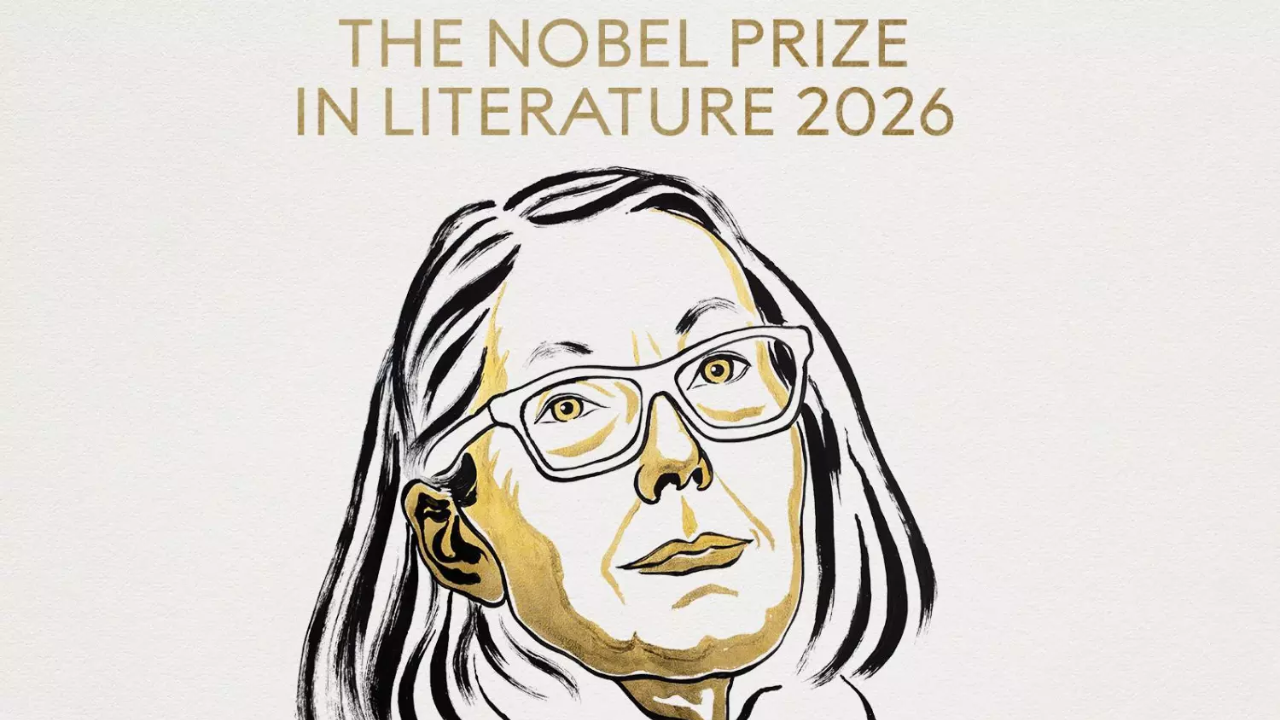
UPSC Current Affairs October 9, 2026: Anne Carson Wins Nobel Prize in Literature | Daily GK Update and Atharva Examwise Current News
The Swedish Academy in Stockholm officially announced the conferment of the 2026 Nobel Prize in Literature on Canadian poet, essayist, and translator Anne Carson. The Academy recognized Carson "for her bold and inventive oeuvre that, in playful dialogue with the classical tradition, has created new forms for contemporary literature". This development forms an essential component of competitive exam news today and provides high-yield material for aspirants tracking daily current affairs and General Studies curricula via Atharva Examwise Current Affairs.
Carson is the 19th woman to receive the Nobel Prize in Literature since the award's inception in 1901 and becomes the second Canadian-born writer to achieve the honor, following short-story writer Alice Munro in 2013. The accolade carries a cash prize of 12 million Swedish kronor (SEK), equivalent to approximately $1.2 million USD or roughly ₹12 crore. The formal investiture ceremony, at which the laureate receives the Nobel diploma and gold medal, will occur in Stockholm on December 10, 2026, marking the death anniversary of Alfred Nobel.
Overview of the 2026 Nobel Prize in Literature
The table below delineates the institutional, financial, and biographical parameters of the 2026 award:
| Parameter | Key Detail | Examination Context |
|---|---|---|
| Award Category | Nobel Prize in Literature 2026 | International Honors & Awards |
| Awarding Body | The Swedish Academy (Stockholm, Sweden) | Static General Knowledge / Global Institutions |
| Laureate | Anne Carson (Age: 76) | Global Personalities in News |
| Nationality & Origins | Canadian (Born June 21, 1950, in Toronto) | UPSC Prelims & State PCS Identification |
| Official Citation | "For her bold and inventive oeuvre that, in playful dialogue with the classical tradition, has created new forms for contemporary literature" | Analytical Quotation & Mains Paper Essay Context |
| Endowment Sum | 12 million Swedish kronor (SEK) | Objective General Knowledge |
| Historical Milestone | 19th female literature laureate out of 123 total recipients | Gender Representation in Global Accolades |
| Preceding Laureate | László Krasznahorkai (Hungary, 2025) | Literature Laureate Chronology |
Key Facts and Exam-Relevant Data
The following factual points summarize the structural and biographical details essential for objective testing formats:
Philological Background: Carson earned a Bachelor of Arts (1974), Master of Arts (1975), and doctorate in Classics (1981) from the University of Toronto, writing her doctoral dissertation on Odi et Amo Ergo Sum ("I hate and I love, therefore I am"). She also completed advanced studies in Greek metrics and textual criticism at the University of St Andrews in Scotland.
National Milestone: Carson represents the second Canadian author to win the literature Nobel, following Alice Munro in 2013. Other prominent Canadian-born laureates include Saul Bellow, who won the award in 1976 after emigrating to the United States.
Literary Recognition: Carson is a two-time winner of the Griffin Poetry Prize, a MacArthur "Genius" Fellow, a Guggenheim Fellow, and a recipient of both the T.S. Eliot Prize and the PEN/Nabokov Award for Achievement in International Literature.
Official Notification: Ingrid Carlberg, Permanent Secretary of the Swedish Academy, confirmed that Carson was reached at her residence in Reykjavík, Iceland, where she learned of the decision alongside her husband and collaborator, Robert Currie.
Nomination Secrecy: Governed by the statutes of the Nobel Foundation, all Swedish Academy deliberations, candidacies, and internal evaluation reports remain sealed from the public for a statutory period of 50 years.
Comprehensive analytical modules covering global cultural honors are systematically maintained in the Atharva Examwise Study Material catalog.
Biographical Profile and Literary Philosophy of Anne Carson
Anne Carson’s intellectual career reflects an unusual fusion of academic philology and creative writing. Rather than treating ancient Greek and Roman literature as historical relics, her work approaches classical texts as living dialogues that can interrogate the psychological anxieties of modernity. Her writing consistently dismantles formal demarcations between narrative fiction, lyric poetry, literary criticism, and translation. Anders Olsson, Chair of the Nobel Literature Committee, pointed out that Carson’s entire production operates at the intersection of a philologist’s grammatical obsession with individual words and a poet’s pursuit of modern philosophical meaning.
A central aesthetic element across Carson’s career is the deliberate use of textual fragmentation. When translating the incomplete verse of the ancient archaic Greek lyricist Sappho in If Not, Winter, Carson chose not to reconstruct the lost poetic fragments into artificial continuous sentences. Instead, she presented the damaged papyrus texts with typographical brackets, compelling readers to confront silence and historical loss directly on the page. This method reflects Carson’s view that contemporary literature must reflect rupture, loss, and open space rather than closed, predictable plots. Her broader intellectual canon incorporates classical dramatists such as Aeschylus, Sophocles, and Euripides alongside modern figures including Emily Dickinson, Franz Kafka, Virginia Woolf, Friedrich Nietzsche, and Simone Weil.
Major Literary Works and Contributions
The table below compiles Anne Carson’s principal publications, outlining their structural formats and underlying themes:
| Year | Title | Genre / Medium | Structural and Thematic Focus |
|---|---|---|---|
| 1986 | Eros the Bittersweet | Critical Essay / Monograph | Adapts Carson's doctoral research to analyze erotic desire, sensory triangulation, and the paradox of romantic longing in Greek lyric poetry. |
| 1998 | Autobiography of Red | Novel in Verse | Reimagines the red winged monster Geryon from the Tenth Labor of Herakles as an artistic adolescent dealing with love and alienation in modern times. |
| 2000 | Men in the Off Hours | Hybrid Poetry & Essay | Combines translations of Catullus with essays on Augustine, Virginia Woolf, painting, and mortality. |
| 2001 | The Beauty of the Husband | Verse Narrative | Subtitled "A Fictional Essay in 29 Tangos," the text maps the collapse of a marriage onto the structural tension of a Latin dance. |
| 2002 | If Not, Winter: Fragments of Sappho | Classical Translation | Translates surviving papyrus fragments of Sappho, retaining original missing sections through typographic brackets. |
| 2010 | Nox | Elegiac Artist's Book | Formatted as an accordion-folded scroll in a box, it memorializes Carson's deceased brother Michael using Catullus Poem 101, photographs, and lexicon definitions. |
| 2016 | Float | Physical Chapbook Collection | Consists of 22 separate chapbooks designed to be shuffled and read in indeterminate order, challenging linear reading. |
| 2019 | Norma Jeane Baker of Troy | Dramatic Adaptation | Blends Euripides' tragedy Helen with the biography of Marilyn Monroe to examine war, beauty, and systemic exploitation. |
Static General Knowledge: The Nobel Prize in Literature
A thorough review of static General Knowledge requires an understanding of the historical, procedural, and institutional aspects of the Nobel Prize in Literature. Primary updates and archival documentation are maintained by Nobel Prize Outreach.
Institutional Mandate and Alfred Nobel's Will
The Nobel Prizes stem from the 1895 will of Alfred Bernhard Nobel, the Swedish chemist and industrialist who patented dynamite in 1867. The original five prizes—Physics, Chemistry, Physiology or Medicine, Literature, and Peace—were first awarded in 1901. The Sveriges Riksbank Prize in Economic Sciences in Memory of Alfred Nobel was added later in 1968 and first awarded in 1969.
While the Royal Swedish Academy of Sciences awards the prizes in Physics, Chemistry, and Economic Sciences, and the Karolinska Institute selects the laureate in Physiology or Medicine, the responsibility for Literature rests with the Swedish Academy. The Nobel Peace Prize remains distinct, being conferred in Oslo by the Norwegian Nobel Committee.
Regulatory Provisions on Posthumous Awards and Refusals
Under amendments made to the statutes of the Nobel Foundation in 1974, a Nobel Prize cannot be awarded posthumously. An exception is permitted only if an individual dies after the official October announcement but before the December 10 investiture ceremony.
Historically, only two laureates have declined the literature honor: Boris Pasternak in 1958, who accepted initially but was compelled by Soviet authorities to refuse the prize, and Jean-Paul Sartre in 1964, who consistently declined all public honors as a matter of philosophical principle.
Demographic Records and Historical Milestones
Earliest Laureate: French poet Sully Prudhomme was the first person to receive the award in 1901.
Youngest Laureate: British author Rudyard Kipling was awarded the literature prize in 1907 at the age of 41 (or 42).
Oldest Laureate: British-Zimbabwean novelist Doris Lessing won the prize in 2007 at the age of 87.
First Female Laureate: Swedish novelist Selma Lagerlöf received the prize in 1909 and subsequently became a voting member of the Swedish Academy in 1914.
Indian Historical Connection: In 1913, polymath Rabindranath Tagore became the first Indian and first Asian laureate across all Nobel categories, recognized for his philosophical poetry collection Gitanjali ("Song Offerings").
Chronology of Recent Literature Laureates (2020–2026)
| Year | Laureate | Country | Core Genre / Academy Focus |
|---|---|---|---|
| 2026 | Anne Carson | Canada | Classical Greek translation, hybrid poetry, and experimental essays. |
| 2025 | László Krasznahorkai | Hungary | Apocalyptic vision, melancholic fiction, and philosophical prose. |
| 2024 | Han Kang | South Korea | Poetic prose addressing historical traumas and human vulnerability. |
| 2023 | Jon Fosse | Norway | Innovative drama and minimalist prose exploring the ineffable. |
| 2022 | Annie Ernaux | France | Autofiction uncovering personal memory and social class disparities. |
| 2021 | Abdulrazak Gurnah | Tanzania / UK | Post-colonial fiction exploring displacement, exile, and colonialism. |
| 2020 | Louise Glück | United States | Lyrical poetry translating individual grief into universal art. |
Why this matters for your exam preparation
The conferment of the Nobel Prize in Literature offers concrete links across multiple sections of competitive examinations, including the UPSC Civil Services Examination (CSE), State Public Service Commissions (such as MPPSC, UPPSC, BPSC, and RAS), and national eligibility tests.
1. UPSC Civil Services Preliminary Examination (Paper I)
In the Preliminary examination, questions regarding international bodies, multilateral awards, and cultural developments test institutional precision and factual accuracy. Candidates must differentiate between the Swedish Academy and the Royal Swedish Academy of Sciences. Questions often address foundational criteria, historical distinctions—such as Rabindranath Tagore's 1913 award—and statutory rules regarding posthumous conferment.
2. UPSC Civil Services Mains Examination (GS-I and Essay Paper)
In General Studies Paper I (Indian Culture and World Heritage), Carson’s work offers an example of how classical languages and ancient oral traditions survive through translation and hybrid literary forms. This mirrors discussions on how ancient Indian traditions, such as Vedic hymns, Sangam literature, and Sanskrit drama, continue to shape contemporary artistic movements.
Furthermore, Carson's observation that modern readers lean toward poetry because "it's brief" and suited to a culture where "everybody is in a hurry" provides useful analytical context for the Mains Essay Paper. This perspective can help frame arguments addressing modern cultural consumption, the decline of long-form reflection, and the impact of rapid digital communication on critical thought.
3. State Public Service Commissions (MPPSC, UPPSC, BPSC)
State examinations regularly include objective questions on major international awards. Students should review:
The laureate’s country of citizenship (Canada).
Carson's notable works, such as Autobiography of Red and Eros the Bittersweet.
The sequence of recent winners (such as Han Kang in 2024 and László Krasznahorkai in 2025).
Aspirants preparing for state examinations can utilize structured regional and national modules through the Atharva Examwise MPPSC Foundation Batches.
Practice Questions for Aspirants
Prelims Practice Question (Objective)
Q. Consider the following statements regarding the Nobel Prize in Literature:
The Nobel Prize in Literature is conferred by the Royal Swedish Academy of Sciences.
Under current statutes adopted by the Nobel Foundation, a prize cannot be awarded posthumously unless death occurs after the official announcement.
Anne Carson is the first Canadian woman to win the Nobel Prize in Literature.
Rabindranath Tagore was the first Asian laureate to receive an award in any Nobel category.
Which of the statements given above are correct?
(a) 1 and 3 only
(b) 2 and 4 only
(c) 2, 3, and 4 only
(d) 1, 2, 3, and 4
Correct Answer: (b) 2 and 4 only
Explanation: Statement 1 is incorrect because the Literature prize is awarded by the Swedish Academy, whereas the Royal Swedish Academy of Sciences oversees Physics, Chemistry, and Economic Sciences. Statement 2 is correct because the 1974 statutory revisions explicitly prohibit posthumous nominations unless death occurs between the announcement and the ceremony. Statement 3 is incorrect because Canadian author Alice Munro won the Nobel Prize in Literature in 2013, making Carson the second Canadian woman to receive the award. Statement 4 is correct because Rabindranath Tagore's recognition in 1913 made him the first Asian laureate across all prize categories.
Mains Practice Question (Descriptive)
"Classical literature does not merely belong to antiquity; it provides a structural lens through which the fractured realities of modern human experience can be interpreted." Critically analyze this statement with reference to the role of classical translations and modern literary adaptations.