
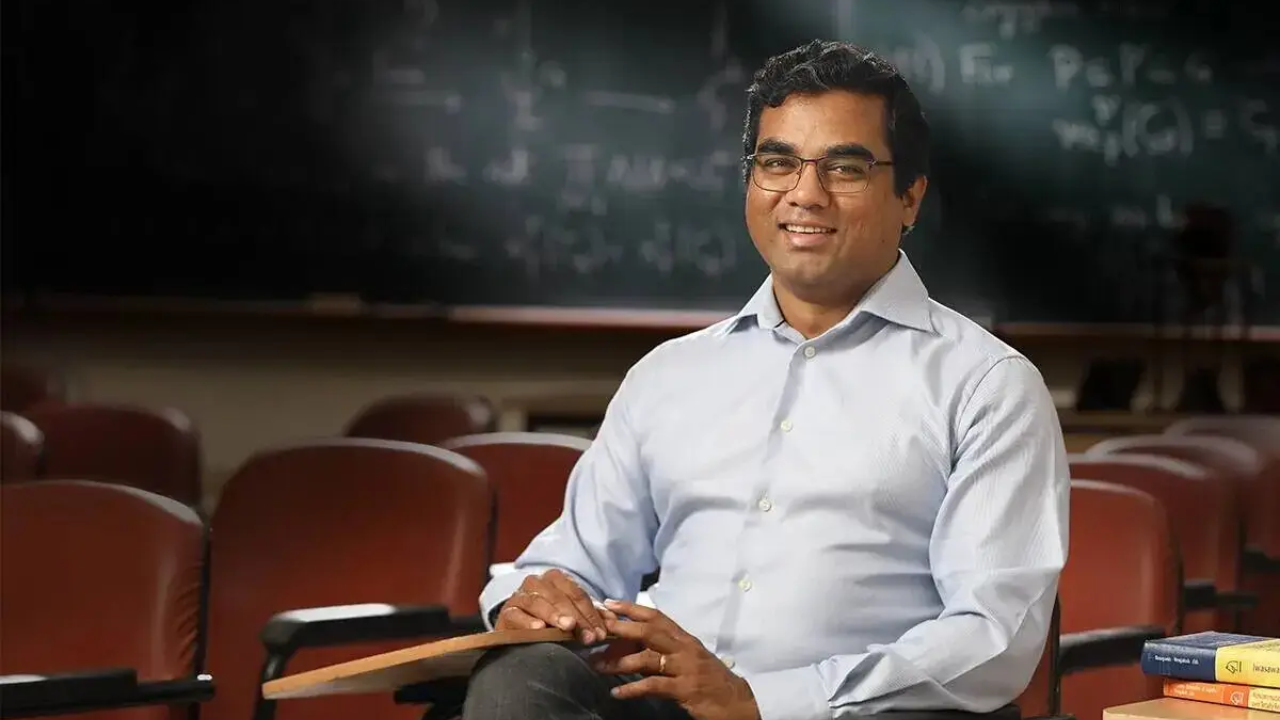
UPSC Current Affairs October 9, 2026: IISc Professor Mahesh Kakde Conferred Ramanujan Prize | Daily GK Update & Atharva Examwise Current News
Concurrence of Global Acclaim and Theoretical Mathematics in India
The international scientific community has conferred the 2026 Ramanujan Prize for Young Mathematicians from Developing Countries upon Professor Mahesh Ramesh Kakde, a faculty member in the Department of Mathematics at the Indian Institute of Science (IISc), Bengaluru. Jointly administered by the Abdus Salam International Centre for Theoretical Physics (ICTP) in Trieste, Italy, the International Mathematical Union (IMU), and the Department of Science and Technology (DST) of the Government of India, the honor distinguishes foundational research carried out by researchers in developing nations.
The selection citation honors Professor Kakde for pioneering breakthroughs in algebraic number theory, specifically his formulation of noncommutative Iwasawa theory and collaborative proofs concerning the Gross–Stark and Brumer–Stark conjectures. These developments have yielded profound structural insights into David Hilbert’s 12th Problem, a foundational question in algebraic number theory that has resisted complete resolution since its proposition at the 1900 International Congress of Mathematicians.
Professor Kakde is the fifth Indian mathematician to receive this distinction since the prize's establishment in 2005. For aspirants following Atharva Examwise Daily Current Affairs, this milestone serves as a vital case study at the intersection of basic scientific research, Indian institutional capability, and global academic cooperation.
Profile and Scholarly Trajectory of Professor Mahesh Kakde
Born in 1983 in Akola, Maharashtra, Professor Mahesh Kakde completed his early mathematical training at the Indian Statistical Institute (ISI), Bengaluru, earning a Bachelor of Mathematics degree. He subsequently entered the University of Cambridge for advanced studies, obtaining a Master of Mathematics and completing his doctorate in pure mathematics in 2008.
His postdoctoral career included research and teaching appointments at Princeton University, University College London, and King's College London, prior to returning to India to join the faculty of the Indian Institute of Science in August 2019. His trajectory reflects a wider trend among Indian institutions that recruit expatriate scientific talent to build domestic research capacity.
Professor Kakde has received several national and international honors:
Conferred the SwarnaJayanti Fellowship by the Department of Science and Technology, Government of India.
Conferred the Infosys Prize in Mathematical Sciences in 2022 for fundamental contributions to algebraic number theory.
Selected as an invited speaker at the International Congress of Mathematicians (ICM) in 2022.
Co-recipient of the Frontiers of Science Award at the International Congress of Basic Science in Beijing in 2023.
Awarded the Whitehead Prize by the London Mathematical Society in 2023.
Conferred the Vigyan Yuva Shanti Swarup Bhatnagar Award in Mathematical Sciences in 2024.
Elected Fellow of the Indian Academy of Sciences (FASc) and appointed Homi Bhabha Chair Professor at IISc Bengaluru.
For further analysis of Indian science honors, candidates may consult the Atharva Examwise Science and Technology Notes.
Theoretical Foundations: Iwasawa Theory and Hilbert’s 12th Problem
Evaluating the significance of the 2026 citation from the International Centre for Theoretical Physics (ICTP) and the International Mathematical Union (IMU) requires an understanding of how modern number theory operates. The field relies on abstract algebra to investigate the properties of numbers, transforming classical arithmetic through rigorous structural analysis.
Algebraic Number Theory and Noncommutative Extensions
Algebraic number theory generalizes the properties of familiar integers to broader algebraic number fields—systems formed by adjoining roots of polynomials to the field of rational numbers $\mathbb{Q}$. Originating in the 1950s through the work of Japanese mathematician Kenkichi Iwasawa, Iwasawa theory analyzes how arithmetic invariants, such as ideal class groups, evolve across infinite systemic towers of number fields.
While classical Iwasawa theory focused predominantly on abelian extensions governed by commutative Galois groups, Professor Kakde’s scholarship solved long-standing questions regarding the noncommutative main conjecture of Iwasawa theory for totally real fields under the vanishing $\mu$-invariant condition ($\mu = 0$). This structural proof provided a rigorous bridge connecting analytic objects, specifically $p$-adic $L$-functions, with purely algebraic structures.
Resolution of the Stark Conjectures
Working in collaboration with mathematicians Samit Dasgupta and Kevin Ventullo, Professor Kakde formulated a proof of the Gross–Stark conjecture. Expanding this analytical framework alongside Dasgupta, Jesse Silliman, and Jiuya Wang, he proved the Brumer–Stark conjecture away from the prime $p = 2$ in 2020, followed by a complete proof over the ring of integers $\mathbb{Z}$ in 2023. These conjectures establish that the values of Artin $L$-functions at specific evaluation points are tied directly to arithmetic units within algebraic number fields, unlocking analytical pathways that had remained theoretical for decades.
Structural Progress on Hilbert’s 12th Problem
The techniques developed during the proofs of the Brumer–Stark conjecture provide an explicit construction of abelian extensions for totally real number fields. In 1900, David Hilbert presented 23 major mathematical problems, the 12th of which proposed extending the classical Kronecker–Weber theorem—which demonstrates that any abelian extension of the rational numbers is generated by roots of unity—to arbitrary base number fields. By producing explicit building blocks and singular invariants for totally real fields, Professor Kakde and his collaborators advanced the global mathematical understanding of this problem further than any research cohort in the modern era.
Institutional Framework of the DST-ICTP-IMU Ramanujan Prize
The Ramanujan Prize is formally designated as the DST-ICTP-IMU Ramanujan Prize for Young Mathematicians from Developing Countries. Instituted in memory of Srinivasa Ramanujan (1887–1920), the prize commemorates his fundamental contributions to partition theory, continued fractions, and modular equations, which were developed largely outside conventional academic infrastructure.
The prize's administrative structure has evolved over time:
Foundation and Administration: Founded in 2004 and first awarded in 2005, the award was established by the ICTP in collaboration with the IMU and the Niels Henrik Abel Memorial Fund of Norway.
Funding Architecture: Following the conclusion of the Abel Fund’s involvement in 2012, the Department of Science and Technology (DST) of the Government of India entered a tripartite agreement in 2014 to finance the prize money directly, integrating the prize into India's international science diplomacy.
Statutory Eligibility Rules: Nominees must be younger than 45 years of age on December 31 of the awarding year and must have conducted outstanding mathematical research within a developing nation.
Evaluation Metrics: The selection committee, comprising mathematicians appointed by the ICTP, the IMU, and the DST, evaluates candidates on both scientific excellence and the institutional challenges under which the research was completed.
Conferment Benefits: The prize carries an honorarium of $15,000 alongside an official invitation to deliver a lecture at the ICTP headquarters in Trieste, Italy.
Comparative Assessment of Global Mathematical Honors
To avoid confusing different international and domestic awards named after Srinivasa Ramanujan, examinees should analyze the comparative institutional metrics shown below:
| Award Name | Administering / Sponsoring Body | Age Ceiling | Geographical Mandate | Primary Focus Area |
|---|---|---|---|---|
| DST-ICTP-IMU Ramanujan Prize | ICTP (Italy), IMU, and DST (India) | Strictly under 45 years | Developing nations | Outstanding mathematical contributions conducted within a developing country |
| SASTRA Ramanujan Prize | SASTRA Deemed University, Tamil Nadu | Strictly under 32 years | Global (any country) | Groundbreaking work influenced by Ramanujan's broad mathematical interests |
| Fields Medal | International Mathematical Union (IMU) | Strictly under 40 years | Global (quadrennial) | Outstanding mathematical achievement and promise of future accomplishment |
| Abel Prize | Norwegian Academy of Science and Letters | None (Career honor) | Global (annual) | Extraordinary lifetime contributions to the mathematical sciences |
Aspirants can review additional global institutional structures in the Atharva Examwise Static GK Compendium.
Indian Laureates of the DST-ICTP-IMU Ramanujan Prize
India's consistent representation among the prize winners highlights the research output of domestic centers like the Indian Institute of Science, the Indian Statistical Institute, and the Tata Institute of Fundamental Research:
| Conferred Year | Laureate Name | Institutional Affiliation at Award | Domain of Research Recognized |
|---|---|---|---|
| 2006 | Ramdorai Sujatha | Tata Institute of Fundamental Research (TIFR), Mumbai | Noncommutative Iwasawa theory and arithmetic of algebraic varieties |
| 2015 | Amalendu Krishna | Tata Institute of Fundamental Research (TIFR), Mumbai | Algebraic $K$-theory, algebraic cycle theory, and the theory of motives |
| 2018 | Ritabrata Munshi | Indian Statistical Institute (ISI) / TIFR | Analytic number theory and subconvexity bounds for automorphic $L$-functions |
| 2021 | Neena Gupta | Indian Statistical Institute (ISI), Kolkata | Affine algebraic geometry, commutative algebra, and solving the Zariski Cancellation Problem |
| 2026 | Mahesh Kakde | Indian Institute of Science (IISc), Bengaluru | Noncommutative Iwasawa theory, the Gross–Stark and Brumer–Stark conjectures, and Hilbert’s 12th Problem |
Key Facts and Exam-Relevant Data
The operational elements of this development are outlined below for quick revision:
Laureate: Professor Mahesh Ramesh Kakde, Professor of Mathematics, Indian Institute of Science (IISc), Bengaluru.
Prize Designation: DST-ICTP-IMU Ramanujan Prize for Young Mathematicians from Developing Countries (2026 edition).
Organizing Consortium: Abdus Salam International Centre for Theoretical Physics (Trieste, Italy) and the International Mathematical Union, with prize money funded by the Department of Science and Technology (DST), Government of India.
Primary Mathematical Citations: Proving the main conjecture of noncommutative Iwasawa theory for totally real fields; resolving the Brumer–Stark and Gross–Stark conjectures; developing explicit class field constructions relevant to Hilbert's 12th Problem.
Eligibility Boundaries: Candidates must be below 45 years of age on December 31 of the awarding year, originate from a developing economy, and conduct their research in a developing nation.
Financial and Academic Entitlements: A cash award of $15,000 and an invitation to deliver a lecture at the ICTP in Trieste, Italy.
Historical Precedence: Fifth Indian national to secure the honor, joining Ramdorai Sujatha (2006), Amalendu Krishna (2015), Ritabrata Munshi (2018), and Neena Gupta (2021).
Why this matters for your exam preparation
Understanding the conferment of the 2026 Ramanujan Prize is valuable for competitive exam aspirants, as it connects directly to multiple dimensions of the UPSC Civil Services Examination and State PSC syllabi:
UPSC Civil Services Preliminary Examination (General Studies Paper I)
In the Preliminary examination, science and technology questions frequently test institutional frameworks, award criteria, and prominent scientific organizations. Examinees should note the administrative distinction between the DST-ICTP-IMU Ramanujan Prize and the SASTRA Ramanujan Prize, particularly the differing age limits (under 45 versus under 32) and geographic scopes (developing nations versus worldwide). Furthermore, questions routinely assess India’s bilateral and multilateral engagements in scientific advancement, where the DST’s role as the sole financial sponsor of an ICTP prize provides a clear example of Indian science diplomacy.
UPSC Civil Services Mains Examination (General Studies Paper III)
General Studies Paper III contains a dedicated syllabus section on Achievements of Indians in Science & Technology; Indigenization of Technology and Developing New Technology. Candidates can cite Professor Kakde’s work as a contemporary example of Indian researchers driving progress in fundamental mathematics from domestic institutions. His transition from international institutions (such as Cambridge and Princeton) back to IISc Bengaluru illustrates how targeted institutional support helps attract academic talent back to India.
In essay and analytical questions evaluating basic versus applied scientific research, this development helps illustrate why continuous state funding for pure sciences—such as through the DST SwarnaJayanti Fellowships and the Anusandhan National Research Foundation (ANRF)—is vital for building long-term technological and academic capability. Theoretical discoveries in algebraic structures and number theory ultimately underpin critical applications in modern cryptography, post-quantum cybersecurity, and secure data communications.
State Public Service Examinations and General Knowledge Tests
State PSC examinations (including MPPSC, UPPSC, BPSC, and KPSC) frequently include objective questions under their Awards and Honours and Current Events of National and International Importance sections. Candidates should be prepared to identify the award recipient, his institutional affiliation at IISc Bengaluru, the co-sponsoring bodies (ICTP, IMU, DST), and the core field of algebraic number theory.
Continuous engagement with fundamental scientific achievements offers candidates practical, high-value case studies for both objective and analytical exam papers. Aspirants can track further updates and conceptual breakdowns through Atharva Examwise Current News.