
UPSC Current Affairs October 3, 2026: Kannauj Perfume Heritage, Deg-Bhapka Distillation, and GI Tag Architecture | Atharva Examwise Daily GK Update
Introduction: The Living Heritage of India's Olfactory Capital
Kannauj, situated along the central alluvial plains of the Ganges in Uttar Pradesh, serves as the historic epicenter of the Indian natural fragrance tradition. Popularly designated as the Itr Nagari (Perfume Capital of India), the city represents an unbroken hydrodistillation lineage spanning more than five millennia. While global perfume manufacturing has largely shifted toward petroleum-derived aroma molecules, synthetic aldehydes, and industrial chemical solvents, Kannauj remains an active repository of zero-carbon, plant-based extraction techniques.
The preservation of this artisanal ecosystem is vital to India's rural economy, botanical supply chains, and cultural diplomacy. Modern regulatory and administrative frameworks—including the Geographical Indications of Goods Act, 1999, the state-sponsored One District One Product (ODOP) scheme, and technical programs under the Ministry of Micro, Small and Medium Enterprises (MSME)—aim to safeguard this indigenous knowledge against industrial adulteration and synthetic displacement.
Aspirants analyzing traditional knowledge systems and industrial geography can review foundational concepts via the Atharva Examwise NCERT Foundation Course and track recurring updates through the Atharva Examwise Daily Current Affairs.
Historical Chronology: From Vedic Gandhayukti to Imperial Mughal Patronage
The practice of capturing fugitive botanical scents in ancient India developed alongside medicinal chemistry and philosophical rituals. Archaeological excavations across the Indus-Saraswati basin reveal primitive terracotta distillation apparatuses, indicating that steam distillation of aromatic plants was practiced in proto-historic India.
Early literary references to fragrant oils (tailas), sacred botanical smoke (dhoop), floral garlands, and macerated perfumes are codified in Vedic literature and foundational Ayurvedic texts such as the Charaka Samhita and Sushruta Samhita. In classical Indian statecraft and elite aesthetics, the formulation of perfumes was classified as Gandhayukti, regarded as one of the sixty-four traditional arts (chaturshashti kalas). The 6th-century polymath Varahamihira dedicated extensive chapters of the Brihat Samhita to the compounding of complex scents for royal courts, religious consecrations, and domestic therapies.
During the 7th century, under Emperor Harsha Vardhana, Kannauj—then known as Kanyakubja or Mahodaya—served as the imperial metropolis of northern India. The city’s administrative prominence stimulated extensive trade linkages and concentrated artisan guilds specializing in cosmetic formulation, metallurgy, and temple perfumery.
The medieval period brought further consolidation and institutional patronage. Although the core distillation technology preceded the Islamic dynasties, the Mughal royal durbars integrated aromatic distillates into state protocol, architecture, personal grooming, and formal gifting. Historical chronicles credit Mughal Empress Nur Jahan with standardizing the extraction of Ruh Gulab (pure Damask rose essential oil) after observing aromatic oil films separating on warm palace water channels. Imperial demand formalized Kannauj's distillation workshops into structured commercial production centers, linking domestic distillers with overland Eurasian trade routes.
Kannauj's geographical setting was instrumental in sustaining this production volume. Positioned within the fertile Ganga-Yamuna Doab, the district possessed deep alluvial soils, high water tables, and a subtropical climate that favored the continuous cultivation of scent-yielding botanicals, including:
Rosa damascena (Damask Rose)
Jasminum sambac (Bela / Mogra)
Jasminum grandiflorum (Chameli)
Pandanus fascicularis (Kewra)
Chrysopogon zizanioides (Khus / Vetiver)
Riparian connectivity along the Ganges facilitated bulk transport of raw botanicals into the city and distributed distilled attars across the subcontinent and outward toward the Persian Gulf.
Science and Mechanics of the Deg-Bhapka Hydrodistillation Process
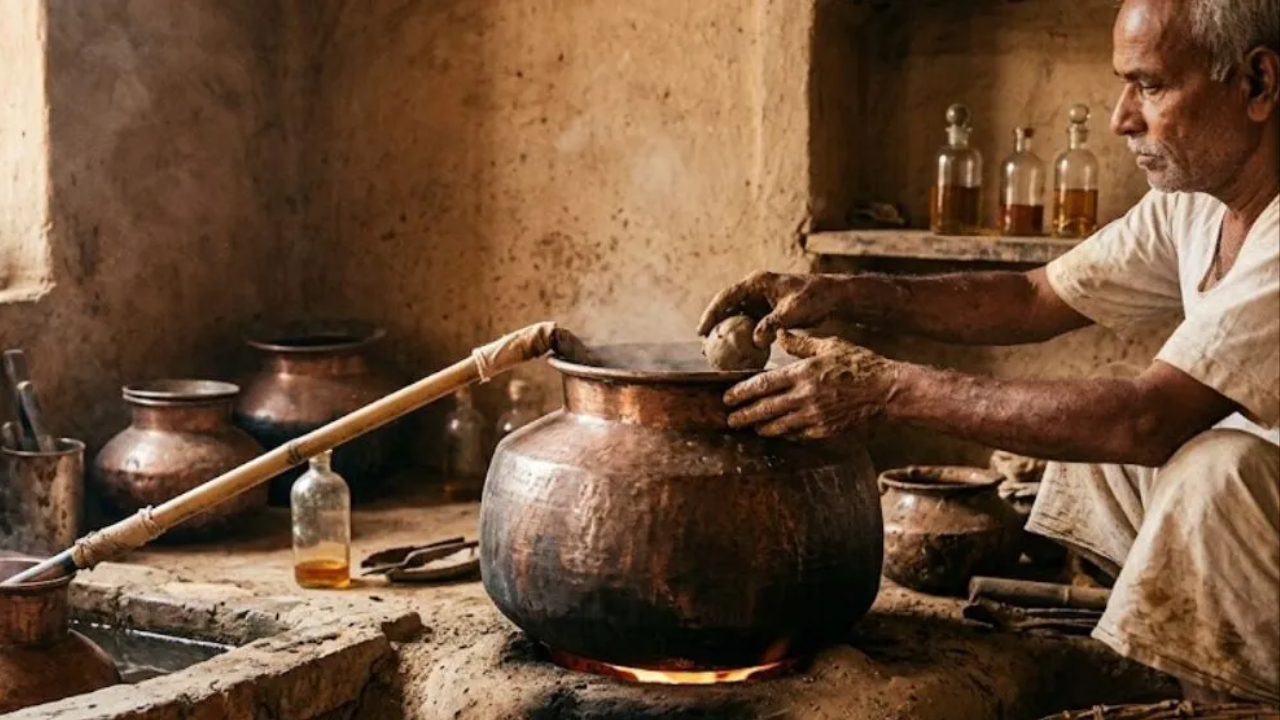
The core operational method of Kannauj’s natural perfume industry is the Deg-Bhapka technique, a traditional hydrodistillation process executed without modern mechanical pumps, computerized thermal controls, or electricity. The process relies on traditional metallurgy, fluid dynamics, and thermodynamic equilibrium, governed entirely by the sensory experience of master distillers (dighas).
Traditional Deg-Bhapka Distillation Equipment
| Equipment Component | Traditional Vernacular | Material Composition | Functional Role in Distillation |
|---|---|---|---|
| Boiler Still | Deg | Heavy-gauge Copper (Tamba) | Accommodates fresh floral biomass and water; copper ensures uniform heat conduction and prevents charring of botanical oils. |
| Still Lid | Sarposh | Copper or Terracotta | Hermetically seals the Deg mouth using a fresh sealant paste of clay, silt, and cotton twine (chikan). |
| Vapor Condenser Tube | Chonga | Natural Bamboo wrapped in Twine | Acts as an angled distillation conduit linking Deg to Bhapka; insulated naturally to prevent premature condensation of volatile vapors. |
| Receiver Flask | Bhapka | Long-necked Copper Vessel | Submerged in cold water; charged with sandalwood or vegetable carrier oil to absorb incoming volatile aromatic vapors. |
| Cooling Reservoir | Gachchi | Masonry Water Tank | Provides continuous passive heat dissipation, condensing steam vapors passing through the receiver. |
| Pit Furnace | Bhatti | Brick, Earth, and Cast Grate | Supplies calibrated heat using agricultural residues, firewood, and dried cow-dung cakes. |
| Aging Receptacle | Kuppi | Treated Camel-Skin Flask | Expels water remnants through microporous leather while retaining hydrophobic essential oil molecules. |
Thermodynamic and Extraction Mechanism
The extraction process begins at dawn when flowers are harvested to preserve light-sensitive monoterpenes and volatile alcohols. Fresh petals and measured volumes of water are transferred directly into the copper deg, which is sealed with the sarposh using an airtight clay-cotton binding.
Botanical Biomass + Water in Copper Deg │ ▼ (Controlled Biomass Combustion) Volatile Hydro-Steam Vapors Ascend │ ▼ (Conducted via Insulated Bamboo Chonga) Condensation in Submerged Receiver (Bhapka) │ ▼ (Dissolution into Sandalwood Base Oil) Immiscible Water Separation & Multi-Day Distillate Recharging │ ▼ (Transfer to Camel-Skin Kuppi) Moisture Transpiration & Molecular Aging of Attar
Once the bhatti furnace is ignited, low-intensity heat converts water into steam, rupturing botanical gland cells and carrying volatile essential oils through the bamboo chonga into the bhapka. Submerged within the cold water of the gachchi, the bhapka acts as a condenser. The aromatic vapors bubble directly into a base of pure sandalwood oil (Santalum album), which acts as a natural fixative by dissolving lipid-soluble aromatic molecules without altering their chemical character.
After several hours of steady heating, the fire is damped, the bhapka is unsealed, and the condensed water is separated from the essential oil layer via manual decantation. This cycle is repeated daily over 15 to 30 days, charging the same base oil with fresh batches of botanical distillates until saturation is reached. The final product is transferred into porous camel-skin kuppis, which allow residual water molecules to transpire through the skin while locking in the heavier aromatic essential oils.
Specialized Olfactory Formulations
Mitti Attar (Petrichor Essence): A distinctive innovation of Kannauj, Mitti Attar captures the scent of summer rain falling upon arid earth. Alluvial topsoil is extracted from surrounding plains, shaped into clay discs or unglazed pottery tiles, baked in kilns, and placed into the copper deg with water. Hydrodistillation volatilizes geosmin—a bicyclic organic compound produced by soil-dwelling Streptomyces bacteria—which is absorbed into sandalwood oil.
Shamama and Shamam-tul-Amber: These dense, warming attars are manufactured through multi-stage fractional distillations of 40 to over 70 herbs, roots, spices, natural gums, and lichens (Parmelia perlata or chharila). Formulations remain proprietary family secrets passed down through generations.
Ruh Concentrates: Pure single-botanical distillates produced without base oil absorption, including Ruh Gulab (pure rose oil) and Ruh Khus (wild vetiver root oil distilled in copper stills, yielding a deep emerald color).
Institutional and Legal Framework: Geographical Indication and ODOP Policy
Artisanal clusters face persistent competition from globalized industrial manufacturing. To protect the domestic and international commercial standing of Kannauj’s fragrance sector, multiple statutory and governmental mechanisms have been implemented. Candidates can evaluate these structural policy dynamics through the Atharva Examwise State Civil Services Modules.
Geographical Indication Protection under the 1999 Act
To mitigate the dilution of its historical brand equity, "Kannauj Perfume" was granted legal protection under the Geographical Indications of Goods (Registration and Protection) Act, 1999:
Filing & Grant: The registration application was filed on February 9, 2009, by the Export Promotion Bureau of the Uttar Pradesh Government, securing formal registration on March 31, 2014 (Certificate No. 203, Application No. 157).
Statutory Classification: Registered under Class 3 as a "Manufactured Good".
Renewal & TRIPS Compliance: Aligned with the World Trade Organization’s Trade-Related Aspects of Intellectual Property Rights (TRIPS) standards, the registration has been renewed through February 8, 2029.
Legal Utility: The GI registration prohibits manufacturers outside the demarcated geographical boundaries of Kannauj from marketing products under the designation "Kannauj Perfume" or "Kannauj Attar," shielding the cluster against imitation.
One District One Product and MSME Modernization Schemes
Under Uttar Pradesh's flagship One District One Product (ODOP) program, Itra (Scents) and Perfume Products were designated as the focus manufacturing vertical for Kannauj District. The ODOP initiative seeks to upgrade rural manufacturing into export-competitive enterprises through subsidized capital loans, common facility centers, and global trade promotion.
Institutional capacity building is anchored by the Fragrance and Flavour Development Centre (FFDC), Kannauj, an autonomous body functioning under the Ministry of Micro, Small and Medium Enterprises (MSME). The FFDC provides technical services to the cluster, including:
Gas Chromatography-Mass Spectrometry (GC-MS) chemical profile verification to detect synthetic dilution.
Scientific standardization of botanical raw materials and carrier bases.
Workshops on sustainable agro-forestry for aromatic crops.
Skill certification for rural youth to stem out-migration from traditional family units.
Comparative Structural Matrix: Traditional Attar vs. Synthetic Industrial Perfume
| Technical Parameter | Traditional Kannauj Attar | Modern Industrial Perfume (Spray Formulations) |
|---|---|---|
| Solvent Carrier | Pure Sandalwood Oil (Santalum album) or botanical oils | Denatured Ethyl Alcohol ($80\text{–}95\%$) and distilled water |
| Extraction Method | Atmospheric Hydrodistillation (Deg-Bhapka) | Chemical solvent extraction (hexane), supercritical $\text{CO}_2$, or total chemical synthesis |
| Raw Material Input | $100\%$ Natural botanicals, baked clay, and spices | Petrochemical derivatives, synthetic aldehydes, and phthalate fixatives |
| Olfactory Behavior | Linear, deep molecular evaporation bonding with skin lipids | Tiered pyramidal notes (top, heart, base) driven by high alcohol volatility |
| Environmental Impact | Biodegradable, unmechanized, zero industrial chemical effluents | Petrochemical-dependent synthesis, volatile organic compound (VOC) emissions |
| Statutory IP Protection | Collective Geographical Indication (GI Tag No. 157) | Proprietary corporate patents, trademarks, and trade-secret chemical formulations |
Industrial Economics, Value Chain Challenges, and the Way Forward
Despite its cultural heritage and statutory protection, Kannauj’s perfume industry faces structural challenges across its value chain.
First, severe statutory felling restrictions and rising market prices for genuine East Indian Sandalwood oil have disrupted the traditional carrier base. To sustain commercial viability, many units have adopted cheaper vegetable oils (such as liquid paraffin or dioctyl phthalate), altering the longevity and quality of traditional attars.
Second, the structural gap between obtaining a collective GI registration and registering individual distillers as "Authorized Users" remains a major hurdle. Most micro-scale distillers lack the administrative capacity to secure formal certification, leaving them vulnerable to market price manipulation and unable to leverage the GI mark in export markets.
Third, synthetic fragrances—often marketed deceptively as natural attars—undercut artisanal products on price by 80 to 90 percent. Without mandatory labeling regulations distinguishing solvent-derived chemical fragrances from traditional hydrodistilled attars, consumer awareness remains low.
Addressing these bottlenecks requires a coordinated policy approach:
Sustainable Raw Material Supply Chains: The state should incentivize sandalwood cultivation across agro-forestry belts and support cooperatives that cultivate alternative carrier oils like cold-pressed jojoba or de-aromatized sesame.
Streamlined GI Certification: Administrative drives by the District Industries Centre and the FFDC are required to register small-scale distillers as Authorized Users under the GI Act.
Traceability Infrastructure: Implementing blockchain-based QR codes on certified GI bottles will allow consumers to verify authentic hydrodistillation batches, shielding artisan distillers against counterfeit synthetic formulations.
Key Facts and Exam-Relevant Data
Geographic Focus: Kannauj District, Uttar Pradesh (Central Indo-Gangetic Alluvial Plain).
Historical Designations: Kanyakubja, Mahodaya, Itr Nagari (Perfume Capital of India).
Governing GI Statute: Geographical Indications of Goods (Registration and Protection) Act, 1999.
GI Registration Specifics:
Application Number: 157 (Certificate No. 203).
Filing Date: February 9, 2009.
Registration Date: March 31, 2014.
Current Legal Renewal: Valid through February 8, 2029.
Goods Category: Class 3 – Manufactured Goods.
State Policy Alignment: One District One Product (ODOP) – Itra (Scents) and Perfume Products.
Nodal Technical Body: Fragrance and Flavour Development Centre (FFDC), Kannauj, under the Ministry of MSME.
Artisanal Distillation Apparatus:
Deg: Copper boiling vessel.
Sarposh: Lid sealed with clay-cotton paste.
Chonga: Bamboo vapor tube wrapped in twine.
Bhapka: Submerged copper receiver containing carrier oil.
Gachchi: Passive cold-water masonry cooling tank.
Kuppi: Porous camel-skin bottle used to age attar and vent residual moisture.
Signature Products: Mitti Attar (geosmin extraction from baked clay), Shamama (multi-herb macerate), Ruh Gulab (pure hydrodistilled rose oil).
Why this matters for your exam preparation
Understanding the Kannauj perfume cluster provides multidisciplinary touchpoints across the syllabus of the Union Public Service Commission (UPSC) Civil Services Examination and State PSCs:
General Studies Paper 1 (Indian Heritage, Culture, and Geography):
Art, Science, and Craft Traditions: Covers the historical evolution of Gandhayukti, ancient metallurgical hydrodistillation, and how continuous royal patronage under Harsha Vardhana and the Mughal Empire institutionalized indigenous crafts.
Economic and Agro-Geography: Demonstrates how the alluvial soil, groundwater reserves, and microclimate of the Indo-Gangetic plain support specialized floriculture and sustain traditional cottage industry clusters.
General Studies Paper 2 (Governance and Government Policies):
Cluster-Based Industrial Promotion: Involves institutional policy analysis of the Ministry of MSME’s technology centers (such as FFDC Kannauj) and evaluates the execution of Uttar Pradesh’s One District One Product (ODOP) program for rural livelihood security and export competitiveness.
General Studies Paper 3 (Economy, Agriculture, and Intellectual Property Rights):
Intellectual Property Rights (IPR): Examines the enforcement of the Geographical Indications of Goods Act, 1999, highlighting challenges in transitioning from collective registration to onboarding artisanal "Authorized Users".
Agro-Processing & MSME Ecosystems: Focuses on raw material supply shocks (e.g., regulatory restrictions on sandalwood), price distortion caused by petroleum-derived synthetics, and strategies to integrate informal artisanal industries into global supply chains.
State Civil Services Examinations (UPPSC GS Papers 1, 5, and 6; MPPSC):
Directly relevant for state-specific economic geography, traditional industrial crafts, district-level export profiles, and cultural heritage conservation in Uttar Pradesh.
Practice Prelims Question
Consider the following statements regarding the traditional perfumery cluster of Kannauj:
Kannauj Perfume is registered under the Geographical Indications of Goods (Registration and Protection) Act, 1999, as an agricultural product.
The Deg-Bhapka method relies on copper vessels and bamboo conduits (chonga) for hydrodistillation without relying on electrical heating elements.
Mitti Attar is produced by distilling baked alluvial clay shards into a carrier oil base to capture the aroma of geosmin.
Which of the statements given above are correct? (a) 1 and 2 only
(b) 2 and 3 only
(c) 1 and 3 only
(d) 1, 2, and 3
Answer: (b) 2 and 3 only. (Statement 1 is incorrect: Kannauj Perfume is officially registered under the category of Manufactured Goods, not agricultural goods).
Practice Mains Question
"While Geographical Indication (GI) registration confers legal identity upon traditional artisanal clusters, it often fails to deliver automatic commercial dividends to grassroots practitioners." Critically analyze this statement with reference to the perfume industry of Kannauj and evaluate the role of the ODOP initiative in addressing supply-chain bottlenecks.